Get Full Government Meeting Transcripts, Videos, & Alerts Forever!
Get email alerts on the International Health Regulations topic
No spam. Unsubscribe anytime.
Robert F. Kennedy Jr. urges rejection of WHO International Health Regulations amendments
Summary
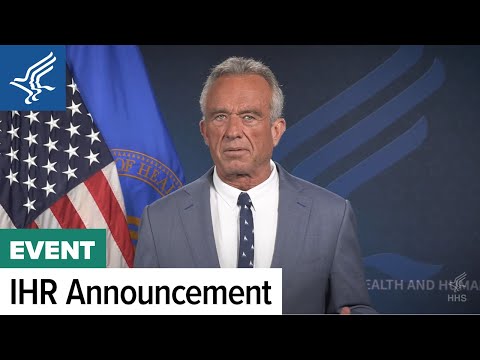
In an audio recording labeled as produced by HHS, Robert F. Kennedy Jr. said the United States "is rejecting" proposed amendments to the World Health Organization's International Health Regulations, arguing they threaten national sovereignty, enable global surveillance and could centralize public-health decisionmaking.
In an audio recording labeled "Produced by the U.S. Department of Health and Human Services," Robert F. Kennedy Jr. said the United States "is rejecting" proposed amendments to the World Health Organization's International Health Regulations (IHR), which he described as a threat to national sovereignty and civil liberties.
Kennedy said the IHR changes would give the WHO broad authority to act on "potential public health risks" without declaring an emergency and to implement unified global messaging. "The first reason is national sovereignty," he said. "Nations who accept the new regulations are signing over their power in health emergencies to an unelected international organization that could order lockdowns, travel restrictions, or any other measures that sees fit."
The recording presented several specific concerns about the text of the amendments, including references to systems of "risk communications," possible "global systems of health IDs, vaccine passports, and a centralized medical database," and what Kennedy described as groundwork for "global medical surveillance of every human being." "That opens the door to the kind of narrative management and propaganda and censorship that we saw during the COVID pandemic," he said.
Kennedy cited the COVID-19 response and a 2024 congressional oversight report to argue the WHO had failed to enforce prior IHR provisions. He said, "China withheld critical information about the outbreak for at least a month and faced no real consequences or criticism from WHO," and called the report evidence the WHO was "misinformed, denied access to China, and used as a cover for the Chinese Communist Party's reckless action."
The speaker described a deadline to reject the amendments as "next week" in the recording but did not give a calendar date. He framed the stated U.S. stance as an assertion of sovereignty and as a model for other nations, saying rejecting the amendments was intended "not only on behalf of our own citizens, but the whole world." He also said President Trump supported the decision, stating, "That's my commitment to you. That's president Trump's commitment to you."
The recording ends with the speaker thanking listeners and the label that it was produced by the U.S. Department of Health and Human Services. The audio is a public statement of intent by the speaker; the recording does not include a formal vote, an official HHS announcement in written form, or documentary evidence of any legally binding action taken by the United States government within the file itself.
The recording attributes multiple factual claims and policy positions to the proposed IHR amendments and to the WHO's prior conduct; those claims are presented by the speaker and are not corroborated within the recording. The recording did not specify the exact procedural mechanism or statutory step by which the United States would "reject" the amendments, nor did it provide a specific deadline date.