Get Full Government Meeting Transcripts, Videos, & Alerts Forever!
Get email alerts on the Telecommunications Tower topic
No spam. Unsubscribe anytime.
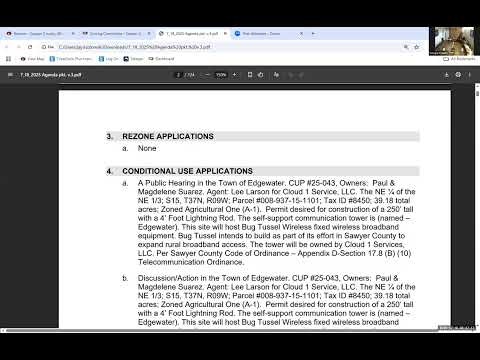
Sawyer County zoning committee denies CloudOne/"BugTussle" 250-foot tower permit in Edgewater
Summary
The Sawyer County Zoning Committee voted to deny a conditional use permit for a proposed 250-foot telecommunications tower on Suarez property in the town of Edgewater, citing the town's denial and incomplete colocation analysis.
The Sawyer County Zoning Committee on July (meeting date not specified) voted to deny a conditional use permit for a proposed 250-foot telecommunications tower on land owned by Paul and Magdalene Suarez in the town of Edgewater.
The committee’s decision followed testimony from the applicant’s agent, documents submitted by neighbors and the town, and legal guidance from county counsel. The proposed tower would have been owned by CloudOne Services LLC and host BugTussle wireless fixed‑wireless broadband equipment as part of an effort to expand rural broadband access.
The committee heard that the application packet included a radio‑frequency affidavit and a search‑ring analysis, but that a 400‑foot tower approximately 2.2 miles from the proposed site — erected after the applicant’s RF affidavit was prepared — was not included in the applicant’s search ring. Town of Edgewater officials had moved to deny the CUP, and the zoning staff reported a petition and several letters of opposition from nearby property owners raising health, lightning and visual‑impact concerns.
County legal counsel told the committee portions of Sawyer County’s telecommunications ordinance are preempted by state law (Wis. Stat. § 66.0404) but that some local requirements — including the town approval requirement in the county tower ordinance — remain relevant. Counsel advised the committee it could require the applicant to complete a revised colocation analysis and that denial is permitted where the applicant refuses or fails to evaluate feasible colocation within its search ring.
After discussion, including committee members’ stated concerns about the town’s denial, incomplete colocation analysis and lighting/visual impacts, a motion to deny the CUP carried.
Applicant agent Lee (Ashley) Larson told the committee BugTussle had federal and state limits on what may be considered in siting decisions and that the company relies on RF affidavits prepared by engineers; Larson said the missing tower did not appear in the original affidavit because it had not yet been erected at the time the affidavit was prepared.
Public commenters included nearby property owners who submitted letters and a petition opposing the tower. Concerns raised in public comment: potential lightning risks, radio‑frequency health impacts, visual impacts and inaccuracies in the applicant’s notice materials and mapping.
The committee’s action was to deny Conditional Use Permit No. 25‑043; the denial included findings that the town denied the permit, the feasibility of colocation was not demonstrated for the recently erected nearby tower, and lighting/visual concerns would be considered as part of the substantial evidence supporting denial. The committee also discussed but did not adopt a shorter reapplication bar; members left open the possibility of an earlier refiling if the applicant addresses the committee’s concerns.