Get Full Government Meeting Transcripts, Videos, & Alerts Forever!
Get email alerts on the Solar Energy topic
No spam. Unsubscribe anytime.
Smithfield planning board approves 3.66-megawatt solar master plan; battery storage deferred
Summary
The Smithfield Talent Planning Board approved a master plan for a 3.66-megawatt solar array proposed by Endurance Clean Energy, granting zoning relief and conditions but leaving battery energy storage for a later filing.
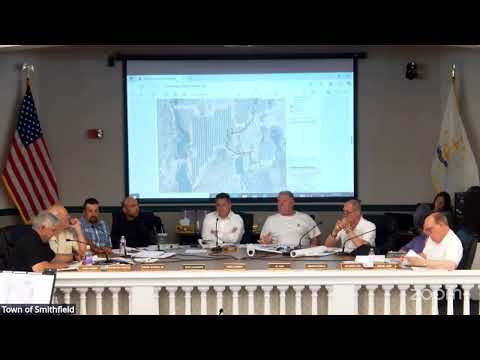
The Smithfield Talent Planning Board on July 2025 approved a master plan for a 3.66-megawatt solar array proposed by Endurance Clean Energy, granting several zoning variances and conditions while withdrawing consideration of on-site battery energy storage until state-level technical rules are final.
The approval clears a proposed solar parcel of roughly 14.9 acres within a larger, roughly 35-acre assemblage of tax parcels to the south of an existing solar field; the board granted a use variance to allow the utility-scale solar use in an R-200 residential zone and variances for lot coverage and dimensional setbacks with conditions. The applicant agreed to withdraw the battery-energy-storage portion of the application and return with detailed plans once state guidance is available.
Board members and the project team said the site’s long history of disturbance and proximity to a nearby EPA Superfund remediation area made the property a candidate for solar. Attorney Joseph Carnivale, representing Endurance Clean Energy, told the board the parcels include “previously disturbed site[s] with minimal ecological disruption” and argued the project supports town and state renewable-energy goals. Principal Gregory Lucini of Endurance said the array uses single-axis tracking technology to increase production and that the interconnection study limited the connectable capacity to roughly 3.66 megawatts.
The board’s approval included the following, as stated at the meeting: a use variance to permit solar in R-200, dimensional relief for lot coverage (applicant cited 41.8% for the new parcel), and setback relief that the board conditioned as 15 feet along the northern edge adjacent to the existing array and 50 feet for other parcel edges. The applicant also committed to decommissioning financial assurance consistent with state practice and to state and federal permitting for wetlands and floodplain issues.
Environmental consultant Megan Elwell of GZA Environmental testified that wetlands and slope constraints limit developable area, and that preliminary mapping shows the array avoiding mapped freshwater-wetland buffers and the areas currently used for EPA remediation. “We don’t foresee any wetland impacts from this project,” Elwell said. She also said the FEMA Zone A mapping that overlays the site is under discussion with DEM and FEMA and may be adjusted.
Several residents raised questions at the public hearing about battery safety, road access for emergency responders, stormwater and groundwater, and likely local impacts. Town Councilor Rachel Taube noted the town council’s 2023 ordinance that bans battery storage facilities in most zones and asked for the distance to the nearest house; the applicant agreed to provide more detail when battery plans are brought forward. Multiple residents asked about fire risk for battery storage; Lucini said the applicant plans to follow the state’s forthcoming battery guidance and anticipates using lithium-iron-phosphate chemistry and modern suppression design if batteries are proposed.
The applicant withdrew the battery site from the current master-plan application at the board’s request and asked the board to approve the solar-only master plan so the project could meet federal tax-credit timetables and proceed to the next permit steps. The board approved the solar master plan and the associated zoning relief, with the condition that battery-energy-storage equipment is not part of this approval and will require a separate submission and review.
Next steps: Endurance will pursue required state permits (freshwater wetlands, RIDEM/DEM, and any FEMA remapping as needed), finalize the lot reconfiguration and site engineering, and return for the board’s preliminary plan review on the solar array. The applicant said it will return separately with a detailed battery proposal if and when state rules and interconnection approvals are final.