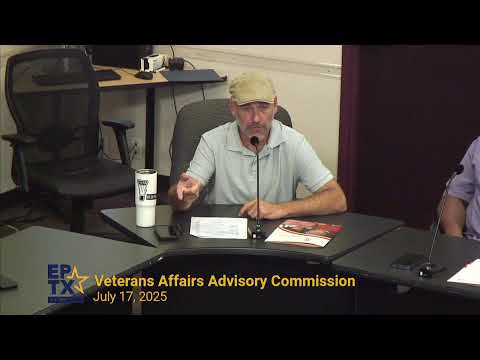
National Organization for Victim Advocacy briefs El Paso committee on military‑connected survivors project
Loading...
Summary
Kimberly Henry, a licensed master social worker with the National Organization for Victim Advocacy, briefed the Veterans Advisory Committee on a DOJ‑funded project that trains community organizations to serve military‑connected survivors of domestic violence, sexual assault, dating violence and stalking.
Kimberly Henry, a licensed master social worker with the National Organization for Victim Advocacy (NOVA), gave a 15‑minute briefing to the City of El Paso Veterans Advisory Committee on NOVA’s DOJ‑funded project to support military‑connected survivors of domestic violence, sexual assault, dating violence and stalking.
“What we do is help the helpers,” Henry said, summarizing the project’s mission to train and provide tools to community advocates, medical personnel, law enforcement and legal professionals who commonly encounter military‑connected survivors.
Why it matters: Military connection adds layers of barriers for survivors — such as fear of retaliation, concern about a service member’s career or benefit eligibility, and differing DOD/VA definitions and processes — that can prevent victims from seeking help through military channels. NOVA’s project aims to reduce those barriers by building coordinated community responses and training civilian providers on the unique dynamics military connection creates.
Henry said the project is funded by the Department of Justice Office on Violence Against Women and provides free training and technical assistance to communities. She described tools NOVA offers, including a customizable organizational self‑assessment to measure readiness to support military‑connected survivors, housing‑access guidance for victims who need to retrieve belongings on base without triggering unwanted reports, and training modules for medical and legal professionals.
Henry said NOVA also partners with the National Crime Victim Law Institute to build a pro‑bono lawyer corps that can provide legal help to military‑connected survivors. She described an upcoming three‑part, no‑cost training series on veteran treatment courts and noted NOVA’s work on fatality reviews and research gaps (for example, limited data on stalking in military populations).
Committee members asked whether Henry is connected to Fort Bliss or El Paso VA leadership; she said she is not yet connected but invited introductions. Henry said NOVA will follow up by email with links, slide materials and information on pro‑bono legal supports.
Ending: Henry offered the committee free training materials and asked members to contact NOVA for assistance in building coordinated community responses. She said NOVA will send slides and links in a follow‑up email and invited local partners to request technical assistance.