Get Full Government Meeting Transcripts, Videos, & Alerts Forever!
Get email alerts on the Stormwater Stream Restoration topic
No spam. Unsubscribe anytime.
Annapolis outlines sewer lining and 490-foot stream restoration after outfall failure
Summary
City of Annapolis staff presented designs and a tentative schedule for a sewer-lining contract and a 490-foot regenerative stormwater conveyance (RSC) stream-restoration project on the Merryman/Merriman outfall to Spa Creek, following a prior sewer failure that undermined a sewer pipe.
My name is Anne Roterer. I'm a stormwater engineer with the city of Annapolis, and we're here to give you an update today about a project, at the Merriman ... at Spa Creek," said Anne Roterer, the city's stormwater engineer, opening a public briefing on the Merryman/Merriman Stream Restoration Project.
City staff said the combined program responds to a past sewer overflow and erosion that undermined a sewer pipe near Merryman Road and Spa Creek. The package includes lining about 2,700 linear feet of 8-inch and 10-inch sewer pipe and approximately 490 linear feet of channel restoration, including repairs at the Hawkins Lane outfall and headwall.
The sewer work: schedule, impacts and procedures
Jen, project manager for wastewater for the City of Annapolis, described the sewer portion as a staged lining operation. "It's going to take approximately 4 months to do the sewer restoration portion," she said, adding the timeline reflects setup, CCTV inspection, ordering a liner (4–6 weeks lead), installation with bypass pumps and a post‑installation CCTV check. Staff said the 4 months is not continuous crew time on every property; the contractor will install temporary access, bypass pumps and perform CCTV before returning to line sections.
City staff warned residents of likely construction noise (pumps and generators), intermittent traffic flagging or brief detours for large trucks, and the curing process for the cured-in-place liner, which can emit steam and odors at manholes. Water use restrictions are possible during liner installation because the liner blocks laterals until crews reinstate connections; staff said such restrictions would typically be limited to several hours and would not exceed about 8–10 hours for affected connections. Notices will be distributed about a week ahead of work and again 48 hours before active lining, staff said.
Stream restoration design and environmental review
Megan, a Bayland Consultants design engineer, said the stream design uses a regenerative stormwater conveyance (RSC) approach. "The proposed design approach for this project is what we call a regenerative stormwater conveyance or RSC system," she said. The design calls for seven parabolic weir structures and pools, each roughly 30 feet wide with average drops of about 0.5 to 1 foot, to slow flows, reduce erosive velocities and reconnect fringe wetlands. Two locations where the sanitary sewer crosses the channel will be encased with stone for added protection.
Consultants reported the site drainage area to the downstream study point is about 97 acres, of which roughly 43 acres (about 44 percent) is impervious. The Severn River watershed covers about 81 square miles (roughly 52,000 acres). As part of the natural resource inventory, consultants delineated about 0.44 acres of wetland and roughly 1,100 linear feet of stream channel on and near the project reach; about 0.8 acres of forest lie within the proposed restoration footprint. Staff said they have tried to minimize clearing and will include tree protection measures, temporary construction mats or mulch over access routes, and a native planting plan to restore habitat after construction.
Permitting, property access and schedule
Jason, a Bayland Consultants design engineer, and city staff said applications are under review by the Maryland Department of the Environment and the U.S. Army Corps of Engineers, following pre-application coordination in November 2024 that also included the Critical Area Commission. The Commission toured the site and, after review, staff said the Commission does not consider the area to be forest-interior dwelling species (FIDS) habitat despite a GIS-layer flag. City permits needed include a city grading permit (with tree-impact/reforestation review), sediment-control approval from the soil conservation district, and a Notice of Intent (NOI) for stormwater associated with construction activity.
Staff said some private-property easements will be required: permanent easements where structures and maintenance access are needed, and temporary easements for construction access/staging that terminate after work is complete. The city will coordinate directly with affected property owners.
Timing: staff said they expect to finish permits and design by late fall 2025, prepare bid documents in winter 2026, complete procurement and contract award in spring 2026, and begin construction as early as summer 2026. Active construction for the stream work is expected to take about 2.5 months, with the full mobilization, grading and restoration timeline stretching to about four months. City presenters said they do not expect lane closures during the stream work, though there may be flaggers during equipment ingress and egress.
Community questions and next steps
Residents asked about elevation changes, potential vibrations during placement of large stone, and how higher upstream impervious area affects flows. Staff noted that RSC weirs are placed strategically and larger stones are set rather than dumped to limit vibration. The project team repeated that upstream stormwater management helps overall watershed health but that the 100‑year storm flows driving severe erosion on this reach are difficult to manage solely with small upland BMPs.
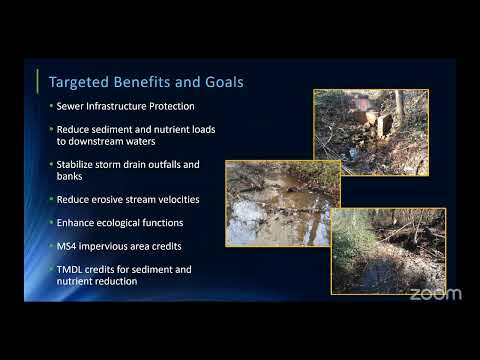
City staff said the project is partially funded through a Whole Watershed Act grant in partnership with the Severn River watershed group, Anne Arundel County, the Spa Creek Conservancy and the Severn River Association, and that the city will earn MS4 credit for the bank stabilization and nutrient-reduction benefits the project provides.
The presentation and project materials will be posted to the project website; staff identified Jen as the contact for sewer/wastewater questions and Anne Roterer as the contact for stormwater questions. Residents were told to expect further public outreach after agency comments are received and before final design and bidding.