Get Full Government Meeting Transcripts, Videos, & Alerts Forever!
Get email alerts on the Sewer System Management topic
No spam. Unsubscribe anytime.
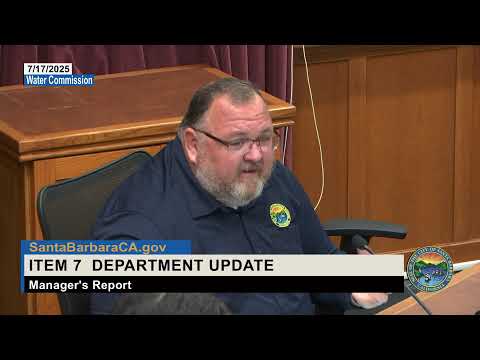
Santa Barbara water staff update sewer system management plan; commission backs forwarding to council
Summary
The Water Commission voted to recommend that City Council approve an updated Sewer System Management Plan that reflects a 2023 state general order, new audit schedules and operational changes intended to reduce sanitary sewer overflows.
The Santa Barbara City Water Commission voted July 17 to recommend the City Council approve an updated Sewer System Management Plan that the city must submit to the Central Coast Water Board to meet a new state general order.
The recommendation comes after a staff presentation explaining that the State Water Resources Control Board’s updated Waste Discharge Requirements (WDR) for sanitary sewer systems — issued in December 2022 and effective June 2023 — requires more documentation, enhanced capacity planning and new audit and update schedules. Thomas Welch, the city’s wastewater system manager, told the commission the city’s internal audit was due in February 2025 and the revised plan must be submitted to the state by Aug. 2, 2025. Welch said staff will present the plan to City Council on July 29.
The plan update incorporates consultant recommendations, new documentation, and operational changes designed to reduce sanitary sewer overflows (SSOs). Welch said the city hired HDR Inc. to perform the internal audit covering Aug. 2021–Aug. 2024 and that the firm identified deficiencies and opportunities for optimization. He credited the collections crew for a revised cleaning strategy and said the updated plan documents that work.
Rob Johns, planner-scheduler for collections, described changes in spill categories and response: "The new WDR ... created a new category for spills less than 50 gallons that were recovered," and, of the nine spills in the most recent fiscal year, four were fully recovered at under 50 gallons. Johns also said crews and new monitoring technology helped capture blockages before they spilled: "we have over 50 smart covers in the system now" that detect high levels in manholes.
Staff described a shift from citywide, scattered cleaning to a basin-based cleaning approach. Welch said crews now clean by watershed-like basins so teams work in one area at a time, reducing travel time and the risk of moving debris between mains. The city also increased cleaning frequency for some mains; Welch said mains previously cleaned every three years are now on an annual schedule where appropriate, and the city is working to eliminate very-high-frequency short-cycle cleanings.
Audit results and metrics were discussed in context. During the audit period the city reported 30 spills, 10 of which reached receiving waters; staff said the city’s volume of sewage reaching receiving waters was about 14,000 gallons per 100 miles for the audit period, compared with a regional average of about 95,000 gallons per 100 miles. Welch noted topography and rapid flow in Santa Barbara complicate spill response but praised crews for fast recovery and mitigation.
On compliance findings, HDR identified one category A noncompliance related to air-valve mapping; after review staff determined the city has no air valves on its force mains, explaining the apparent gap. HDR also noted multiple minor nonconformances, including one to post the SSMP in a clearly public location with explicit contact information; staff said they added that contact information to the posted plan. Welch said many findings were documentation-level and that the city had implemented many operational changes earlier under a prior consent decree; the current work focuses on documenting procedures to meet the new WDR’s detail requirements.
Commission action: A motion to "recommend" the SSMP update to City Council passed on a roll call vote with recorded affirmative votes from Commissioner Davis, Commissioner Cooney, Vice Chair Keller and Chair Snyder.
The commission’s endorsement is a required step before the city submits the updated plan to the state by the August deadline.