Get Full Government Meeting Transcripts, Videos, & Alerts Forever!
Get email alerts on the Land Use Genesis Rv topic
No spam. Unsubscribe anytime.
Washington County Quorum Court denies Genesis RV Park conditional-use permit over safety and infrastructure concerns
Summary
After extended public comment and debate, the Washington County Quorum Court voted to deny a conditional-use permit for the proposed Genesis RV Park on Natural Walk Road, citing road safety, water and septic questions, and neighborhood opposition. The planning board had earlier recommended approval.
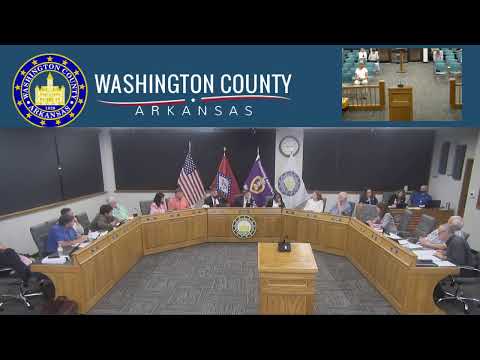
The Washington County Quorum Court on its July meeting denied a conditional-use permit for the proposed Genesis RV Park on Natural Walk Road, rejecting the planning board’s recommendation and citing public safety and infrastructure concerns.
The planning department’s director, Dr. Atta, told the court the planning board approved the project on May 1 by a 4–1 vote and that the application would allow up to 41 RV pads built in three phases. Dr. Atta summarized technical details: the project proposes three septic systems (primary and alternates) and a drilled well as the primary water source with a Springdale Water connection as backup. He also said 11 property owners within the required notification radius were notified and staff received about 28 emails and phone calls opposing the project (Dr. Atta, planning director for Washington County).
Opponents, most of them nearby residents, pressed the court on road width, steep grades, blind curves and emergency response. Amber Henderson, a Natural Walk Road resident, told the court the road is narrow, has steep grades and low water pressure and that neighbors had signed a petition opposing the CUP. “This is a very steep grade. So what if one of these camper people don't know how to drive their new RV or camper? They're gonna die or they're gonna kill somebody,” Henderson said.
Other neighbors described limited sight lines for schoolchildren getting off buses, repeated emergency-response delays, and frequent crashes along the approach roads. Zachary Pugh, another nearby resident, said some stretches are narrower than the 20-foot standard and that increased RV and boat traffic would worsen congestion and safety risks.
Applicant representatives and engineers said the CUP is a land‑use approval, not final construction approval, and they must still satisfy large‑scale development, health‑department and fire‑safety requirements before any phase can open. Will Keltstrom, representing the applicant’s engineer, said the conditions attached to the CUP would require state approvals and that “if they can't make the septic work, they can't build it.” He noted the project’s entrance drive would be 36 feet wide and that the applicant planned to drill a semi‑public well; engineer Jason Ingalls said drillers reported adequate capacity at the proposed site.
Justices weighed planning staff expertise and the planning board recommendation against resident testimony about local safety. Justice Ecki voted against denying the CUP, but the motion carried: Justice Lyons moved to approve an ordinance to deny the conditional-use permit; Justice Koger seconded; the roll call vote recorded 12 in favor of denial and 1 opposed (Ecki). The court adopted the ordinance denying the CUP.
The court's order denies the permit; the project would need to reapply if proponents wish to pursue the development again. The county planning director said that if the owners later submit a new application, each phase must pass a separate large-scale review and final inspection before it may become operational.
The decision follows a large public turnout: the planning board had seven members initially consider the CUP (four voted for approval, one against), neighbors submitted multiple written complaints, and seven residents testified at the planning board. Planning staff noted the CUP, if approved, would allow phased construction (15 pads per initial phase) and that final approvals would require health‑department signoffs for septic and documented fire‑safety compliance before any pads are occupied.