Get Full Government Meeting Transcripts, Videos, & Alerts Forever!
Get email alerts on the Water Rates Decoupling topic
No spam. Unsubscribe anytime.
Padillas SB 473 would restore decoupling option for regulated water utilities; Public Advocate opposes citing pilot results
Summary
SB 473 would permit the PUC to authorize a full revenue-decoupling mechanism for investor-owned water utilities; supporters say decoupling supports conservation and affordability, while the Public Advocate cited pilot results that showed higher net costs for ratepayers under full RAM.
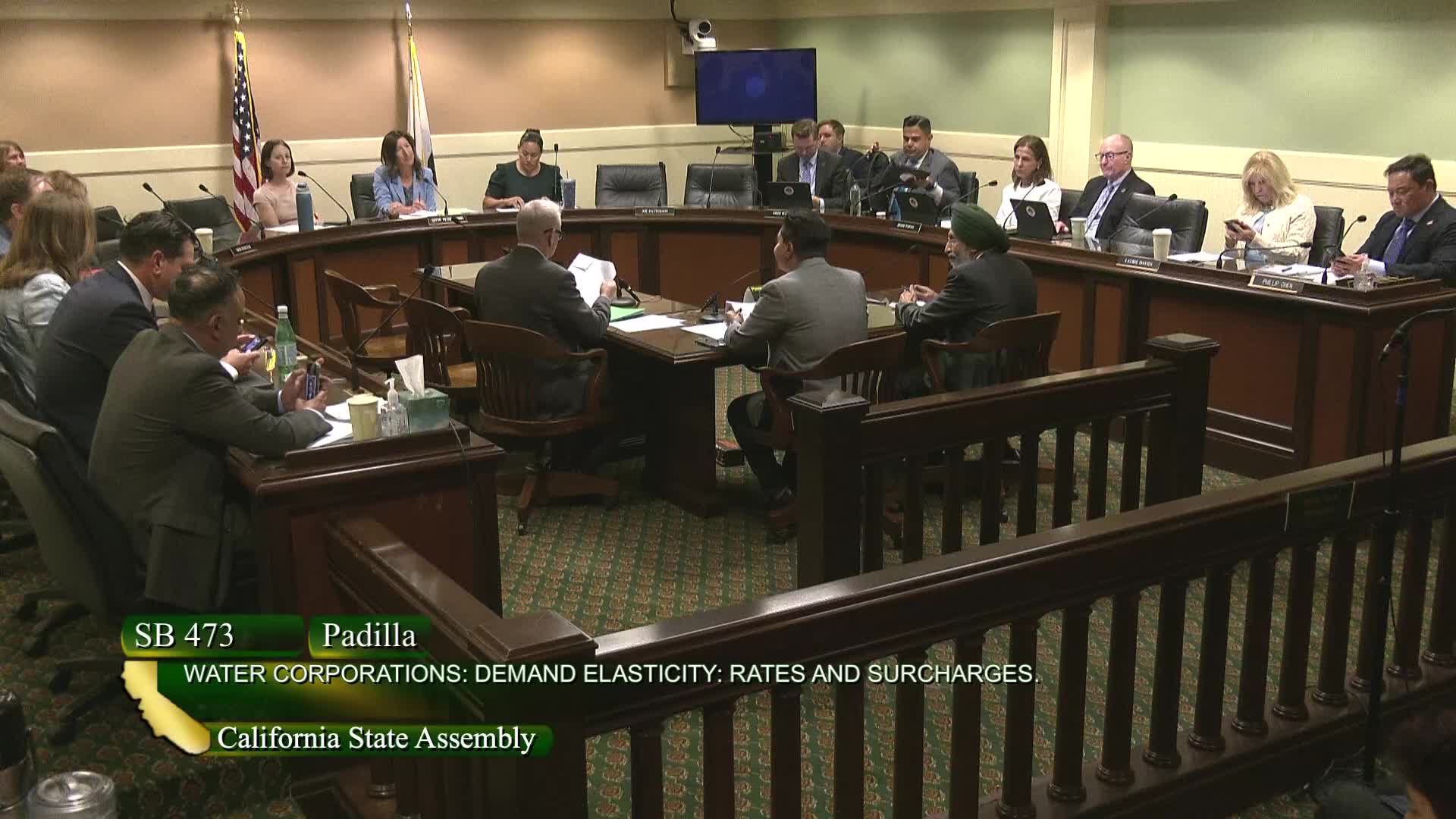
Sen. Padilla presented SB 473 to allow the California Public Utilities Commission to authorize a revenue decoupling mechanism for water corporations regulated by the PUC (commonly called a revenue adjustment mechanism, or RAM). The author and water industry supporters said decoupling separates utility revenue recovery from retail sales volumes, enabling tiered, conservation-focused rate design while protecting utilities revenue stability needed for capital investments.
Supporters, including California Water Service, the State Pipe Trades Council and labor, the Water Efficiency Partnership and industry groups, told the committee that decoupling enables more aggressive tiered rates that make lower-volume users pay less per unit and higher users pay more. They argued that decoupling reduces incentives to set large fixed charges that disproportionately burden low-use households and helps utilities plan capital projects with revenue stability. Several speakers said the CPUC has denied decoupling requests despite a prior pilot and that denying decoupling has led to higher bills for low-volume users in some places.
The Office of the Public Advocate opposed the bill, saying the CPUCs 10-year pilot found no measurable conservation advantage for full RAM versus a conservation-oriented mechanism (a cart or Monterey-style RAM) and that the full RAM historically resulted in higher net costs to ratepayers (the office cited approximately $1 billion in increased charges in the pilot period). The Public Advocate recommended continuing rate-case processes and said the CPUC repeatedly rejected decoupling requests after study.
Committee action: After questions and extended debate the committee voted to move SB 473 to Appropriations as amended (the author accepted committee amendments); members expressed deep engagement on the differing interpretations of the pilot data and directed continued stakeholder work.
Ending: The committee advanced SB 473 to Appropriations; stakeholders will continue to discuss profit vs. revenue concerns, rate design, and how decoupling would be applied in modern drought and conservation contexts.