Get Full Government Meeting Transcripts, Videos, & Alerts Forever!
Get email alerts on the Extreme Heat Housing topic
No spam. Unsubscribe anytime.
Assembly committee backs bill urging state policy that homes must be able to maintain safe indoor temperatures
Summary
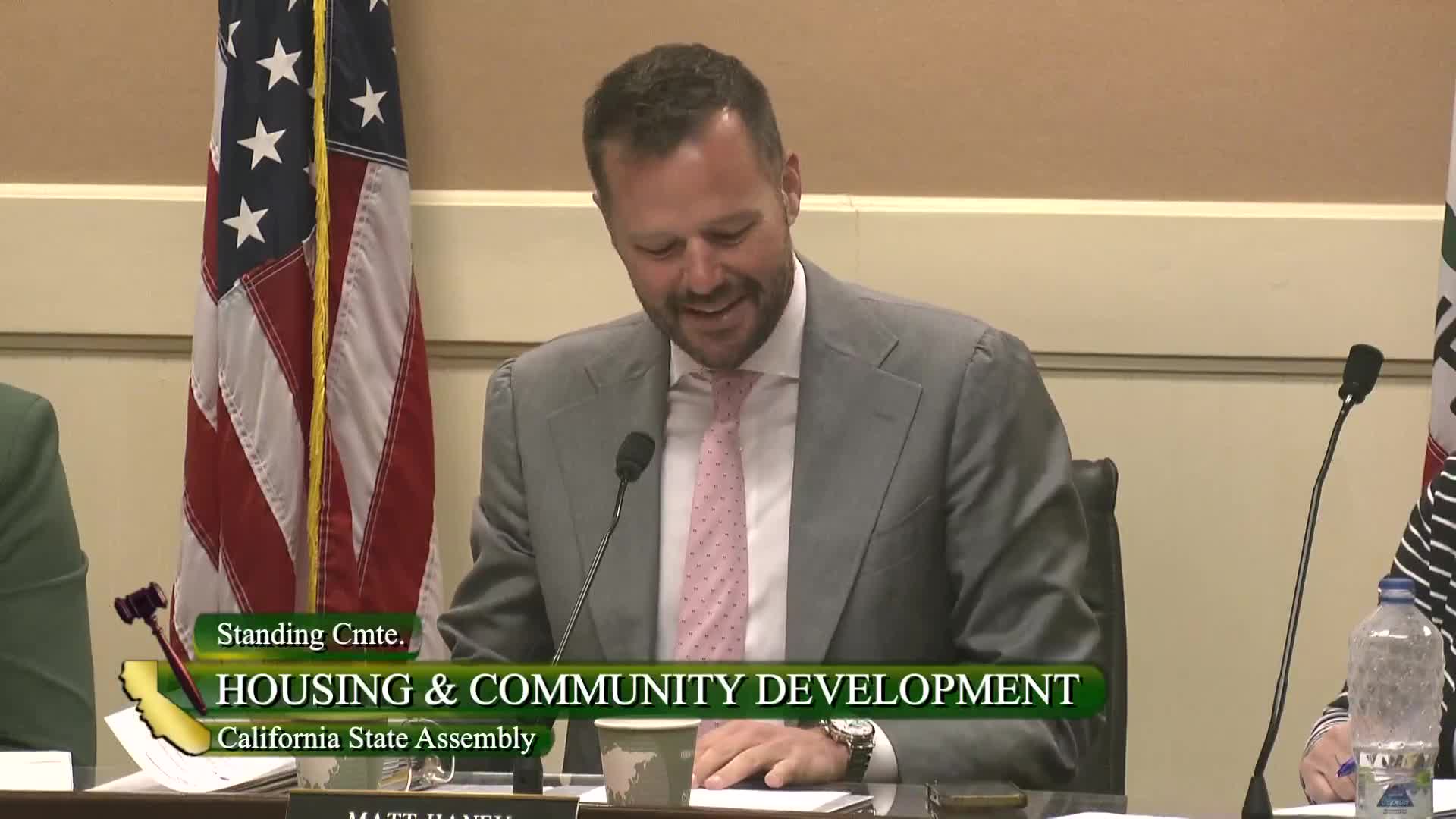
The Assembly Housing and Community Development Committee passed SB 655 as amended, a bill directing state agencies to consider maximum indoor temperatures when designing housing-related programs and grants to protect residents — especially low‑income and rural communities — from extreme heat.
Senator Stern introduced SB 655 to the Assembly Housing and Community Development Committee, arguing the bill will unify state efforts to protect Californians from extreme heat inside their homes.
The bill directs state agencies to consider the goal that “all residential dwelling units shall be able to maintain a safe maximum indoor temperature” when they develop, revise or implement policies, programs, regulations and grant criteria relevant to that goal.
SB 655’s author said extreme heat is already the leading weather‑related cause of death in the U.S. and cited a California Department of Public Health report that attributed 400 excess heat deaths to a September 2022 heat wave. “There is no unifying policy at this point,” the senator said, arguing the bill would let agencies leverage existing and emerging measures to protect people in their homes.
Supporters said the bill responds to lived experience in rural and low‑income communities. Giovanna Morales Tillgren, housing and land use policy manager for Leadership Council Action, told the committee many residents in the San Joaquin Valley live in older, substandard homes without cooling or avoid using air conditioning because energy costs are too high. “This gap in our programs and policies puts the most vulnerable Californians at risk from illness and death from extreme heat,” she said.
Natalie Delgado, policy associate with the Central California Environmental Justice Network, said swamp coolers used in some rural homes lose effectiveness above about 95 degrees and can pull outdoor pollution, including pesticide drift, into living spaces. “These conditions put these residents at risk of heat illness and heat stroke,” Delgado said.
Committee members raised concerns about leaving any maximum temperature undefined. Several members said a fixed threshold could help clarity and protect utilities from strain during peak use, while the bill’s supporters and witnesses said they intentionally left a specific numeric limit to allow agencies flexibility and to account for regional differences.
Senator Stern said the committee amendments identify which state agencies should consider the objective, and emphasized the bill is intended as a policy‑setting first step rather than an immediate mandate with a single statewide numeric standard.
The committee passed SB 655, as amended, to the Assembly Appropriations Committee.
SB 655 will now go to Appropriations for further review of fiscal effects and implementation pathways.