Lifetime Citizen Portal Access — AI Briefings, Alerts & Unlimited Follows
Chico planning commission backs engineering code updates, removes maze-gate standard for bike paths
Loading...
Summary
The Chico Planning Commission recommended the City Council adopt broad engineering updates to the Chico Municipal Code — covering Titles 10, 14, 16, 16R and 18R — and voted to remove a proposed standard that would have added maze-style bicycle gates, favoring more bike‑friendly alternatives.
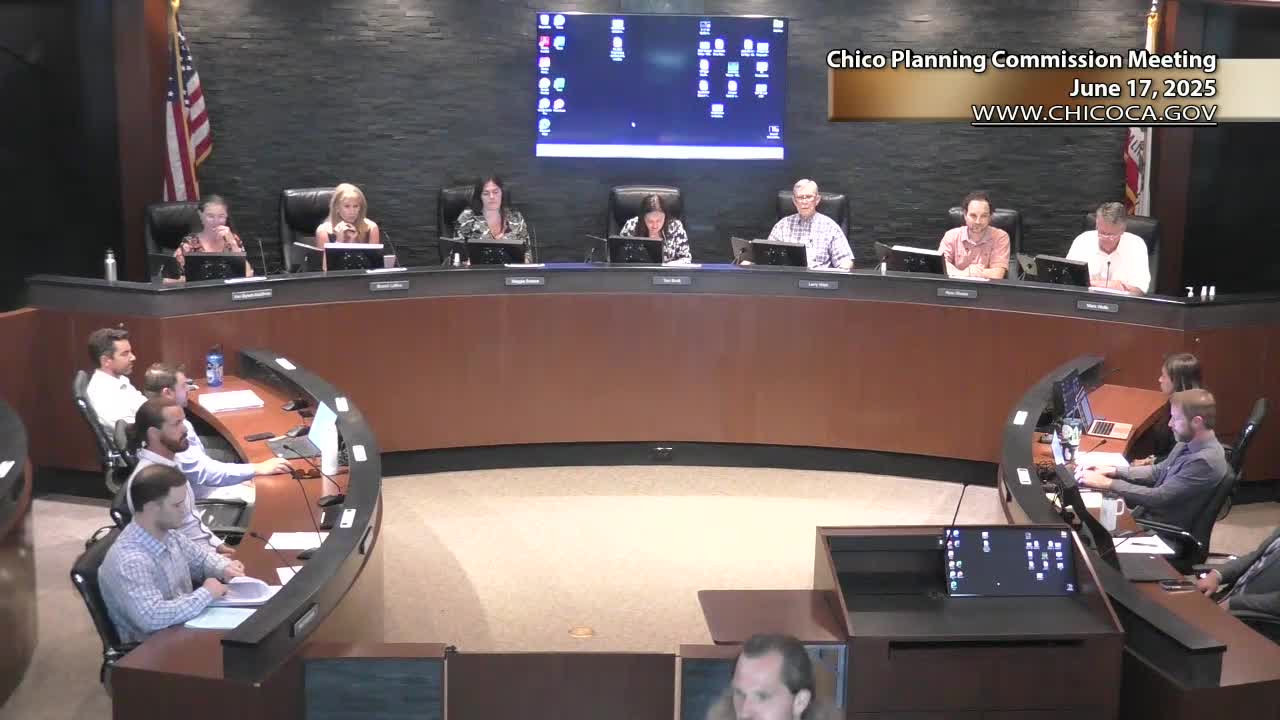
The Chico Planning Commission voted 4–3 on July 17 to recommend that the City Council adopt a suite of engineering updates to the Chico Municipal Code that change development and street‑design standards and to remove a proposed standard for maze‑style bicycle gates in favor of flexible bollards or other ADA‑compliant, bike‑friendly alternatives.
The updates, presented by David Keane of the Public Works Engineering Department, cover traffic control authority, encroachment permits and material submittals, a pavement cut moratorium, updated pavement and street‑lighting standards, floodplain and grading language, minimum depths for non‑gravity utilities and a lowered traffic‑impact study threshold for new developments.
City staff said the amendments are designed to incorporate recent state regulatory changes, council directives, lessons learned by inspectors and long‑term infrastructure sustainability practices. The commission’s action sends Resolution 25‑10 to the City Council with the commission’s recommendation and the modification removing the maze‑gate standard.
David Keane, Public Works Engineering Department, summarized the package and why staff brought a consolidated set of changes: "It's been a long time since we've updated the Chico Municipal Code with regards to engineering design details and design updates," he said, adding the update responds to "regulatory changes, council directives, process enhancements, and long term sustainability of City infrastructure." Keane told commissioners the city received more than 70 stakeholder comments on the draft and directly incorporated roughly 20 changes into the proposed text.
Key proposed changes
- Traffic control authority: Language will move certain intersection traffic regulation authority (Title 10) per an existing council directive to the Director of Public Works/Engineering.
- Encroachment permits and material submittals (Title 14): The draft removes several existing exceptions for encroachment permits, adds a material submittal requirement so inspectors can confirm what is installed, and authorizes administrative citations for noncompliance.
- Pavement cut moratorium (Title 14): To protect newly reconstructed streets, staff proposed a moratorium on cutting into roadways: generally five years after full reconstruction and three years after surface treatments such as slurry seals; streets with a pavement condition index of 80 or higher would also be protected unless the public works director grants a justified exception with stricter restoration requirements.
- Utility depth and full‑depth reclamation (Title 18R): The code would require non‑gravity utilities (conduit, communications, gas, etc.) be installed with a minimum cover of 3 feet from surface to top of pipe. Staff said the 3‑foot depth supports full‑depth reclamation pavement techniques and reduces the risk of utilities being damaged during pavement recycling operations.
- Traffic impact studies (Title 18R): The threshold that triggers a traffic impact analysis would be lowered from 100 to 50 net new peak‑hour trips (staff noted that is roughly equivalent to a 50‑unit subdivision). Staff and commenters said the change memorializes a common practice and gives the city authority to require analyses that identify needed mitigations.
- Pavement structural section and standard plans: Staff proposed updated standard plan details, including a 3‑inch asphalt surface over an 8‑inch aggregate base as a minimum structural section for new streets that the city will accept for long‑term maintenance. Staff said many recent projects already use that section and that geotechnical or traffic‑index conditions could require alternative engineered sections.
- Floodplain and grading (Title 16R): The amendments add flood hazard definitions and require flood hazard information on subdivision mapping and bring grading into floodplain standards.
Environmental review and findings
Staff said the amendments are exempt from project‑level environmental review because they do not themselves propose construction or demolition; future development would require project‑level environmental review as required. Staff also said the draft amendments comply with the general plan and other municipal code provisions and asked the commission to adopt findings supporting Resolution 25‑10.
Public comment and debate
The commission heard public comment from six speakers. Katie Toma, executive director of the Chico Builders Association, told the commission the association appreciated staff outreach but asked the commission to modify the draft because several changes — notably lowering the traffic‑study threshold and stricter pavement standards — could increase housing costs. "Lowering the peak threshold from 100 to 50 will trigger significantly more traffic studies. These studies can cost between $10,000 and $30,000, increasing project expenses," Toma said.
Multiple speakers and commissioners focused debate on a proposed standard that would allow maze‑style bicycle gates on multi‑use paths. Several regular bicycle users and older residents testified that maze gates are hard or impossible for cargo bikes, tandems, handcycles and trailers to navigate and can create unsafe bypass paths. Matthew Willie, a daily cyclist, said: "Maze gates are just absolutely terrible full stop, for any kind of nonstandard bike." Julian Zenar and Kirk Monfort described crashes and mobility limits they associate with existing maze gates around town.
Staff responded that the draft standard memorialized a practice used in select existing installations and that the proposed detail calls for gates to be spaced so they do not overlap, with an 8‑foot minimum clear spacing in the detail. David Keane said the swing‑gate devices had been applied selectively for roughly seven to eight years and were intended to slow cyclists where paths meet higher‑speed roadways; Director of Public Works Bridal Adeboni said installations are evaluated on a case‑by‑case engineering basis.
Commission deliberations and action
After discussion, Commissioner [motion recorded as "Commissioner"] moved that the commission adopt Resolution 25‑10 recommending City Council adopt the engineering updates but remove the proposed maze‑gate standard (S‑35) and instead recommend flexible bollards or other ADA‑compliant, bike‑friendly alternatives to manage cyclist speed at path intersections. The motion was seconded. The commission approved the motion in a recorded roll call vote with four yes votes and three no votes.
Roll call vote (recorded): Commissioner Wolf — no; Commissioner Wall — no; Commissioner Sharp — yes; Commissioner Laffins — yes; Commissioner Baikirk Kauffman — yes; Vice Chair Scarpa — yes; Chair Scott — no. Outcome: motion approved (yes 4, no 3). The commission’s recommendation, including the modification, will be forwarded to the City Council for final action.
What happens next
The commission’s vote is advisory: the Planning Commission recommended adoption of the code changes and the single modification on maze gates. The City Council will receive staff’s materials, the commission’s resolution and public testimony and decide whether to adopt the municipal code amendments as proposed, as modified or not at all. Staff said notices for the ordinance changes and related materials were posted and that the full redline text, stakeholder comments and staff responses are in the staff report and attachments.
Ending
The motion transmits a bundled set of municipal code engineering updates to the City Council while removing maze‑gate language and asking the Council to consider less‑restrictive, more accessible traffic‑calming alternatives at multi‑use path intersections. If the council adopts the amendments, changes to permitting, pavement restoration requirements, utility installation depths and traffic‑study triggers will take effect as specified in the implementing resolution and code sections.