Get Full Government Meeting Transcripts, Videos, & Alerts Forever!
Get email alerts on the Utility Affordability topic
No spam. Unsubscribe anytime.
Senate bill targets utility costs, proposes Power Fund and $15B securitization; committee advances bill amid divided testimony
Summary
Sen. Beckers SB 254, a package of measures to curb rising residential electricity bills, advanced from the Assembly Utilities and Energy Committee after supporters described new customer credits, a Power Fund and a plan to securitize $15 billion of utility spending and opponents warned the bill needs narrower drafting and further analysis.
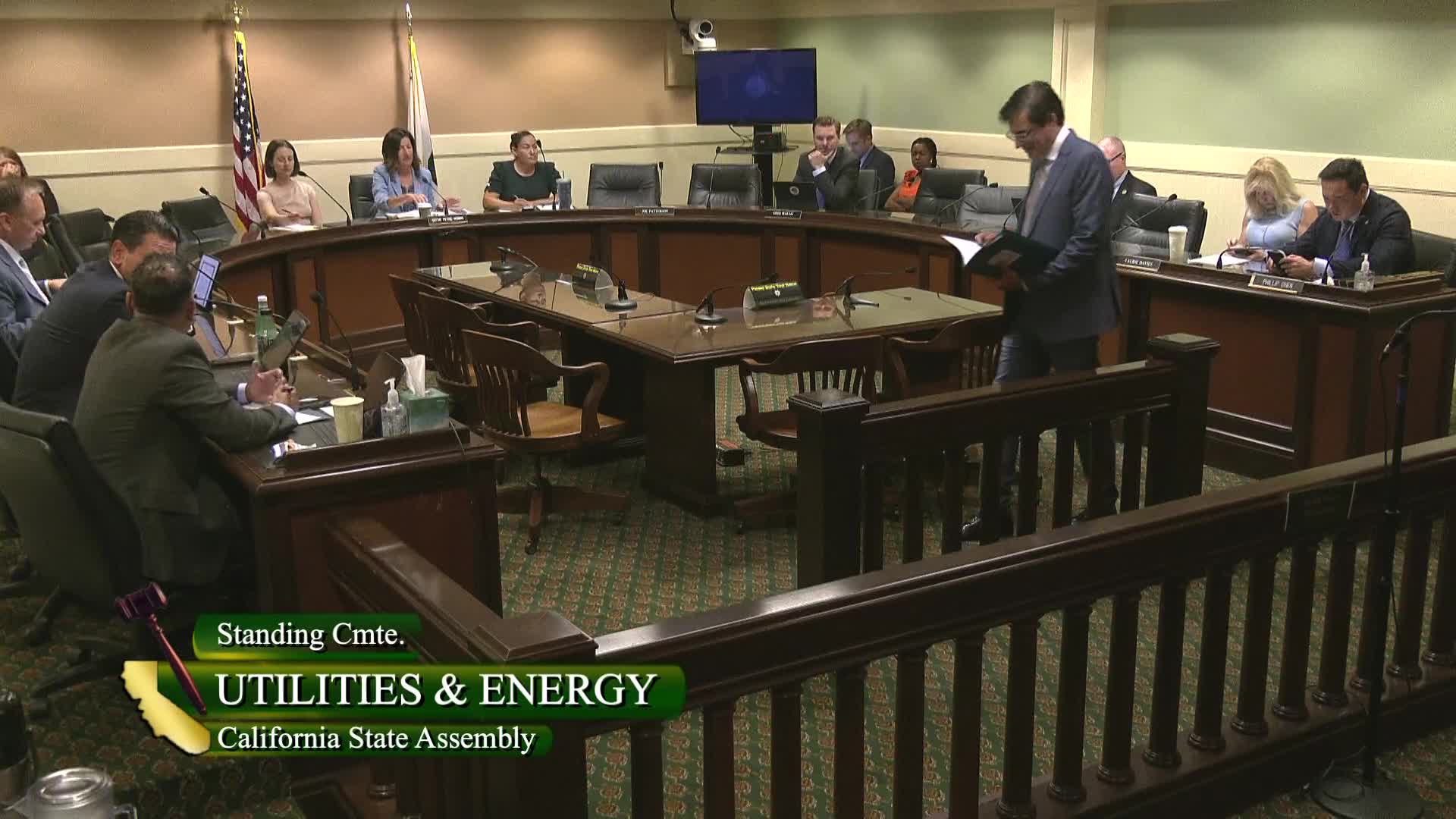
Senator Beckers SB 254, a multi-part affordability bill aimed at reducing long-term utility costs for California electricity customers, was presented and advanced by the Assembly Committee on Utilities and Energy after debate on cost, scope and implementation.
The bill would dedicate climate/dividend credits to customer bills, create a Power Fund administered by the California Energy Commission to shift some costs out of rates into other funding sources, require greater transparency and scrutiny of utility spending, and require investor-owned utilities to securitize $15 billion of future wildfire- and customer-energization-related capital spending. Supporters say the mix could materially reduce future rate growth; opponents warned the bill as drafted does not address the attributable legal and regulatory cost drivers and risked unintended market impacts.
Why it matters: California has seen large rate increases in recent years; SB 254 seeks both immediate relief through credits and longer-term structural changes (public financing, securitization, spending benchmarks) the author and supporters say will lower the cost of financing and curb rate increases.
What the bill would do: Sponsor testimony and the bill text focus on several areas: 1) devote a larger share of the semiannual climate credit to low-income customers and add summer credits to reduce peak-bill pressure; 2) establish a Power Fund at the CEC to channel non-rate revenue to avoid recovering certain costs in rates; 3) require tighter public scrutiny and a benchmark for utility spending increases tied to inflation; 4) authorize securitization of up to $15 billion in utility capital expenditures tied to wildfire mitigation and customer energization so those costs are financed with lower-cost, ratepayer-backed debt.
Key testimony: Matt Friedman of The Utility Reform Network told the committee SB 254 would allow public ownership or public financing of transmission and estimated possible long-term savings to ratepayers (TURN urged an Aye). Multiple environmental, climate and clean-energy organizations testified in support. Opposition came from utility representatives including Kent Kaus (Southern California Gas Company and SDG&E) and other trade groups who said the bill lacks needed precision, does not address regulatory or statutory cost drivers, and that the $15 billion securitization would yield modest near-term reductions and needs further analysis.
Committee action: The committee took a recorded vote to move the bill out of committee (motion: due pass to Natural Resources). The clerk recorded a roll with multiple aye/no votes and the chair placed the bill "on call" to permit absent members to add on before final action in the full house.
What remained unresolved: Opponents asked for narrower drafting, independent economic analyses of the securitization savings, and carve-outs for cost items outside utility control (tariffs, mandated programs). The author and supporters said those topics remain open for amendment and negotiation.
Ending: The committee advanced SB 254 to the next committee step with votes recorded; sponsors and a broad set of stakeholders said they will continue negotiations during the summer and before subsequent hearings.