Get Full Government Meeting Transcripts, Videos, & Alerts Forever!
Get email alerts on the Traffic Signals Technology topic
No spam. Unsubscribe anytime.
Indianapolis begins rollout of video detection and automated signal management at 160 intersections
Summary
DPW traffic signals engineer Tucker Born told the Public Works Committee that Miovision Scout counters, video-detection cameras and Syntrax automated traffic-management software are being deployed to gather data, improve timing and support event management; initial deployment covers 160 locations.
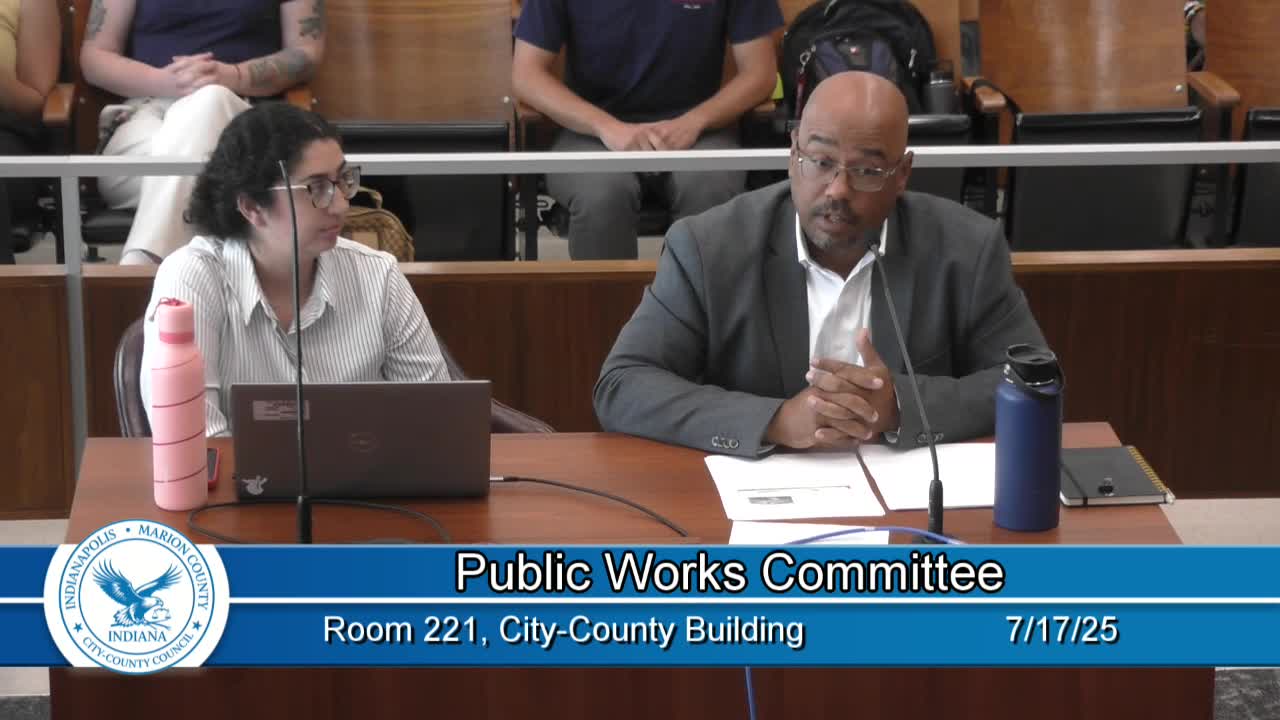
Tucker Born, the city’s traffic signals engineer, briefed the Public Works Committee on July 17 about three technologies the Department of Public Works is deploying to collect traffic data and remotely manage signal timing.
Born described the Miovision Scout as a lightweight, mobile unit for short-term data collection. "Per intersection, it's only about $450 to get the needed data that we need," he said, noting the device collects turning-movement counts, speed data and near-miss information useful for engineers.
He said the department is adding video detection — typically using a 360-degree camera at intersections — to replace or supplement traditional loop detection embedded in pavement. Born said the cameras can detect and classify vehicles, bicycles and pedestrians, count red-light running incidents and generate alerts when signals are flashing or power is out. He estimated cost per camera in the range of $28,000 to $35,000 and told the committee that vendors configured for the department avoid capturing license-plate images. "None of them will capture license plates with this," he said, adding vendors have intentionally reduced resolution to prevent plate capture.
The third component is an automated traffic management platform the department called Syntrax. Born said Syntrax will show real-time signal status and allow remote adjustments to timing, phases and coordination across corridors. "Sitting in my desk, I can recalibrate the signals for timings and phases … rather than having to send someone out to the signal itself," he said. He said the department is deploying Syntrax at 160 locations now and has 250 licenses available but limited initial rollout to 160 based on available funds.
Councilors asked technical and policy questions. Councilor Jessica McCormack asked whether the deployed devices are mobile; Born replied the communication devices are movable and Syntrax hardware can be relocated if needed. Councilor Briggs asked whether video detection could capture license plates; Born said current vendor systems used by the department do not capture plates and that adding that capability would depend on future products and any changes in state law.
Council members raised event-management and public-safety uses. Members discussed using Syntrax to better manage signal timing during large downtown events and to reduce the need for police overtime to manage pedestrian flows. Born said DPW has started coordination with event partners such as the Indianapolis Indians and expects to discuss operations with the Indianapolis Metropolitan Police Department (IMPD) as Syntrax deployment expands.
Born said the department expects to use video-detection data to identify hot spots for red-light running and to refine clearance intervals and timings. The presentation included examples of applications: counting pedestrian and bicycle movements, remotely detecting signal failures, and improving corridor progression for traffic flow.
Councilors asked for maps of current deployment and timing for expansion. Born and staff said they will provide additional maps and progress updates as rollout continues.