Get Full Government Meeting Transcripts, Videos, & Alerts Forever!
Get email alerts on the Budgets Rates topic
No spam. Unsubscribe anytime.
Austin Energy proposes FY2026 budget with 5% base‑rate increase; projects $43.5M 2026 shortfall
Summary
Austin Energy presented its FY2026 proposed budget July 17 seeking a 5% base‑rate increase, forecasting $1.95 billion in revenue and $1.99 billion in costs for a $43.5 million shortfall in 2026; staff said the deficit narrows in later years and typical residential bills may fall as power‑supply costs decline.
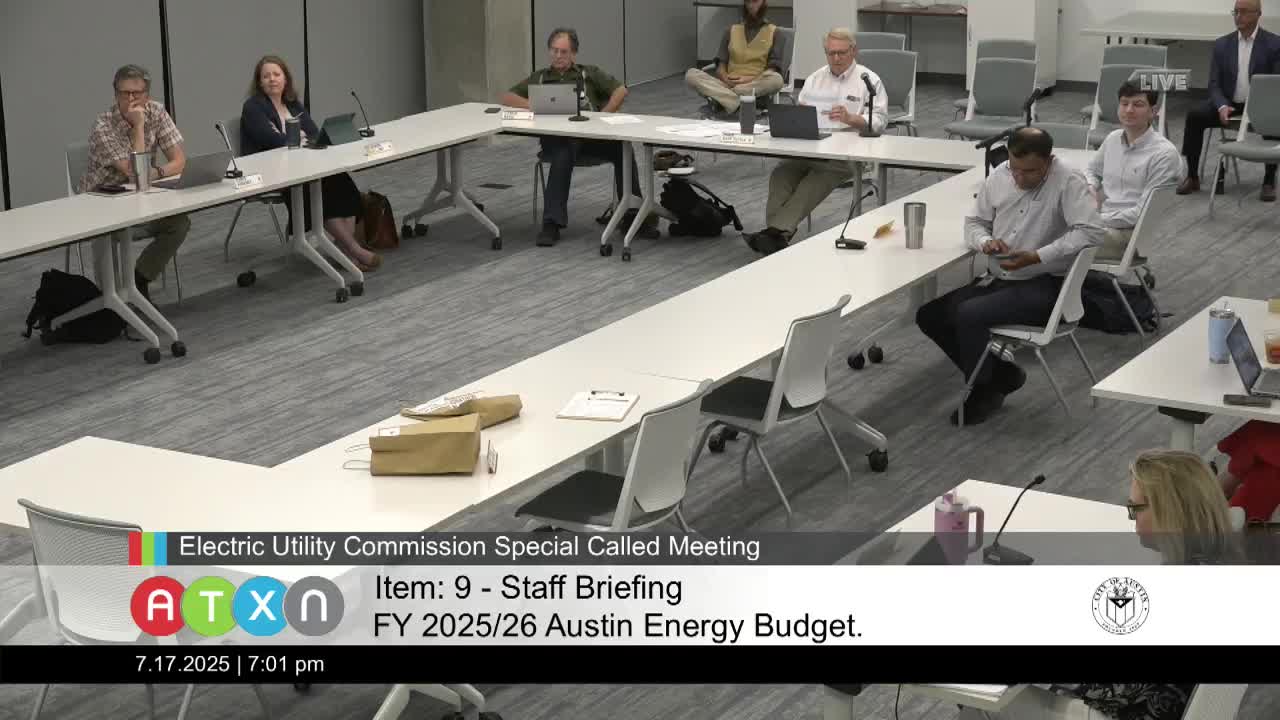
Austin Energy staff on July 17 presented the utility’s proposed fiscal year 2026 budget and recommended a 5% increase in base rates to address rising costs and support capital projects.
John Davis, acting senior vice president and chief financial officer, said the proposed FY2026 revenue budget is roughly $1.95 billion while budgeted uses total about $1.99 billion, producing a projected 2026 deficit of about $43.5 million. Staff told the Electric Utility Commission (EUC) the gap narrows in later years as the plan relies on continued cost control and projected base‑rate revenue growth.
Staff highlighted key cost drivers: higher operating and maintenance expenses including personnel and contractual costs, increased transmission and joint‑project charges, higher debt service related to a larger capital plan and growing general fund and other transfers. The five‑year capital improvement program totals roughly $1.741 billion, split across electric service delivery, power production and district cooling. Staff said $83 million of the five‑year CIP is earmarked for resiliency work identified in the overhead resiliency study.
The proposal includes a residential customer charge increase to $16.50 and a reallocation of the remainder of the 5% across the first energy tier; staff said the increase is spread across all customer classes, not only residential customers. Staff emphasized that the utility is a cost‑recovery entity: power‑supply costs are passed through via the power‑supply adjustment (PSA). Because PSA amounts have fallen since the prior budget, staff showed a modeled typical residential bill that is roughly $4.89 per month lower in 2026 than in the 2025 budget, primarily because power‑supply costs have declined.
Commissioners pressed staff on transparency, the method for recovering costs outside of a full rate case, and the size of transfers to the city general fund. Staff replied that council approves rates via the budget process, that the utility follows a five‑year cost‑of‑service cadence to limit rate shock, and that planned transfers reflect city policy and rising obligations; staff noted a portion of the 5% uplift will flow to the general fund transfer.
Staff reported key financial targets and metrics: operating margin that grows in outer years, a target minimum days‑cash‑on‑hand around 150 days (with a longer‑term goal of about 200 days), and debt metrics that reflect higher CIP borrowing needs. Personnel changes in the FY26 budget include net additions (conversions and new FTEs) at a net personnel cost of about $2.28 million. Staff said they will not typically release proprietary financial modeling used for project‑level decisions.
Several commissioners asked to put the FY26 budget and associated rate changes on the EUC’s August 11 agenda for potential recommendation to council. Staff said they would accommodate a brief, commission‑sponsored recommendation item on that agenda so the EUC can advise council before the council vote.