Get Full Government Meeting Transcripts, Videos, & Alerts Forever!
Get email alerts on the Distribution Resiliency topic
No spam. Unsubscribe anytime.
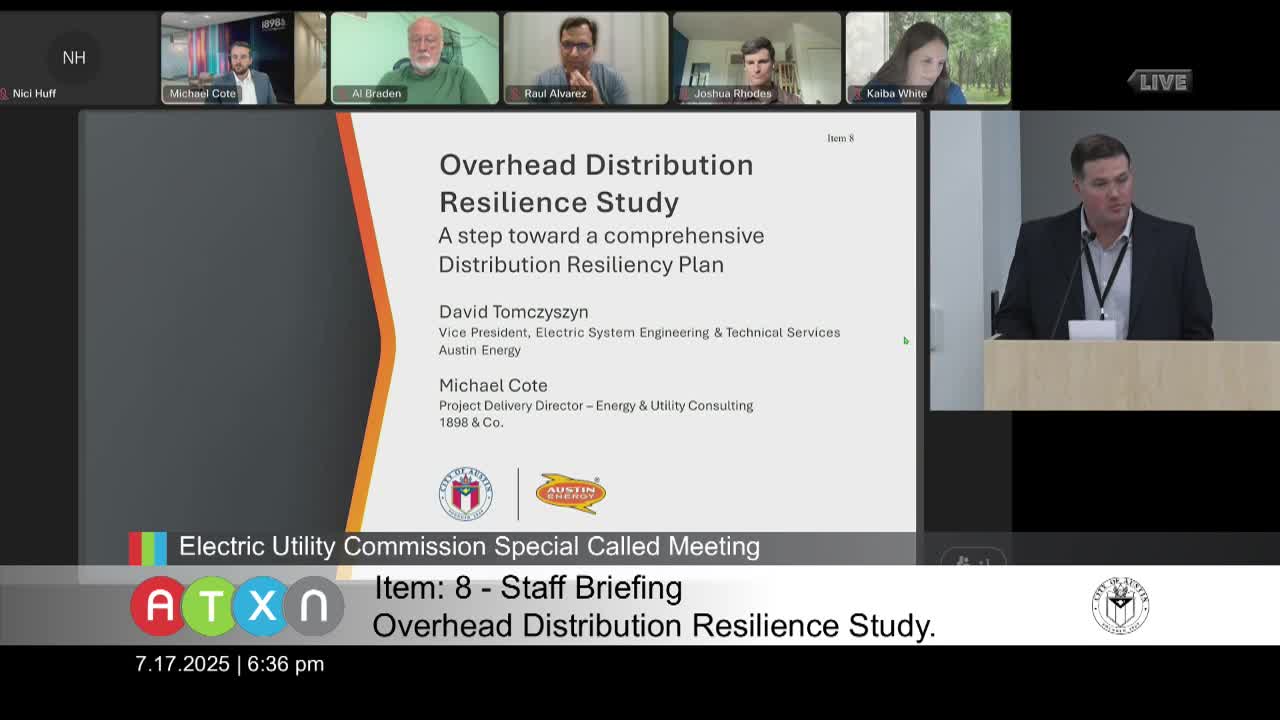
Austin Energy presents overhead distribution resiliency study; consultants recommend reclosers, automation and phased investments
Summary
Consultants for Austin Energy presented a year‑long study of the city’s 5,000 miles of overhead distribution lines on July 17, identifying device placements and a 24‑initiative future state to improve resilience faster and cheaper than full undergrounding.
Austin Energy staff and consultants on July 17 presented an overhead distribution resiliency study that examined the utility’s roughly 5,000 miles of overhead lines and produced a set of feeder‑level device recommendations and a prioritized list of resiliency initiatives.
David Tomcheson, vice president for electric system engineering and technical services at Austin Energy, and Michael Cody of 1898 & Company (the consulting arm of Burns & McDonnell) told the Electric Utility Commission the study was funded through a FEMA BRIC (Building Resilient Infrastructure and Communities) grant and took more than a year to complete. The study assessed system standards compliance, asset age, capacity limits, load‑shed capability and the hosting capacity for distributed energy resources.
Key findings and recommendations included: prioritizing replacement of legacy or high‑risk infrastructure (some assets are 40–50 years old); tracking 14 substations that are nearing operational limits; and expanding automation and sectionalization by deploying reclosers and feeder ties. The consultants said they identified specific deployment options — more than 600 mainline reclosers and more than 1,000 lateral reclosers — as candidate device placements to reduce outage sizes and speed restoration.
The report recommends a phased, parallel approach: take early “low‑hanging” actions for near‑term benefits while building a longer‑term, enterprise‑level resiliency program. The consultants also delivered 24 independent resiliency initiatives grouped into five themes: infrastructure resilience, data‑driven operations, grid connectivity, emergency readiness and operational excellence.
Tomcheson emphasized the study is an input to a broader distribution resiliency plan now being drafted. He said the study will allow a feeder‑by‑feeder comparison of overhead versus underground options; by contrast, a separate undergrounding study estimated the cost to put the remaining 5,000 overhead miles underground at about $50 billion and a build time measured in decades. Because the detailed study includes sensitive mapping of critical infrastructure and protection schemes, Austin Energy said only the executive summary will be made public at this stage.
Commissioners asked several implementation questions. One asked whether batteries had been assessed as a substation‑level resilience option; staff said the study focused on distribution feeder improvements but noted batteries, solar and other DERs are part of hosting‑capacity considerations. A commissioner asked whether advanced metering could be used to shed load at a more granular customer level; staff said that approach was not part of the study but that internal discussions are under way about additional sectionalization methods for load‑shed purposes.
Financial and timing questions: staff said some funding exists in the current and upcoming budgets and that the city’s five‑year capital improvement plan will increase resilience‑related spending over the next five years. In response to a commissioner, staff said they expect to present a draft distribution resiliency plan to council later this calendar year and will engage stakeholders beforehand. The commission voted to note the briefing; commissioners discussed placing the study on the August 11th agenda if the commission wants to make a formal recommendation before council consideration.
The study gives Austin Energy a detailed, device‑level menu for resilience investments that staff said will be used to prioritize work to improve reliability, reduce outage durations and increase the system’s ability to host distributed energy resources.