Get Full Government Meeting Transcripts, Videos, & Alerts Forever!
Get email alerts on the Downtown Vacancy topic
No spam. Unsubscribe anytime.
Commission discusses stronger tools for downtown vacancy; Leo's Building redevelopment advancing
Summary
Commissioners debated tools to address downtown vacancies — including vacancy registration, inspections, and limits on eminent domain — and received an update that the Leo's Building redevelopment is pursuing tax abatement and MEDC funding for an estimated $4.8 million private investment.
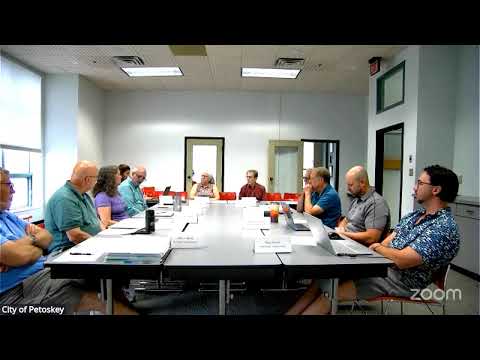
Commissioners at the Petoskey City Planning Commission meeting in July 2025 discussed a range of tools to address downtown vacancy and deteriorating buildings, including vacancy registration ordinances, inspection programs tied to fire safety, enforcement under the International Property Maintenance Code, and municipal financing options such as tax increment financing (TIF). Commissioners cautioned that eminent domain is limited to public‑purpose uses and is not a simple route for economic development.
Commissioner Charlie, who led much of the discussion, described eminent domain as “the ultimate tool” but noted that it requires a public purpose and funding to acquire and redevelop property. Other commissioners and staff cited the International Property Maintenance Code and local nuisance/blight enforcement as more common and practical enforcement tracks for derelict buildings. Commissioners discussed vacancy registration ordinances that require owners of vacant buildings to register annually and maintain glazing in windows, and they discussed fee levels as a compliance tool; the meeting referenced a possible $5,000 annual registration fee as an example used elsewhere.
The commission also received a project update on the Leo's Building redevelopment. Commissioners said the City Council held a public hearing and advanced consideration of an obsolete property tax abatement (OPA) for the project. The developer is pursuing historic rehabilitation tax credits and has applied to the Michigan Economic Development Corporation (MEDC) for additional funding. At the meeting a presenter said private investment for the project was approximately $4,800,000. The proposed program would include ground‑floor commercial space and upper‑floor residential units; the first floor will include restaurant use and the basement will contain ancillary space.
Commissioners urged members to research tools other municipalities use and to coordinate recommendations with the city manager and City Council as the council considers vacancy registration and nuisance code changes. No formal action was taken by the Planning Commission on downtown vacancy policy during this meeting.