Get Full Government Meeting Transcripts, Videos, & Alerts Forever!
Get email alerts on the School Health Telehealth topic
No spam. Unsubscribe anytime.
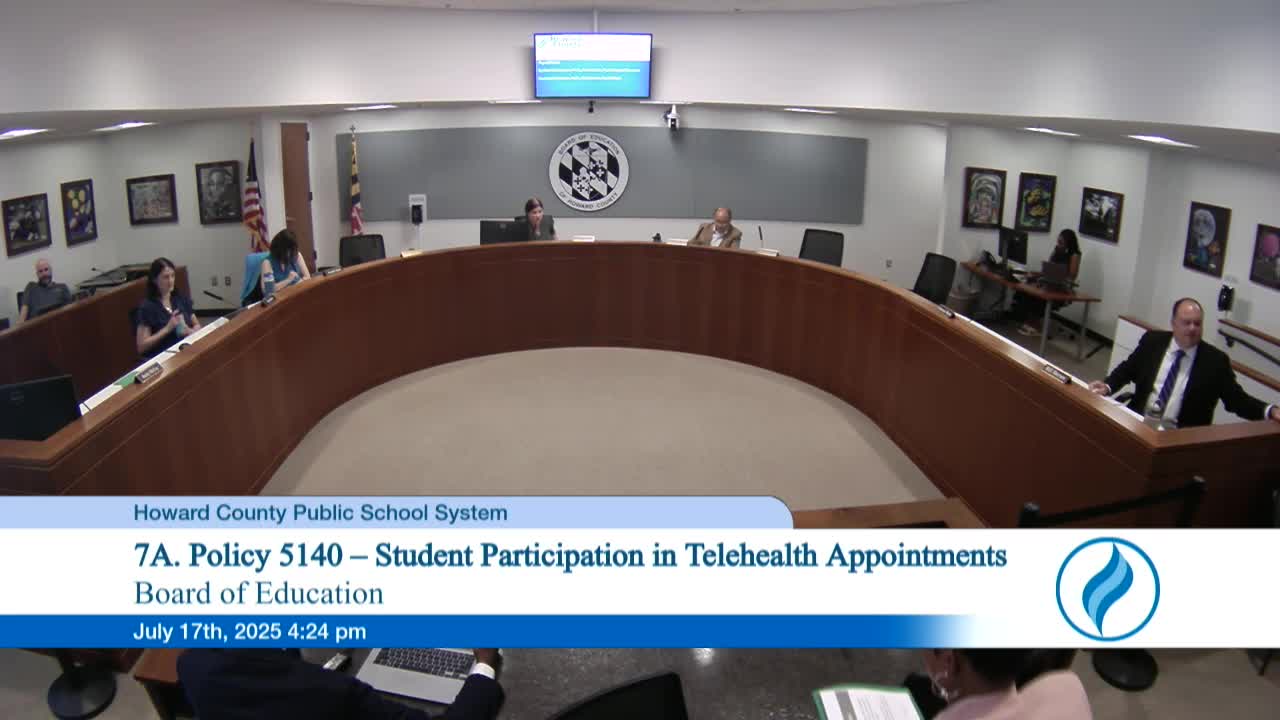
Howard County Board adopts policy allowing middle- and high-school telehealth visits during school day
Summary
The Board of Education approved Policy 51-40, establishing rules and an implementation manual for student telehealth appointments during the school day in middle and high schools, including requirements for private space, written parental consent and limits on initial weekly appointments.
The Board of Education of Howard County voted 7-0 on July 17 to adopt Policy 51-40, Student Participation in Telehealth Appointments, formally allowing middle and high school students to attend telehealth appointments during the school day under specified conditions.
The policy responds to House Bill 522 and requires written parental consent and a private, internet‑connected space at school for telehealth visits. Dr. Consuela Robinson, Coordinator of Social Work, told the board, "House bill 522 in Maryland mandates that public schools allow students to participate in telehealth appointments during the school day with specific requirements" and that the district must publish procedures and inform staff, parents and students.
Why it matters: supporters said telehealth access will allow students to get medical and behavioral-health care without missing class time; board members pressed staff on implementation details, such as staffing, locations and how many appointments each school can support during the initial rollout.
During a presentation, Cynthia Schollmeyer, Coordinator for Psychological Services, summarized core implementation features: parents must be present and sign written consent; school staff must secure a private location that has internet access; options for devices include a parent's device, the student's Chromebook or a Howard County Public School System device; and the manual will be posted in the student handbook and online.
Board members asked several operational questions. Dr. Chen asked whether schools have the staff and private rooms required; Schollmeyer said schools will be given guidance and suggested shared offices or spaces that are not dedicated 24/7, and that the district will initially offer about five telehealth appointments per school per week while the program is phased in. Schollmeyer said the telehealth procedures manual was "in progress" and would be ready "by the start of the year."
Concerns and follow-up: Board members asked that the manual include a required review schedule. Schollmeyer agreed and said she would add language recommending an annual review and that the manual be updated when the handbook is revised. The board also discussed who will be present for appointments (parents must attend) and reiterated that the program is separate from the district's nurse‑led telemedicine programs.
The motion to adopt Policy 51-40 passed on roll call: Miss Shambly, Miss Ricks, Miss Watts, Dr. Chen, Miss McCoy, Miss Mallow and Chair Moseley all voted yes.
What happens next: staff will finalize the telehealth procedures manual, post it to the district website and include it in the student handbook, and the system plans an initial rollout for the 2025–26 school year with limited appointments per school while they monitor implementation.