Get Full Government Meeting Transcripts, Videos, & Alerts Forever!
Get email alerts on the Tourism Marketing topic
No spam. Unsubscribe anytime.
Visit Lake County reports 2024 growth in web and marketing metrics; supervisors press for better booking data
Summary
Visit Lake County presented its 2024 Tourism Improvement District annual marketing report to the Lake County Board of Supervisors, detailing web, social and paid-marketing gains while supervisors pressed for clearer booking and return-on-investment data.
Visit Lake County presented its 2024 Tourism Improvement District (TID) annual marketing report to the Lake County Board of Supervisors, describing stronger website traffic, social engagement and programmatic partnerships while supervisors pressed the agency for clearer booking and tax-return-on-investment data.
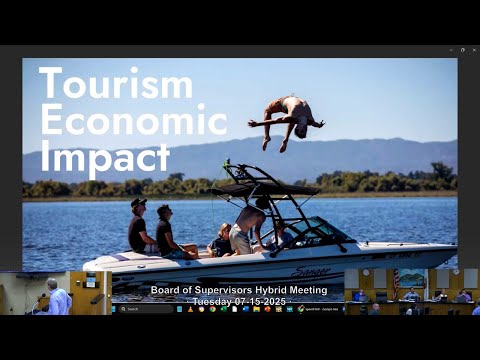
Bruno Fisher, presenting the Visit Lake County 2024 fiscal report, told the board the district recorded a “good, stable” year and has been “finding our groove” in understanding revenue sources and compliance. He cited a Visit California–funded Dean Runyon study showing the county’s 2024 travel-related spending at “a little over $200,000,000” and said the study links roughly 1,800 jobs in Lake County to tourism.
That economic picture frames why supervisors pressed the tourism agency on metrics that tie marketing to revenue. Supervisor Sabatier asked whether Book Direct, the booking-referral widget Visit Lake County uses, can report how many actual reservations flowed from its referrals. “Does bookings have the ability to, track data and provide that data of how many actual bookings occurred through their widget system?” Sabatier asked.
Fisher said Book Direct can provide detailed booking information when properties use compatible booking engines, but many Lake County lodging operators are “mom and pop” enterprises whose reservation systems do not integrate. Fisher told the board Book Direct generated 68,000 searches on the Visit Lake County site in 2024; about 9,860 clicks went from that widget to individual property websites, a figure Fisher summarized as delivering roughly 10,000 “live bodies to Lake County lodging establishments” in 2024.
County staff provided related finance figures at the meeting. Steven Carter, assistant county administrative officer, told the board that for fiscal 2024–25 gross transient occupancy tax (TOT) collections were “a little over 1,020,000.” Carter said about $323,000 of that went to the TID and that the county’s contract with the TID provides $112,500 to the district. Carter also reviewed recent annual TOT collections: roughly $930,000 in 2023–24, $975,000 in 2022–23 and about $1,030,000 in 2021–22.
Fisher walked the board through marketing performance and channels that Visit Lake County uses to drive visitation. Key metrics Fisher cited for 2024: - Website traffic: roughly 449,000 page views, 286,000 users and 327,000 sessions (a 24% year-over-year sessions increase). - Email newsletter and blog: about 17,000 contacts on the mailing list, an 89% year-over-year increase, with open rates near 30%. - Social media: Facebook followers around 36,000 (a 4% increase) and Instagram growth of about 14% year over year; Visit Lake County said it increased video content and organic reach. - Paid search and paid social: paid search produced about 570,000 impressions and 48,000 clicks; paid social impressions rose about 67% year over year.
Fisher described Book Direct as part of the Simpleview ecosystem and said Visit Lake County connects Book Direct reporting to Google Analytics 4 to improve data stability. He cautioned, however, that when visitors click out to a property’s own website Visit Lake County loses visibility into whether a booking is completed unless the lodging provider shares booking-engine data.
The presentation also described partnerships and earned media: the North of Ordinary regional partnership with Mendocino, Humboldt and Del Norte counties; trade-show activity (including a shared booth at a Santa Clara industry show and participation at Visit California events); and a fully ad-supported visitor magazine planned for distribution in-county and along Interstate 5.
Supervisors and public commenters suggested additional marketing priorities. Several supervisors urged more promotion of Lake Pillsbury and its visitor assets and recommended targeted campaigns for fishing tournaments, night-sky/ecotourism visitors and special-interest groups. Fisher and board members said Visit Lake County can pursue connections and asked staff to help identify on-the-ground partners for Lake Pillsbury outreach. Public commenter Elaine Brown proposed that some county support help larger local properties market themselves to conference and group business.
Board members discussed measurement and budget context. Supervisor Sabatier and others asked the county to track TOT trends to assess the TID’s return on investment; Carter confirmed the county will provide fiscal-year TOT figures and noted differences between calendar-year and fiscal-year presentations. Fisher said Visit Lake County will continue focusing on search and social channels, expand its video assets for partners, and make Book Direct and GA4 data more central to performance reporting.
No formal board action or vote was taken on the item; the presentation concluded with staff and board members agreeing to follow up on requests for (1) clearer booking data options and (2) contacts and campaign ideas to promote Lake Pillsbury and other targeted products.
Questions for follow-up listed during the meeting included how to collect reservation-level data from small lodging providers, whether outdoor billboards are affordable or effective given current rates, and how the TID can better demonstrate direct returns to the county’s general-fund and economic-development investments.