Get Full Government Meeting Transcripts, Videos, & Alerts Forever!
Get email alerts on the Police Discipline topic
No spam. Unsubscribe anytime.
Milwaukee officer suspended 15 days for integrity violation; commissioners also adopt 5‑day suspension for missed cell checks
Summary
At a July 2025 hearing, the Milwaukee Fire and Police Commission unanimously found Officer Andrew K. Stanton violated department integrity rules for falsely recording cell checks and adopted the chief's recommendation of a 15‑day unpaid suspension; the commission also adopted a stipulated 5‑day suspension for a separate competence violation.
The Milwaukee Fire and Police Commission at a July 2025 hearing unanimously found Milwaukee police Officer Andrew K. Stanton violated the department's integrity requirement for ‘‘forthright and candid’’ reporting and adopted the chief's recommendation of a 15‑day unpaid suspension; the commission also adopted a previously stipulated 5‑day unpaid suspension for a separate competence violation.
The findings stem from an internal investigation into Stanton's work as the district booker on the late shift on March 25, 2023. Investigators concluded Stanton documented 14 cell‑block checks that video evidence showed he did not perform and documented an additional four checks that did not meet the department standard of occurring no more than 15 minutes apart. A prisoner in custody that night, identified in the record as Stephen J. Briggs, reported two suicide attempts while in his cell, which drew investigators' attention to the cell‑check records and video.
Assistant City Attorney Cynthia Harris Ortega, representing the chief, summarized the charges in an opening statement: "Officer Andrew Stanton...failed to make timely checks of the prisoner cells, and then he untruthfully filled out the cell check form indicating that he had completed these cell checks." Ortega told the panel the department would present video, the cell‑check forms and testimony showing the discrepancies.
Why it matters: cell‑block checks and truthful reporting are governed by department guidance and by state oversight of municipal lockups. Captain Liam Looney, who commands Internal Affairs, told commissioners the Department of Corrections municipal‑lockup rule (referred to in testimony as DOC 349) requires retained cell‑block cards showing times and initials and that the department can be audited on those records. "Not only is it important, it's mandated by state law," Looney said in his testimony.
Evidence and testimony: Investigator Lieutenant Derek Kitts said he created a time‑matched chart comparing the times printed on Stanton's daily cell‑block card with timestamps from booking‑area video. Kitts testified he found multiple entries on the form that did not align with the video and that some intervals between documented checks exceeded the 15‑minute standard. Kitts said he observed footage consistent with Stanton not performing a check at some recorded times and, at other times, Stanton appearing to be occupied with booking tasks or, as Kitts described, watching a program on his computer.
Sergeant Raymond Hewitt, who conducted a PI‑21 interview of Stanton based on Kitts' questions and materials, said Stanton agreed the cell‑block card and his initials on it matched the department form and that Stanton acknowledged the SOP violation related to failing to do timely checks but denied intentionally falsifying the card. Hewitt said Stanton "acknowledged to the SOP violation" but denied intentional falsification.
Stanton's account: Stanton, appearing pro se, told the commission he came to work sick that night and said he "did not" complete the checks required by SOP. He acknowledged that, "in that context, yes. It's untruthful," when asked whether writing times he had not actually done amounted to being untruthful. Stanton repeatedly said he did not intend to deceive and described his failures as errors caused by illness, forgetfulness and the operational difficulty of booking while also attempting scheduled cell checks.
Charges and legal framework: The parties stipulated that Stanton performed the duties of a district booker that night and that the relevant department requirement required five checks per hour no more than 15 minutes apart (cited in testimony as SOP 090.45(g)(3)). The charges presented and adopted were (1) a competence violation referencing guiding principle 1.05 and SOP 090.45(g)(3) — for which the parties stipulated a recommended 5‑day suspension without pay — and (2) an integrity violation referencing guiding principle 3.1(o) ("All department members shall be forthright and candid orally or in writing in connection with any administrative inquiry or report") — for which the chief recommended, and the commission adopted, a 15‑day suspension without pay. Testimony also referenced Wisconsin statute language cited by counsel during the hearing regarding appeal rights and hearing phases.
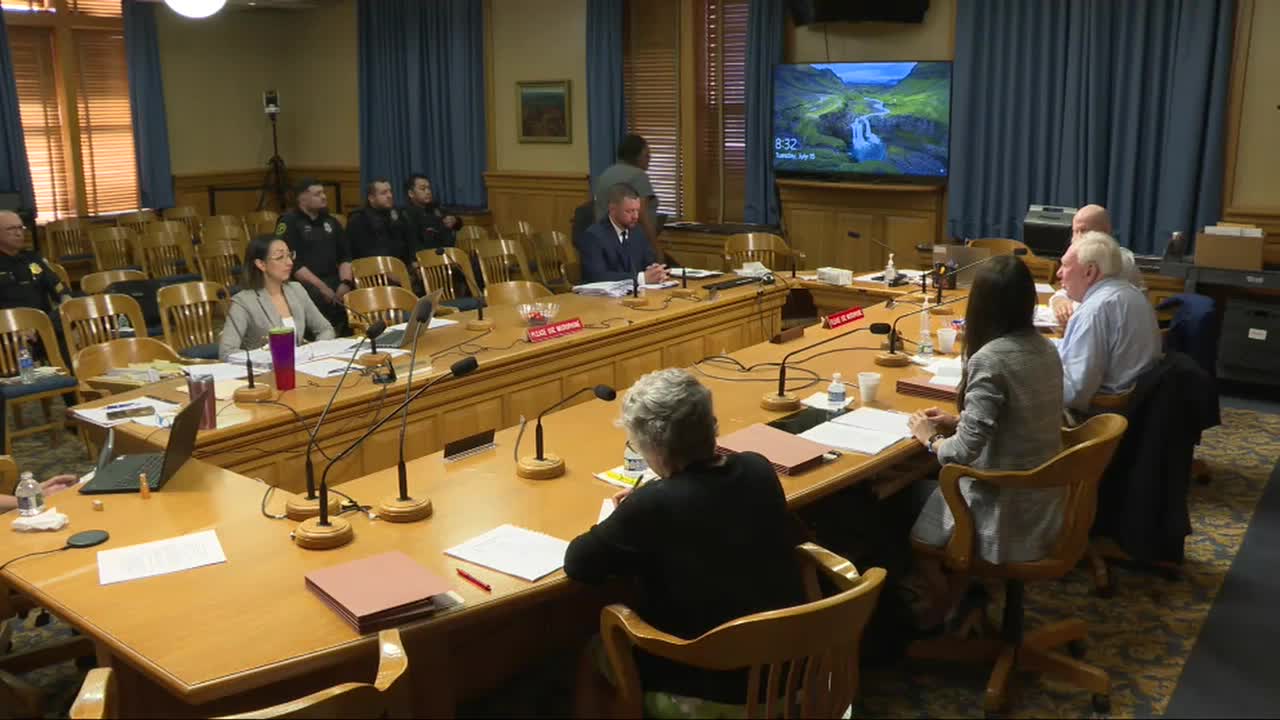
Commission decision and sanctions: After receiving stipulated exhibits and hearing testimony, the commissioners — identified in the record as Chairperson Miriam, Commissioner Chrissy Fung and Commissioner Christopher Schneider — retired to closed session and returned with a unanimous decision. The panel adopted the parties' stipulation on the competence charge and the chief's discipline recommendation of a 5‑day suspension for that offense. On the integrity charge the panel found a violation of guiding principle 3.1(o) and adopted the chief's recommended 15‑day unpaid suspension; the commissioners also waived a phase‑2 proceeding per the parties' stipulation. Hearing Examiner Dennis Maroney, reading the outcome into the record, said, "Thank God that nothing more serious happened to that prisoner."
What the record shows and what it does not: The commission record contains investigator charts, the booking‑area video review, the daily cell‑block card filled out by Stanton, and the PI‑21 interview transcript. The parties stipulated to admission of exhibits 1–27. The record reflects Stanton's training as a booker (training records shown in the hearing indicate a 16‑hour booker training on Sept. 14–15, 2021) and the department's training slides that state cell checks must not exceed 15 minutes and that bookers should visually verify breathing and suspend booking to make required checks.
The commission did not address any appeal in open session and did not take further disciplinary steps beyond the two adopted suspensions at that hearing; the stipulation and the commissioners' decision ended the proceeding as to the matters before them.
Ending: The hearing concluded with the commission announcing the adopted suspensions and the matter recorded as complete. The transcript reflects the panel's unanimous vote and the stipulation that eliminated the need for a separate phase‑2 proceeding.