Get Full Government Meeting Transcripts, Videos, & Alerts Forever!
Get email alerts on the Social Services 211 topic
No spam. Unsubscribe anytime.
211info director outlines services, access routes and data tools for Clark County residents
Summary
Kara Kangas, director of partnerships for 211info, told the Clark County Community Action Advisory Board on July 2 that the nonprofit operates a live, human-staffed resource and referral line that connects callers to local services across Southwest Washington and Oregon.
Kara Kangas, director of partnerships for 211info, told the Clark County Community Action Advisory Board on July 2 that the nonprofit operates a live, human-staffed resource and referral line that connects callers to local services across Southwest Washington and Oregon.
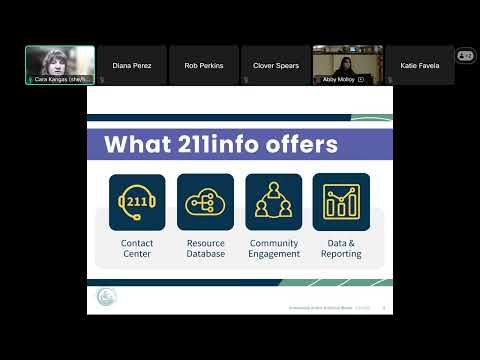
"I use she/her pronouns. I'm the director of partnerships with 211info," Kangas said, and described the organization as an "independent private nonprofit" that became an official 2-1-1 affiliate in 2004. She said the affiliate now lists over 2,500 agencies across a roughly 40-county service region and maintains a resource database that is updated daily.
Kangas said 211info is reachable by dialing 211, texting a ZIP code to 898211, emailing, using a mobile app or the website search tool at 211info.org. In Southwest Washington the center is open Monday–Friday, 8 a.m. to 6 p.m.; texting and email are also offered in English and Spanish. Kangas said the contact center uses trained staff (60–90 days of training) and three interpreter lines with access to more than 240 languages; roughly 40 percent of staff are bilingual or multilingual.
Why it matters: Board members said they want local data for planning and program applications. Kangas noted a publicly available data dashboard on 211info.org that can be filtered by county and ZIP code and that staff can produce custom reports for funders or partners.
Details and examples
- Service types: Kangas listed housing and rent assistance, food access, health care and maternal/child health referrals, childcare referrals (through Oregon partnerships), SNAP and public benefits navigation, and disaster or public-health FAQs during emergencies. She said some programs (for example, foster-parent supports and coordinated entry for homelessness) operate as 24/7 or extended-hour services in partnership with counties or statewide systems when funded to do so.
- Data and reporting: Kangas said the website includes a live data dashboard where users can view top-requested needs, met vs. unmet needs and optional demographic data collected during contacts. She said callers are asked 15–20 optional demographic questions and that location (ZIP or cross-streets) is the primary required field to provide geographically appropriate referrals.
Board Q&A
- Diana Perez (City Councilor, City of Vancouver) asked whether 211 still answered Council for the Homeless after-hours calls; Kangas said that contract ended about three years ago. Perez also asked how 211 manages differences between Washington and Oregon laws; Kangas said staff refer callers to the appropriate state or local legal or municipal resources and make clear that 211 provides information and referrals rather than legal advice.
- Board members asked whether the dashboard and underlying tables are publicly available; Kangas confirmed the data dashboard is on 211info.org and said June 2025 data were live. She said dashboard views and underlying tables can be shared as images, PDFs or links and that custom reports can be produced on request.
Ending
Kangas invited board members and providers to contact her for outreach, data requests or provider updates; she provided contact details and a QR code for feedback. The presentation concluded with board members thanking Kangas and noting the value of 211 data for funding and planning.