Get Full Government Meeting Transcripts, Videos, & Alerts Forever!
Get email alerts on the Zoning Text Amendments topic
No spam. Unsubscribe anytime.
Planning commission endorses zoning text amendments to ease ADU occupancy rules and reduce special-use permits
Summary
The Fairfax City Planning Commission unanimously recommended city council approve a package of zoning text amendments aimed at removing age/disability occupancy limits for accessory dwelling units, setting size thresholds that remove some businesses from special-use permit requirements, and separating veterinary and boarding uses.
The Fairfax City Planning Commission on Monday recommended that the City Council approve a package of zoning text amendments to the City Code (Chapter 110) that change accessory dwelling unit (ADU) occupancy rules, narrow the scope of several special-use permit categories, and make a range of clarifying edits to zoning definitions and procedures.
The amendments would remove the ordinance language that requires either the main house or the accessory dwelling unit to be occupied by someone age 55 or older or by a person with a disability; keep the existing owner-occupancy requirement for ADUs; correct an outdated reference from “family” to “household” in the ADU overcrowding measure; and adjust how occupancy is measured for purposes of determining overcrowding. Planning staff said the ADU occupancy edit is intended as a relatively minor regulatory change that does not alter physical ADU design standards.
Commissioners were also asked to consider three related groups of special-use permit changes: (1) reclassifying smaller indoor recreation uses (small gyms, day spas, small fitness studios) as personal service uses rather than “indoor recreation” when under a 30,000-square-foot threshold; (2) reclassifying smaller medical care uses as medical offices rather than medical care facilities when under a 10,000-square-foot threshold (to avoid subjecting typical urgent-care and similar small clinics to a special-use public hearing); and (3) splitting “animal care facilities” into two separate defined uses so veterinary clinics (lower intensity) would generally be permitted in more commercial and industrial zones while animal boarding/kennels (higher intensity, dog boarding) would remain a special use in the more intensive commercial zones.
Planning staff presented multiple supporting refinements included in the draft: updates to animal-care use standards carried forward from common special-use conditions (sound mitigation, animal waste control, ventilation for multi-tenant buildings), a requirement that outdoor exercise areas for kenneled animals be 300 feet from the nearest residence and be usable between 8 a.m. and 8 p.m., and clarifying edits to restaurant and donation-container language. Staff also said the revisions standardize terms and fix cross-references and public notice timelines to match recent state law changes.
During the public-comment portion of the hearing, George Mason University student Evan Ramey of 5722 Crowley Court told commissioners he supported removing the age and disability occupancy restrictions so younger residents and students could rent ADUs. “I personally really love the idea of being able to rent out an ADU… I really hope that you’ll pass this forward to City Council,” Ramey said.
Commissioners asked staff clarifying questions about several pieces of the package. Commissioner Rice questioned the 30,000-square-foot cut-off for indoor recreation, calling it “still pretty big,” and staff explained the threshold aligns with the city’s existing “large-format retail” cutoff and was selected after reviewing local examples. On medical care, one commissioner described the drafting as potentially circular because defined terms such as “medical office” and “medical care facility” are referenced repeatedly; staff said the intent was to preserve special-use review for larger urgent-care or surgical centers while allowing typical small urgent-care or office-type clinics to proceed without a special-use hearing.
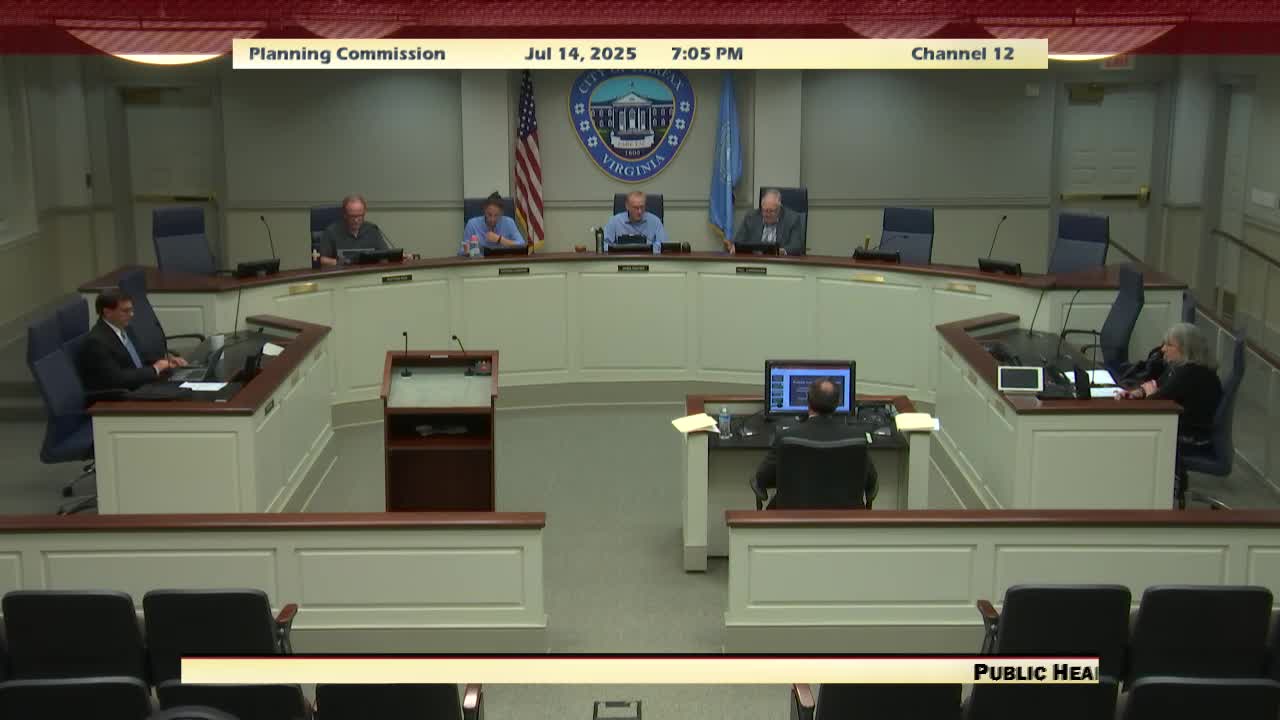
After discussion, a commissioner moved and another seconded that the commission recommend approval of the proposed ordinance amendments to Chapter 110 (Zoning). The planning commission voted unanimously to forward the package to the City Council for public hearing on July 22.
The ordinance as drafted preserves the owner-occupancy requirement for ADUs, removes the age/disability occupancy condition, sets the indoor recreation threshold at 30,000 square feet and the medical-care threshold at 10,000 square feet, and separates veterinary clinics from animal boarding in the use table and use interpretations. Staff said other routine fixes and clarifications are included in the packet: simplified restaurant use language, a consistent definition for donation drop-off containers, corrections to tree-permit references, and updates to public-notice timelines to reflect recent state legislation.
City Council will hold its public hearing on the amendments at the July 22 meeting. Planning staff told the commission the ADU work is part of a broader staff review; staff expects a community meeting in the fall to consider detached ADUs and other ADU topics that are outside the limited occupancy change approved tonight.