Get Full Government Meeting Transcripts, Videos, & Alerts Forever!
Get email alerts on the Opioid Abatement topic
No spam. Unsubscribe anytime.
Daviess County fiscal court creates separate opioid-abatement fund, asks for coordinated spending plan
Summary
Daviess County Fiscal Court approved creation of a new opioid abatement settlement fund (Fund 74), moved roughly $1.46 million into it and asked staff to develop coordinated spending plans that comply with state rules and county legal review.
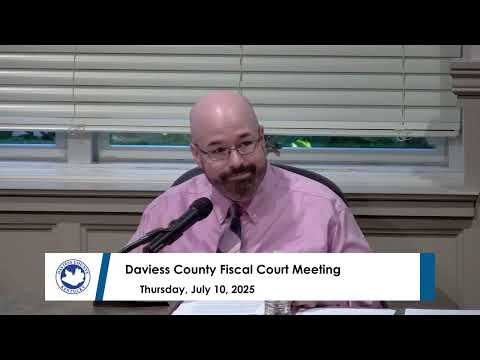
Daviess County Fiscal Court on July 10 approved creation of a new, separately accounted opioid abatement settlement fund and transferred existing settlement proceeds into the new Fund 74 while asking staff and commissioners to develop a coordinated spending plan.
County Treasurer Mr. Johnson told the court the separation is required by state local finance officers and that the county will move the current balance of opioid settlement funds — $1,464,951.45 — into Fund 74 as part of preparing the 2025–26 budget. "The current balance of the settlement funds in the amount of $1,464,951.45 will be moved to fund 74," Mr. Johnson said.
The move also includes an internal budget adjustment, Mr. Johnson said: the 2025–26 general fund will be reduced by $1,500,000 and the new opioid abatement settlement fund will increase by $1,500,000; the county's total budget figure remains unchanged at $110,219,400. Mr. Johnson said the Office of the State Auditor of Public Accounts and the Department for Local Government reviewed the county's documentation and "see no issues." He recommended approval.
Why it matters: opioid settlement dollars are restricted by state guidance and typically must be used for abatement and related services. Commissioners pressed for clarity on eligible uses and for a plan to ensure the money is applied effectively in Daviess County.
Commissioner Conner said the county should define allowable uses and coordinate with the city: "The opioid settlement funds are monies that were basically awarded to the state of Kentucky, by Big Pharma ... I have done the same. And so the funds, hopefully, we can do this in combination with the city." Commissioner Conner asked the county to define permissible uses and to put spending plans in place.
Treasurer Mr. Johnson cited state guidance on eligible uses during the meeting: "KRS 15 2 91 details various approved uses of the money, all of which are directly related to opioid abatement. Any proposed expenditure that's not detailed in that statute requires the review and approval of the county attorney," he said, adding that the Department for Local Government and the State Auditor had reviewed the county's proposed budget adjustments.
Commissioner Marksberry said local partners are developing options and that the county is already coordinating with a local drug-steering committee and other stakeholders to identify programs. "I really hope that we can use this money to help the people that have suffered the loss from this," Marksberry said.
No specific projects or line-item expenditures were approved at the July 10 meeting; the court approved creation of the fund, the transfer of existing settlement dollars into Fund 74 and a series of budget transfers to reflect the new fund. The court directed staff to continue developing plans and to ensure county attorney review of proposed uses, as recommended by state officials.
Ending: The court approved the fund-creation and cash transfers by voice vote. Commissioners signaled interest in a coordinated, vetted spending plan and continued work with the drug-steering committee and city partners before disbursing funds.