Get Full Government Meeting Transcripts, Videos, & Alerts Forever!
Get email alerts on the Police Oversight topic
No spam. Unsubscribe anytime.
Office of Police Oversight briefs Mayor’s Committee on investigations, training and community outreach
Summary
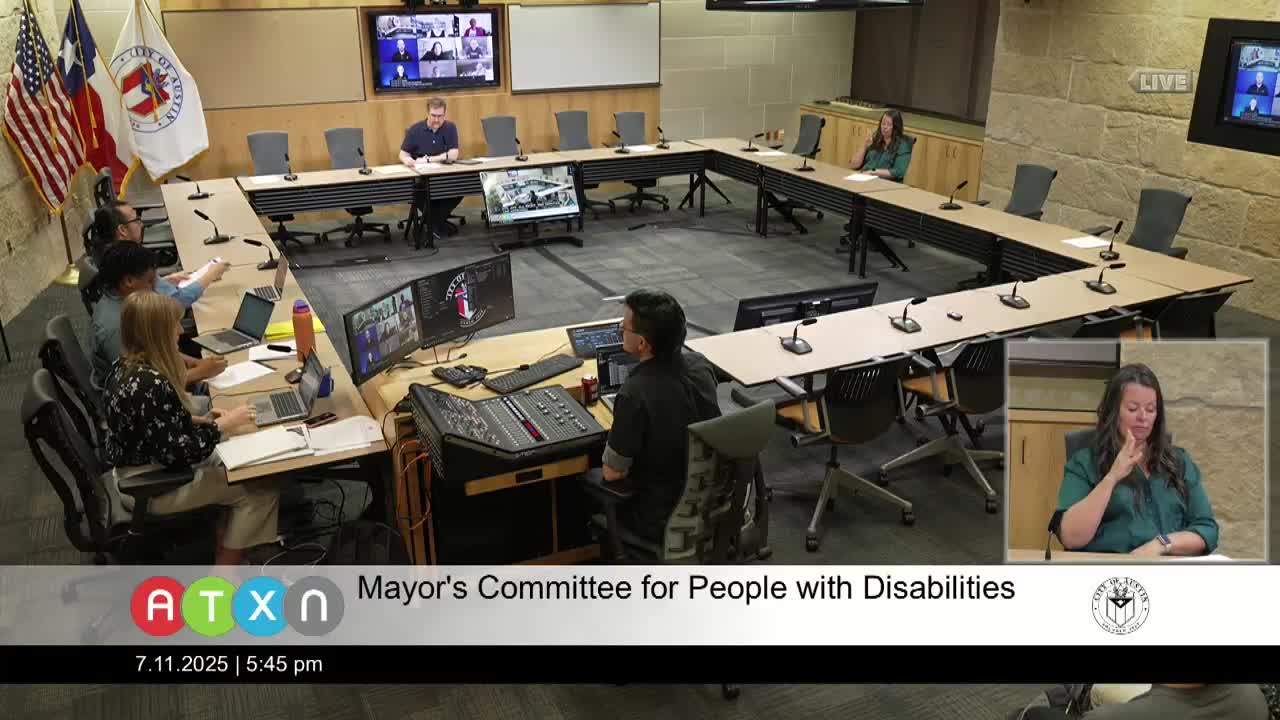
The Office of Police Oversight told the Mayor’s Committee for People with Disabilities on July 11 that it is publishing complaint records, has independent investigative authority under the Austin Police Oversight Act (May 2023) and is working with the Austin Police Department on academy curriculum updates and community-facing events.
The Office of Police Oversight on July 11 told the Mayor’s Committee for People with Disabilities that it has expanded investigative access, is publishing complaint records and is working with the Austin Police Department (APD) to revise academy training and outreach.
Cooper Thompson, a community engagement specialist with the Office of Police Oversight (OPO), told the committee the office’s mission is “to provide impartial oversight of the Austin Police Department’s conduct, practices, and policies in order to enhance accountability, inform the public to increase transparency, and create sustainable partnerships throughout the community.”
Why it matters: Committee members pressed OPO staff about whether people with disabilities are represented in complaint data and how training and policy recommendations reach APD officers. The committee’s members said better data and training could reduce harmful encounters involving people with disabilities.
OPO structure and authority OPO staff described three core divisions: complaints and investigations, policy and research, and community engagement and communications. Thompson said the complaints division walks community members through filing a complaint, conducts administrative investigations when requested and issues disciplinary recommendations. He said the Policy and Research Division issues policy recommendations on APD general orders and training curricula and produces reports on traffic stops and use of force.
Sarah Peralta, OPO staff in the policy and research area, said the office has started to publish complaints publicly. “When we publish complaints you can see the body of the complaint as submitted by the committee member,” Peralta said, noting some published complaints involve service animals, wheelchair access and other access concerns experienced by people with disabilities.
Committee questions and follow-up requests Committee members asked whether OPO tracks the share of complaints filed by people with disabilities. Thompson said the complaint form includes optional demographic questions but that the data are only as complete as community members who choose to provide them. He offered to consult the complaints division and follow up with the committee on any analysis of complaint demographics.
Members also asked about OPO’s authority to train officers directly. Thompson and Peralta said OPO’s authority is recommendation-based: the office can investigate and recommend discipline or policy changes but does not itself impose discipline. Peralta described recent work in which OPO helped develop a class, taught at the APD Academy, on the history of racism in policing — a curriculum developed with the Office of Equity and Inclusion and subject-matter experts at the University of Texas.
Training and curriculum work Peralta said OPO’s recommendations for academy curriculum revisions include centering modules around the lived experience of people with disabilities, expanding engagement of subject-matter experts and reviewing one module at a time. She named the module on deaf and hard-of-hearing people as an early recommendation and said recent recommendations addressed search-and-seizure topics. Peralta said detailed recommendation documents are published on OPO’s website and offered to follow up with links for the committee.
Community outreach and events Thompson invited committee members to an OPO open house at the Central Library (10 a.m.–2 p.m. the week after the meeting), saying staff will be available to explain the complaints process, policy work and community engagement, and that Spanish and ASL interpretation will be provided for the event.
What the committee asked staff to do Committee members requested follow-up on whether OPO runs formal analyses comparing complaint demographics to community disability prevalence and asked the office to return with that information. Members also requested notification when OPO next reviews a chapter of APD academy curriculum that relates to disabilities.
Ending OPO staff said they will provide requested follow-ups, including links to published recommendations and any available demographic analyses. Thompson and Peralta thanked the committee for the opportunity to present and for prior collaboration, including a Town Hall for People with Disabilities that informed OPO’s recommendations.