Get Full Government Meeting Transcripts, Videos, & Alerts Forever!
Get email alerts on the Arts And Technology topic
No spam. Unsubscribe anytime.
Lackawanna County panel stresses tools, training and ethics as arts meet AI and other technologies
Summary
A panel hosted by Lackawanna County Arts & Culture on Oct. 26 brought local artists, educators and entrepreneurs together to discuss how technology — from pro‑editing apps to AI — is changing creative practice and what supports nonprofit and freelance creators need.
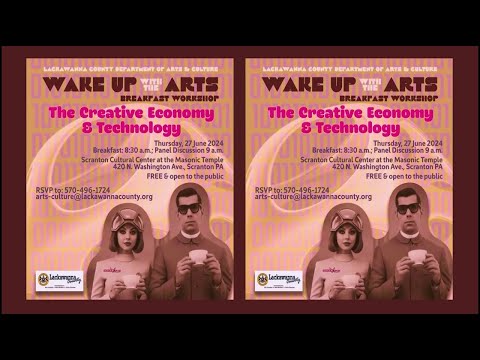
Lackawanna County’s Arts & Culture department convened a panel discussion on arts and technology on Oct. 26, focusing on how digital tools and artificial intelligence are changing creative practice and what training and resources local artists and small arts organizations need.
The event opened with Maureen McGuigan, director of arts and culture for Lackawanna County, introducing the program and thanking organizers, volunteers and musicians. Don Webster, director of Techbridge and the session moderator, asked attendees to participate and said, “By choosing to be here, what I'm gonna ask you to do is to participate.”
Why it matters: panelists and audience members described a rapid shift in how art is produced, shared and funded. Speakers framed technology as both a productivity aid and a potential threat to traditional practice; they urged practical training, clearer nonprofit tech supports and attention to ethical and economic implications of AI in creative work.
Panelists described specific tools, recommended entry points for learners and several persistent concerns. Cole Goldstein, director of mechatronics at Johnson College, said mechatronics and digital fabrication (CNC, 3‑D printing, CAD) “enhance the abilities that I have and make me into more of a production house than I could ever be by myself.” Joey Zarcone, vice president of Posture Interactive, and Britney Takata, executive creative director at Market Share Consulting, urged artists not to fear new tools. Zarcone said video “is performing the best right now” on social platforms and encouraged creators to tailor content to platform audiences.
Several panelists and audience members addressed AI directly. Panelists described three distinct uses: (1) tools that speed routine work (for example, image or layout adjustments), (2) assistive uses that help creators with disabilities or time constraints, and (3) fully generated compositions that raise ethical and market questions. Theresa O’Connor, director of the APHA Gallery, asked how AI affects creators’ time and livelihoods; panelists replied that outcomes depend on how AI is used and on market and institutional responses.
Workshop‑style recommendations and specific tools were frequent. Panelists and attendees recommended beginner tools for young users (Procreate for drawing, Flipaclip for frame‑by‑frame animation, Canva for simple layouts, Tinkercad for basic 3‑D modeling), project and workflow tools (Asana, Google Drive/G Suite, Miro, Gantt charts) and business tools for freelancers (HoneyBook, Wave, Rocket Money). Several speakers described using ChatGPT for brainstorming, drafting emails and quick research. County IT staff and others pointed attendees to nonprofit discounts via TechSoup and Microsoft for Nonprofits for discounted or free Microsoft 365 services.
Questions from the audience highlighted needs beyond software: arts educators asked how to teach foundational studio skills alongside digital fluency; parents and teachers asked for practical entry points for children; and arts administrators asked how funders and local government can balance support for traditional, process‑based practice with demand for digital production and social media reach. Multiple panelists said exposure and foundational training (color theory, composition, process) remain important even as tools change.
Panelists also raised social and ethical issues. Several speakers compared the AI moment to earlier technological inflection points (photography, electricity), noting that the cultural reassessment of tools can take decades. They urged arts organizations and educators to teach critical media literacy and to discuss how platforms’ algorithms affect perception and distribution. Mike Brown, Lackawanna County’s IT director, advised organizations to attend to cybersecurity when adopting new tools.
Closing and next steps: organizers said they plan follow‑up programming, including workshops and training sessions on practical tools and on ethical questions around AI. Maureen McGuigan and Don Webster discussed future creative‑entrepreneurship events to continue hands‑on training and networking.
The session included about 20 speakers and a wide range of audience questions; organizers encouraged attendees to follow the county’s Arts & Culture social channels for event materials and future workshops.