Get Full Government Meeting Transcripts, Videos, & Alerts Forever!
Get email alerts on the Animal Control topic
No spam. Unsubscribe anytime.
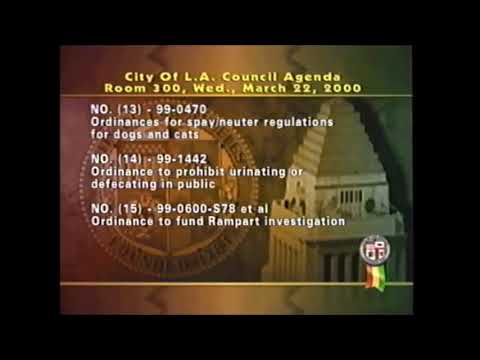
City Council gives initial approval to tougher spay-and-neuter rules after hours of testimony
Summary
After more than two hours of public testimony and a lengthy council debate, the Los Angeles City Council approved on first reading amendments to the city—reeders-permit and dog-licensing ordinances that raise fees and add enforcement steps intended to increase spay-and-neuter rates. A proposed sunset amendment failed.
The Los Angeles City Council voted 10-3 on first reading Tuesday to approve amendments to two existing local animal-control ordinances that raise fees for unaltered pets and for breeder permits and add staged civil penalties meant to drive compliance.
The council ction came after a lengthy public hearing in which dozens of speakers, including animal-welfare groups, veterinarians and breeder organizations, addressed the chamber. Pam Wilkinson, who identified herself as a 20-year Los Angeles resident, told the council she collected signatures across the city and said residents see "a public safety hazard" from unsterilized animals and support the ordinance. "They want the city to go to the source of the problem, which is spay and neuter," Wilkinson said.
The measure amends the city—reeders-permit law (identified in the discussion as section 53.15.2) and the city og-licensing provisions. The city epartment and commission package raised the annual dog license for an unaltered animal to $100 and proposed a $100 breeders permit for those breeding for sale. Officials described the fee as a "threshold" intended to make the one-time cost of sterilization comparatively cheaper for most owners. Dan Knapp, general manager of the Animal Regulation Department, summarized the commission's position: the changes "are designed to, first of all, encourage individuals to spay neuter their dog or cat" and to replace misdemeanor penalties with remedial, civil steps that include warnings, educational materials and a graduated fine schedule.
Why it matters: supporters, including council members and several animal-welfare organizations, said the city faces a public-safety and public-health crisis tied to stray and unowned animals, high euthanasia rates and frequent dog bites to children. Opponents—rom breeder and kennel organizations argued the ordinance would punish responsible hobby and professional breeders, that other jurisdictions had failed with similar differentials and that the proposal could drive breeding underground or out of the city. The City Council and staff tied adoption of the ordinance to a package of services and enforcement: mobile spay-and-neuter clinics promised by nonprofit partners, increased canvassing for dog licenses and additional enforcement officers funded in the budget.
Public testimony: Speakers in support included Susan Taylor, executive director of Actors and Others for Animals, who pledged $50,000 in additional spay/neuter subsidies if the city adopted a "tougher spay neuter policy," and the Amanda Foundation president Terry Austin, who said the foundation regularly rescues animals and sees many purebreds in shelters. Opponents included Charles Olber and representatives of the Cat Fanciers Association and the Kennel Club of Beverly Hills; they argued the ordinance could penalize responsible breeders and owners and urged expanded free spay/neuter services before imposing permits and fees.
Council debate and amendments: Councilmember Cindy Misakowski, chair of the Public Safety committee, moved the communication recommending adoption. Several council members emphasized the ordinance is one component of a broader strategy that must include education, subsidies, and enforcement. A motion to add a sunset clause (amendment 13a) to have the ordinance expire on June 30, 2003 unless reenacted was defeated 6-7. After that failed amendment, the ordinance itself passed first reading 10-3. Councilmembers who spoke in favor framed the measure as a targeted incentive to reduce the flow of animals into shelters and to lower bite and euthanasia rates; several said the commission had conditioned the ordinance on spay/neuter subsidies and enforcement capacity.
What the ordinance does (as stated in council debate and the department presentation): the package (1) raises licensing/permit fees for unaltered animals (the package cited a $100 threshold fee for unaltered licenses and a $100 breeders permit), (2) changes penalties from misdemeanor to a staged remedial enforcement model (warnings and education, a 45-day compliance window, then civil penalties capped at $500 before misdemeanor prosecution), (3) clarifies that outdoor unaltered cats must be altered or kept indoors, and (4) routes civil penalties into a spay/neuter trust fund to support subsidies and mobile clinics. Dan Knapp said the department will provide booklets and multilingual outreach to owners and give a 45-day and then a 15-day notice before assessing civil penalties.
Next steps: The council approved the ordinance on first reading; it will return for a second reading and final adoption at the council—all in one week. Members repeatedly urged budget augmentations and follow-up reports to ensure the enforcement, subsidy and canvassing programs are in place alongside the ordinance.
Quote: "The $100 fee was chosen as a threshold simply because you can get the majority of surgeries under that cost," Knapp said, describing the commission's rationale for the fee.
Ending: Council members and the department said they expect the measure to be accompanied by mobile spay/neuter vans and subsidy programs run by nonprofit partners; the council also directed the department to report back on results and implementation planning as the item returns for second reading.