
City Council approves funding for Police Commission and inspector general to follow up on Rampart Board of Inquiry
Get AI-powered insights, summaries, and transcripts
Subscribe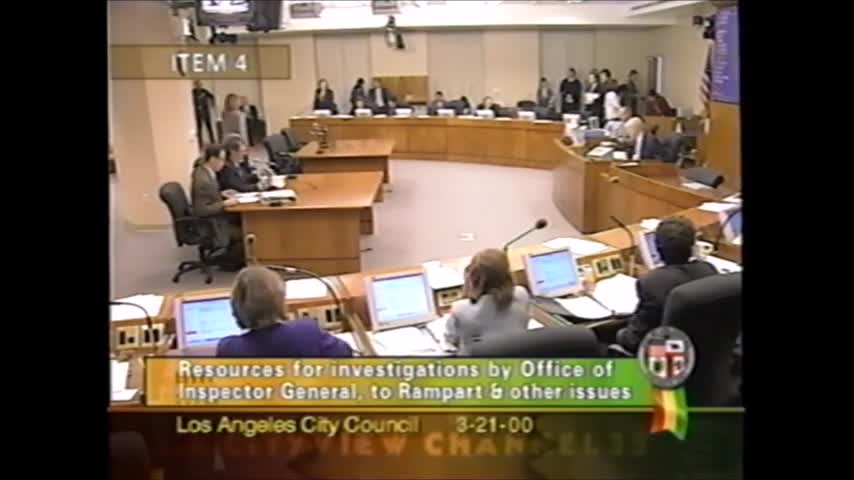
Summary
The Los Angeles City Council approved a measure to provide resources to the Police Commission and the Office of the Inspector General to conduct a broad review and follow-up work related to the Rampart Board of Inquiry report, amid debate about independence, overlaps with criminal investigations and personnel screening practices.
The Los Angeles City Council voted to approve funding and staff resources for the Police Commission and the Office of the Inspector General to carry out a broad review and follow-up to the Rampart Board of Inquiry report, passing the committee recommendation by roll call (14 ayes).
The commission and inspector general presented a scope of work to the council that extends beyond the board of inquiry’s management audit to examine hiring and background screening, internal affairs and disciplinary systems, informant and search-warrant practices, officer-involved-shooting reviews, specialized unit oversight, and personnel-tracking systems. The Police Commission said it would seek outside expertise and pro bono assistance where needed and expects additional resource requests as the work continues.
Why it matters: the council’s vote authorizes the civilian oversight bodies to expand their staff and investigative work following findings in the Rampart Board of Inquiry report. Council members and outside observers said the effort is intended to identify operational and structural changes aimed at preventing a reoccurrence of the failures the report described.
Council discussion focused on three recurring concerns: whether the commission’s and inspector general’s work will be sufficiently independent from the police department and from ongoing criminal and federal inquiries; how civilian and personnel offices should share sensitive candidate background information; and whether expanded resources will be adequate and properly targeted. Some council members urged caution to avoid jeopardizing active criminal investigations; others pressed for rapid action and ongoing funding to ensure the oversight offices can complete the scope of work they outlined.
Police Commission presenters described the planned review as comprehensive. The written and verbal briefing distributed to the council listed dozens of workstreams including: statewide and departmental improvements to testing and psychological screening of candidates; consideration of polygraph and financial checks; development of personnel-tracking databases; creation or expansion of public-integrity and anti-corruption units; review of internal affairs and discipline processes (including whether greater civilian participation is appropriate); and changes in how officer-involved-shooting investigations are staffed and handled. The commission also recommended seeking a state law change to obtain more complete criminal-history records when necessary for hiring decisions.
Commander Betty Kalipas (personnel group) told the council that background and nonselect hiring processes are complicated and that some operational choices previously made reflected limited options in certifying classes and managing large applicant pools. She said the issues are complex and that personnel and department staff needed to work through them together. The commission noted that some recommendations will require charter or ordinance changes, others will require departmental policy changes, and some will require budgetary action.
Council members called for continued public review of chapters of the board of inquiry report and suggested a series of committee hearings to track progress. Several members requested a joint review by the Public Safety and Personnel committees; the council chair and committee leads said they would coordinate a timetable for follow-up. Members also flagged the need for an implementation plan showing how much of the work can be done with existing department resources versus additional city funding.
The council approved the immediate resource request and also reconsidered and reopened the presentation item to allow the commission and chief’s office to brief the body publicly. Members emphasized that this action is the start of a longer process: the commission stated repeatedly that the board of inquiry report was the beginning, not the end, of the review.
The council asked the Police Commission and the inspector general to provide regular updates on staffing, outside expert support, contracting for temporary investigative personnel, and any requested charter or ordinance changes. Additional budget requests for next fiscal year were foreshadowed by commission and council members.