Get Full Government Meeting Transcripts, Videos, & Alerts Forever!
Get email alerts on the Consolidated Plan topic
No spam. Unsubscribe anytime.
Tulsa CDC holds public hearing on PY2026 HUD priorities; residents press for eviction prevention, DV services and small-business loans
Summary
At a Tulsa Community Development Corporation meeting, staff outlined the Program Year 2026 consolidated-plan schedule and residents urged priorities including eviction prevention, housing for people with developmental disabilities, domestic-violence supports and continued CDBG backing for a small-business loan fund.
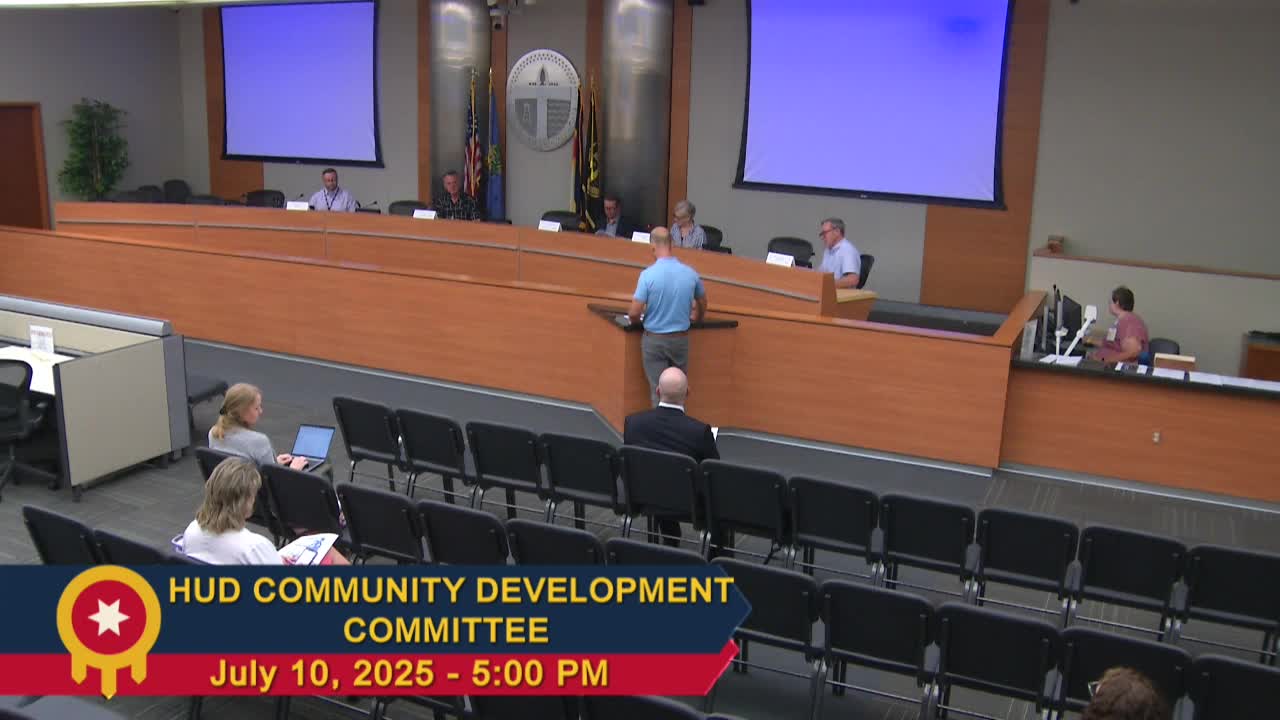
The Tulsa Community Development Corporation (CDC) on Wednesday opened a public hearing to gather community input on Program Year 2026 priorities for the city’s HUD Consolidated Plan, which guides how federal grant funds such as CDBG are spent.
City staff said the CDC will use the hearing and any written comments to produce a priority needs statement to forward to the mayor and city council for final approval. The statement will feed the request for proposals process that runs from September 2025 through April 2026; the city must submit its annual action plan to HUD by May 15, 2026, and the council is required by city ordinance (Title 12, Chapter 8) to make final funding decisions no later than the second Thursday in April.
Grants and consolidated-plan overview A staff member identified only as the grants contracts administration manager summarized the Consolidated Plan’s purpose: to provide “a blueprint for effectively spending [HUD] federal grant funds in a 5 year time frame” and to integrate economic, physical, environmental, community and human development. The staff presentation listed nine priority areas in the draft consolidated plan and 11 associated goals. Those priorities include affordable housing development, housing assistance and homelessness services; goals include acquisition/new construction of affordable housing, rental housing subsidies, rehabilitation and homelessness services. Staff told the CDC it will evaluate proposals, tabulate applicant scores and interview applicants before making funding recommendations; the mayor reviews those recommendations and forwards his position to the council for final action.
Public commenters urge focus on prevention and services Speakers urged the CDC to prioritize services aimed at preventing homelessness and supporting vulnerable residents. Nathan, identifying himself with SOAR Partners and the Gitsway Foundation, said the city should designate housing and supportive services for vulnerable populations, including seniors and people with developmental disabilities. He cited a November report he said found “245 people with developmental disabilities experiencing homelessness in Tulsa.”
Rose Turner, chief administrative officer of Domestic Violence Intervention Services, thanked the CDC for prioritizing people fleeing domestic violence and urged continued funding for safe, affordable housing and protective services. “We had over 4,000 calls to our crisis line this past year along with over 3,000 protective orders that we assisted in helping individuals file,” Turner said, adding that her agency responds to sexual-assault calls 24/7 and recorded 466 such responses last year.
Eric Hallett, housing coordinator of housing advocacy for Legal Aid Services of Oklahoma, urged the CDC to include eviction prevention and tenant legal services in the priority statement. “Last year in Tulsa County, 13,426 evictions were filed here,” Hallett said, and he described Legal Aid’s efforts to keep people housed, including a docket staffed by 11 attorneys that represents many tenants and a study Legal Aid released on the costs and benefits of a full right-to-counsel program.
Hallett described court timelines and barriers: Oklahoma law allows a three-day notice for tenants (he said most receive about five) and hearings generally occur within five to ten days of filing, which limits opportunities to reach tenants. He said 56% of people on eviction dockets make it to court and that 40% of cases are dismissed before reaching a judge because landlords and tenants work out arrangements in that short period. Hallett said federal funding for housing-assistance programs has become uncertain and that Legal Aid is using general-fund money to cover eviction-prevention work currently.
Business lending and workforce-support appeals Ray Fitzgerald, assistant director of loan programs at Tulsa Economic Development Corporation, asked the CDC to continue allocating CDBG funds to TDC’s small-business revolving loan fund. Fitzgerald said CDBG capital functions as patient, flexible lending that can reach entrepreneurs in under-resourced neighborhoods and described measurable local projects, including the Shops on Peoria and Oasis Fresh Market. “Every dollar you allocate to the revolving loan fund is not a one-time expense; it revolves,” Fitzgerald said, adding that TDC’s portfolio default rate is “under 5%” and that repayment rates are strong.
Tiara Estes, founder and executive director of Teach Not Punish Family Resource Center, described her nonprofit’s focus on early childhood social and employability skills, said the group served more than 300 families and about 450 children last year, and asked the CDC to consider mental-health treatment and job-creation goals as funding priorities.
Next steps and timeline Following the public hearing, CDC members said they will review public input and develop a priority needs statement to submit to the mayor and city council. The grants staff reiterated the RFP period (September 2025–April 2026) and the May 15, 2026 deadline for submitting the annual action plan to HUD. The CDC emphasized that mayoral review and city-council approval are required before HUD submission.
Votes at a glance - Approval of minutes from the March 13, 2025 meeting — motion moved and seconded; outcome: approved. - Election of officers: Scott Bjornsson was nominated and re-elected as chair; Ryan Lynch was nominated and elected vice chair — outcomes: approved. - Motion to enter the Program Year 2026 priority needs public hearing — motion moved by Bob Winchester, seconded; outcome: approved. - Motion to exit the public hearing — motion moved and seconded; outcome: approved. - Motion to adjourn — outcome: approved.
The CDC will consolidate tonight’s comments into a proposed priority needs statement and forward it to the mayor and city council as required by city ordinance; the council must act before HUD’s May 15, 2026 submission deadline.