Get Full Government Meeting Transcripts, Videos, & Alerts Forever!
Get email alerts on the Multifamily Zoning topic
No spam. Unsubscribe anytime.
Commission approves 90‑unit multifamily project on West Wheatland with deed restrictions after public outcry over traffic
Summary
The Dallas City Planning Commission voted to approve a proposed MF‑2 multifamily zoning and a 90‑unit residential project on West Wheatland Road, subject to volunteer deed restrictions the developer read into the record. The item drew extensive public comment focused on traffic safety, school drop‑off congestion and emergency‑response concerns.
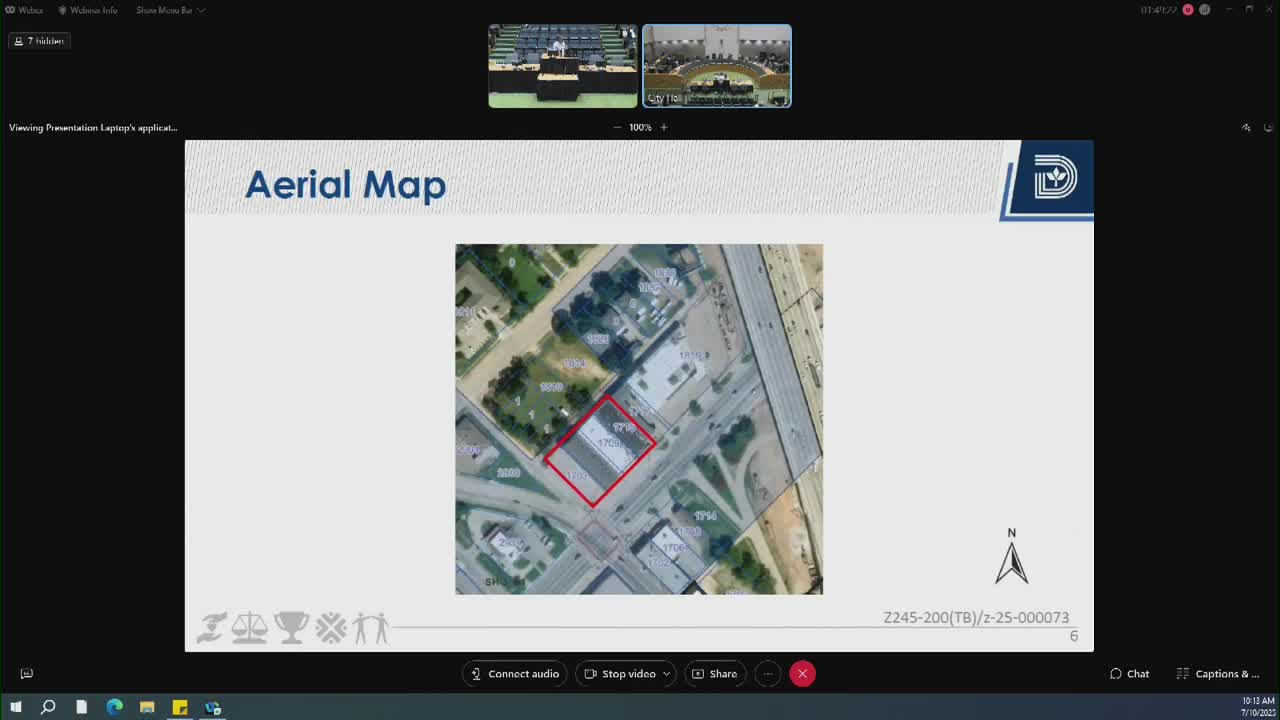
The Dallas City Planning Commission on July 10 approved a rezoning request from Community Retail (CR) to MF‑2 multifamily on a 3.7‑acre site along West Wheatland Road after developer representatives offered a series of volunteer deed restrictions intended to limit impacts on adjacent neighbors.
Staff and developer presentations: City staff recommended approval of an MF‑2 district to allow residential use and described how the site fits a ‘‘neighborhood mixed‑use’’ place type. Rob Baldwin, representing the applicant, told the commission the project would include three‑story apartment buildings and that the applicant was offering deed restrictions to address neighbors’ concerns.
Public comment: Dozens of nearby residents spoke during public comment, citing heavy existing traffic at the nearby Wheatland/Clark intersection, school pickup congestion, recent traffic incidents and concerns about emergency vehicle access. Several residents asked the commission to deny the rezoning or require further mitigation. Specific speakers included neighborhood residents who said they had learned of the plan only days earlier and urged more time for community engagement.
Deed restrictions: During the hearing Baldwin read a set of volunteered deed restrictions into the record. Those included planting rows of canopy trees along street frontages, a six‑foot perimeter fence of specified materials, limits on building materials, shielded down‑facing lighting with a maximum one foot‑candle at the property line, trash‑enclosure siting rules, restricted construction hours, a minimum parking ratio and a promise to comply with the residential‑proximity slope. Baldwin said the restrictions were intended to address the neighborhood’s concerns and to provide protections beyond the base zoning.
Why it matters: Residents argued the site’s only primary access faces a busy school corridor and that adding new residential units would increase congestion and safety risk. Staff and the applicant said the deed restrictions and standard permitting reviews, including required traffic analysis at permitting, would address impacts.
Vote and outcome: The commission voted to close the public hearing and approve the zoning change to MF‑2 subject to the deed restrictions read into the record and the staff conditions. The chair announced the motion carried.
What’s next: The project must comply with the deed restrictions read into the record and pass the transportation and permitting reviews required by city code. Staff and the developer indicated they would continue to coordinate with the neighborhood on construction timing, screening and on‑site management measures.
Quotes: ‘‘As soon as it was brought up to light, we began taking every step to correct the issue,’’ the applicant’s representative said addressing earlier nonconforming activity on a related property. Several residents said the project would place additional strain on an already dangerous intersection and on emergency response times.
Note on state law: Commissioners and staff discussed Senate Bill 840 during the meeting: staff warned that recent state legislation expanding by‑right multifamily entitlements in certain commercial districts limits local control in some situations, and that in some cases voluntary deed restrictions are a mechanism to capture neighborhood protections that otherwise could be harder to secure once the state rule applies.