Get Full Government Meeting Transcripts, Videos, & Alerts Forever!
Get email alerts on the BYOB Ordinance topic
No spam. Unsubscribe anytime.
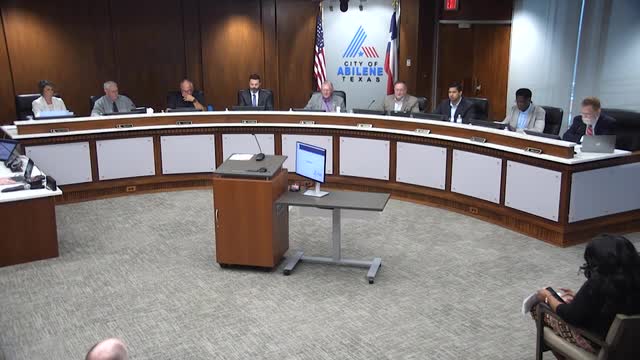
Council delays vote on proposed BYOB ordinance after public concern about burden on venues
Summary
The council heard lengthy debate and public testimony about a proposed Bring-Your-Own-Beverage ordinance regulating venues that allow patrons to bring alcohol. City staff will revise the draft and return it for further consideration at the next meeting.
The Abilene City Council on Thursday declined to adopt a proposed Bring-Your-Own-Beverage (BYOB) ordinance and directed staff to return with revisions after extensive council questions and public comment.
Emily Crawford, city manager, opened the discussion by saying staff had examined local BYOB ordinances used elsewhere and provided two versions in the packet: an original, more prescriptive draft and a redlined alternative that makes several requirements trigger-based. Crawford described the policy goal as addressing “public health and safety concerns” tied to a locally problematic establishment while avoiding unintended burdens on law-abiding businesses.
City Attorney Stanley Smith reviewed the draft ordinance’s main provisions. Among the requirements in the version provided were a permit to operate, a permit-holder presence on-site, mandatory metal-detector or hand-wand checks, well-lit exteriors during business hours, a security video system with low-light capability, and at least one licensed level-2 security officer per 50 patrons. The ordinance would also prohibit owners and staff from consuming alcohol during business hours, limit hours of operation (2 a.m. to 7 a.m. Monday–Saturday; 2 a.m. to noon Sunday), and make certain entities—residences; government-run venues; private clubs, fraternal and veterans organizations as defined in the Texas Alcoholic Beverage Code; colleges and universities; places of worship; and restaurants—exempt from the permit requirement.
Smith described a key alternative in the redlined draft: many of the more stringent requirements would not “kick in” until a venue had three or more qualifying incidents within a 180-day window (weapons charges related to the business, violent crimes, major disturbances, deadly conduct, felonies, or human-trafficking-related offenses). He also noted that permit revocation language in the draft uses a 120-day standard for revocation in some instances.
Council members raised multiple concerns: the potential compliance cost for small venues and nonprofits, the operational impracticality for large events such as the Western Heritage Classic (which can draw about 5,000 people), how the city would verify compliance, and whether the city’s existing nuisance-abatement authority might provide a narrower emergency enforcement tool for immediate threats between 2 a.m. and 7 a.m.
Public commenters included operators of local event venues and community organizations. Rochelle Johnson, representing the Taylor County Expo Center, said the facility routinely hires private security and asked that responsibility for permitting rest with event hosts rather than the facility when a private party rents a space. Multiple venue owners described existing security measures: one operator said the D & W Underground already uses 16 security cameras, enforces a midnight cutoff for events, and pays for security at larger gatherings. Several speakers urged the council to avoid rules that would effectively shut down event activity or add large new costs to venues that already hire security.
Police Chief Seager answered council questions about operational triggers and said the department could work with staff to better define what constitutes a qualifying incident and to exclude false or malicious reports (for example, swatting) from triggering enforcement action.
After debate, council members agreed not to adopt the ordinance at this meeting and directed City Attorney Stanley Smith and staff to return with revisions at the next meeting. Staff said they would prioritize follow-up between meetings.