Get Full Government Meeting Transcripts, Videos, & Alerts Forever!
Get email alerts on the Telecommunications topic
No spam. Unsubscribe anytime.
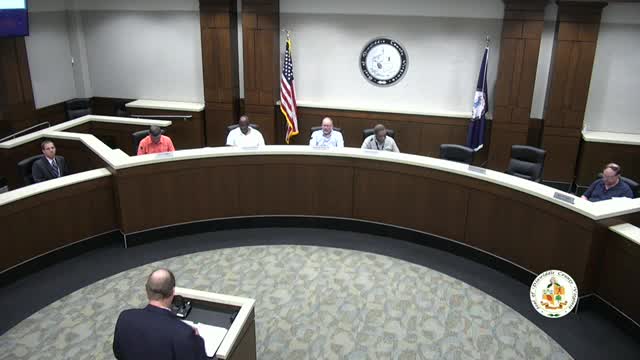
Planning commission recommends approval of 199-foot cell tower permit in Dinwiddie County
Summary
The Dinwiddie County Planning Commission voted unanimously to recommend approval of a conditional-use permit for a 199-foot monopole telecommunications tower proposed by Selco Partnership/Verizon Wyler Wireless, removing a staff-proposed decommissioning surety condition.
The Dinwiddie County Planning Commission voted 5-0 to recommend approval of a conditional-use permit for a 199-foot monopole wireless telecommunications tower proposed by Selco Partnership/Verizon Wyler Wireless, advancing the application to the Board of Supervisors with one staff condition removed.
County planner Mark Bassett opened the public hearing, identifying the case as C25-5 and saying, "The case we have before us this evening is C25-five. The applicant is Selco Partnership, Verizon Wyler Wireless. There the applicant's representative is here this evening, Tyler Rosa with Williams Mullen to represent the application." Bassett told commissioners the site is a roughly 7.4-acre parcel in the county's rural conservation land-use category and that the applicant had submitted a site plan and balloon-test imagery to show visibility and setbacks.
The commission's motion recommended approval subject to the site plan and other standard conditions but removed a proposed condition (condition 3) that would have required a local surety for decommissioning. Bassett explained the condition was withdrawn after consultation with the applicant because, as he summarized during the hearing, a provision in state code does not permit a locality to require a decommissioning surety in this context. The commission voted to forward the permit to the Board of Supervisors with that modification.
Applicant attorney Tyler Rosa and a member of the site-acquisition team, Sean Cai of BCI, described the project to commissioners. Rosa said the tower is engineered to accommodate Verizon plus multiple additional carriers and argued it will improve coverage and public-safety communications; he said, "so this tower will be filling that need as well." Rosa and staff also described site details: the proposed compound is shown on the site plan, the tower will be a galvanized-steel monopole, and the design is intended to minimize visual impacts by siting the structure within a wooded area and adding landscaping.
Staff and the applicant provided additional technical details in the record. The application materials describe a lease/compound area and site plan that the staff tied to the permit; staff's recommended condition text refers to a 199-foot monopole located within a 65-by-65-foot lease/compound area while earlier project materials also referenced a 60-by-60 lease area. Towers must meet setback rules in the zoning ordinance: 200% of the tower height to the nearest residential structure (no less than 400 feet) and 110% of tower height from property lines. Staff said the distance to the nearest dwelling is approximately 401 feet and the nearest property-line setback would be about 222 feet, which meets the cited requirements. The application also noted a 4-foot lightning rod on top of the monopole and that the site will use an existing gravel driveway with a proposed 12-foot gravel access road into the compound.
Visibility testing included a balloon test; staff said the tower would be visible primarily from immediately in front of the property and from some points farther east on Namazin Road. Landscaping plans call for about 10 holly trees, roughly 5 to 6 feet tall, to screen the equipment. The compound would be fenced (7-foot fence) and include equipment cabinets and turning areas for construction/maintenance vehicles. Utilities required for operation are electricity and broadband fiber. Staff noted that the applicant must complete a Section 106 review before issuance of a building permit.
During the public-hearing period a commissioner asked whether the applicant had received neighborhood complaints. Rosa said he was not aware of opposition from neighbors. After discussion, a commissioner moved to recommend approval of case C25-5 to the Board of Supervisors with the removal of condition 3; the motion passed on a 5-0 vote.
The commission's action is a recommendation; the Board of Supervisors will have the final decision on the conditional-use permit. Bassett directed the applicant to the next administrative steps following the commission's vote.