Get Full Government Meeting Transcripts, Videos, & Alerts Forever!
Get email alerts on the City Budget topic
No spam. Unsubscribe anytime.
Rowlett council hears fiscal-2025 preview as city manager, police and utilities outline priorities
Summary
City staff presented a preliminary FY2025 budget preview June 17, including a police pay-plan proposal, a utility-rate update tied to North Texas Municipal Water District increases, board-and-commission funding requests and a range of department supplemental asks.
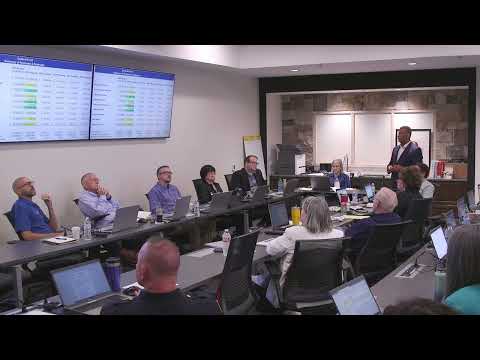
Rowlett City officials used a June 17 budget workshop to outline fiscal 2025 priorities and tradeoffs, as staff presented a preliminary budget plan, a wide-ranging police compensation proposal, an annual utility rate update and requests from parks, public works and boards and commissions. City Manager-level remarks framed the process as one aimed at stabilizing reserves while avoiding a property tax-rate increase; department leaders then presented a list of proposed hires, capital needs and ongoing programs for council consideration.
The multi-hour session opened with a budget preview in which the city manager emphasized three goals for FY2025: improve long-term financial stability, restore the police department’s competitive pay posture and prioritize capital projects while protecting general-fund reserves. The manager said staff had identified about $3.7 million in one-time resources and about $3.3 million in ongoing capacity in preliminary modeling, and that council direction would determine which enhancements become part of the adopted plan.
Police compensation dominated discussion. Assistant Chief Hutchins presented a recommended restructuring of the department's step plan: a condensed step schedule aimed at getting officers to higher pay faster. Hutchins told council the goal was to reduce turnover: “Over a three-year span we had 44 officers leave the agency; 31 left between step 1 and step 5,” he said, adding that replacing those departures has cost the city roughly $100,000 per officer in recruitment and training. Staff modeling shows the proposed pay plan would raise starting and mid-career pay and would add roughly $335,000 (ongoing) beyond the amounts already included in the draft staffing model. The council signaled support for moving ahead with the compensation package while asking city management to present follow-up scenarios showing the fiscal impact and options for phasing or offsets.
Willdan Financial Services presented the city’s annual water/wastewater rate update. The consultant said Rowlett’s rates remain near the metro midpoint but warned that wholesale cost pressures — mainly from the North Texas Municipal Water District for water and from the City of Garland for wastewater treatment — will drive increases for ratepayers over the coming decade. The consulting update recommended modest, staged increases beginning Oct. 1 and keeping residential minimum charges stable in the near term while raising volume charges; modeled roughly, the typical household using about 7,500 gallons monthly would see a $3–$6-per-month increase under the recommended approach. The presenter stressed the rationale: smoothing the impact while protecting the water fund’s days‑of‑operations balance and paying projected debt and wholesale cost increases.
Park and public-works items drew council attention. The Golf Advisory Board asked for about $20,000 a year to establish a preventive maintenance program for nine decorative lakes and their fountains in the Waterview area; members said the lakes have not been regularly maintained and that improving them would protect property values and public safety (algae/mosquito concerns). Councilors agreed to use existing golf-fund capital money to pay an upfront $30,000 to restore the fountains and asked staff to negotiate longer-term maintenance and responsibility with the golf contractor, American Golf , and neighborhood HOA vendors.
Boards-and-commissions budget requests were reviewed for fiscal 2025. Most requests were modest: Arts & Humanities asked for roughly $21,000 (increased event and contest funding), Parks & Recreation requested about $3,000 after staff and council trimmed items tied to reforestation funds, and several small advisory boards asked for parking, badges and travel allowances. Nonprofit grant applicants were also previewed; Friends of Rescue Animals asked for $20,000 and demonstrated matching fundraising and in-kind veterinary support from partner agencies.
Staff also presented a long list of supplemental department requests: examples included an additional building-maintenance technician for city facilities, a public-safety-dedicated IT systems administrator, a small fleet and equipment asks for public works and parks (compact loader, aerator, sprayer), and upgrades to the city website and economic-development portal. The Rowlett Public Library proposed joining a growing national trend by eliminating overdue fines to remove barriers to access; library staff said dozens of Texas libraries had already gone fine-free and that fines revenue has trended down while administrative costs of collecting small fines remain high.
What’s next: staff will return with refined fiscal-impact numbers after council direction. The city manager said staff will model the police pay options, the effect of the utility-rate proposal, and the debt/capital timeline so council can prioritize projects within available ongoing and one-time resources ahead of adopting the FY2025 budget and tax rate later this summer.
Sources: Presentations and discussions at the Rowlett City Council budget workshop, June 17, 2024.