Get Full Government Meeting Transcripts, Videos, & Alerts Forever!
Get email alerts on the Employer Annual Certification topic
No spam. Unsubscribe anytime.
TRS tells employers how to complete annual certification; deadline Aug. 15 and $250/day late penalty
Summary
A Teachers' Retirement System staff member reviewed the employer annual certification process, including the July 1 start link, six review pages, mass-update options, requirements for edit explanations in 2025–26 and an Aug. 15 deadline with a $250-per-day late filing penalty.
A staff member for the Teachers' Retirement System told employer representatives that annual certification of employer reports must be completed and submitted by 11:59 p.m. on Friday, Aug. 15, and warned that a $250-per-day late filing penalty may apply if reports are not timely filed.
The presenter said the annual certification compiles employer contributions, reported earnings and service credit for more than 160,000 active TRS members and that the process can only be started after all pay-period reports for the 2024–25 fiscal year are uploaded and processed. A link to begin the certification was made available July 1; clicking that link freezes uploads for the 2024–25 reports and begins the process that produces final totals used for pension benefits.
The presenter said the certification workflow contains six pages employers must review: General/member summary, Edit Explanations, Final Sick Leave, Federally Funded Salaries, Workers' Compensation and the Final Annual Certification Review. Employers must mark each page "review complete" at the bottom of the page; changes on one page can affect others, requiring rechecks. Employers cannot add members during certification; if a member is missing because a pay-period report was not uploaded, the presenter advised deleting the in-progress certification, uploading the missing pay-period report, and restarting certification.
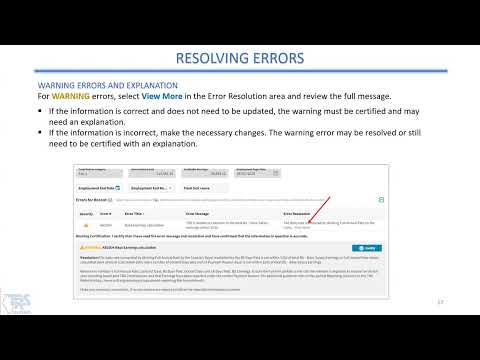
The presenter described TRS's error system: fatal errors block finalization and must be corrected; warnings may require either a correction or a written explanation that follows the error-resolution guidance. For 2025–26, the presenter said, explanations must include a breakdown for specific edits; vague comments will be rejected by the system. Employers can view edit explanations on the member detail, via an actions drop-down on the member summary, or from a dedicated Edit Explanations page.
A mass-update feature lets employers change contract days and days paid for selected members without reuploading pay-period reports; the presenter cautioned that mass updates are irreversible and employers who apply an unintended change must either delete and restart the certification or manually correct individual member rows. Employers can add rows for payment reasons (for example, to split extra duty from base salary) but cannot delete original pay-period data — instead they must set the original fields to zero to remove that reported amount.
The presenter highlighted a new fatal-error check for 2025–26: supplementary reports filed for retirement or death must match annual-certification values; mismatches produce a fatal error that must be resolved by adjusting the supplementary report or the annual certification so the amounts match. The presenter noted a workaround for forcing a recheck (adjusting an annual rate by one cent, saving, and allowing the system to rerun checks), and said the actions are intended to ensure retirement and death claims' accuracy.
Employers can add federally funded salaries and split grants (for example, Title I vs. Title II) on the Federally Funded Salaries page, and must report whether they paid a portion of a member's daily rate while the member was on workers' compensation; if so, the employer must add that member on the Workers' Compensation page. After all pages are reviewed, employers must certify the final numbers and submit to TRS; submission reruns edits and will generate an email indicating whether transmission was successful or additional errors must be fixed.
Once TRS marks a certification as "transmitted," the record becomes read-only in the annual certification inquiry under Services. The presenter advised employers to contact TRS immediately if they discover an error after transmission; TRS will return the certification so the employer can correct and resubmit. The presenter also described reports available in Gemini and Employer Access, including: Final Annual Report of Earnings, Annual Report Remittances (which shows amounts owed or refunded based on the submitted report), and an Employer Changes CSV that details original and corrected values for payment reason, annual salary rate, earnings, FTE, contract days, days paid and dock days.
The presenter warned employers not to wait until the final week to start certification and emphasized reading the error-resolution guidance closely, because TRS may need to contact employers for clarifications that could come weeks later. The presenter repeated that the certification cannot be finalized while fatal errors remain and that employers should preserve documentation and provide detailed explanations where requested to avoid delays or later follow-up by TRS.