Get Full Government Meeting Transcripts, Videos, & Alerts Forever!
Get email alerts on the Housing Funding topic
No spam. Unsubscribe anytime.
Bend AHAC recommends $4 million in pro-housing awards; committee also backs $1.5 million in affordable and CDBG grants
Summary
At its July meeting the Bend Affordable Housing Advisory Committee voted to recommend pro-housing, affordable housing and CDBG allocations to support a mix of rental and ownership projects, prioritizing projects with site control and readiness to proceed.
At its July meeting, the Bend Affordable Housing Advisory Committee (AHAC) voted to recommend that City Council direct funding from three local housing pools to five projects across Bend.
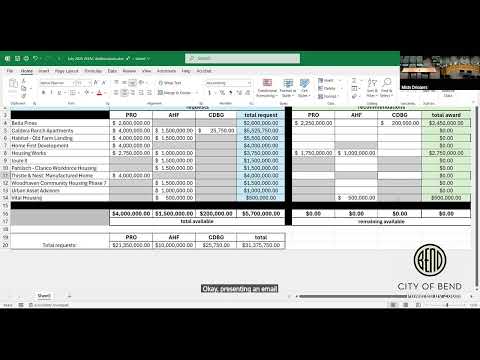
The committee voted to recommend $4 million from the city's pro-housing acquisition fund split between United Housing Partners' Bella Pines (2.25 million) and Housing Works' West Side project (1.75 million). AHAC also recommended $1 million from the city's Affordable Housing Fee fund to Housing Works and $500,000 to Vital Housing (Cedar West preservation). Finally, AHAC recommended a $200,000 Community Development Block Grant award to Bella Pines.
The recommendations will be forwarded to Bend City Council for final action. AHAC committee members announced the votes as unanimous on each motion.
Why it matters: the awards target land acquisition and early site costs for projects the committee found most likely to move quickly to permit and construction. Several presenters told AHAC that site control or immediate acquisition was critical: "Without funding support today, we will lose site control," United Housing Partners' Seth O'Connell told the committee, describing the Bella Pines site option. The choices reflect AHAC's emphasis on projects that can use city funds quickly and that fill distinct needs, from culturally specific family units to deeper-income rental housing.
What AHAC recommended
Votes at a glance (committee recommendation to City Council) - Pro-housing acquisition fund: Bella Pines (United Housing Partners) — $2,250,000; loan terms as proposed in the application. Project summary: 102 units planned (initial phase), ownership by a culturally specific nonprofit partner (Latino Community Association) intended to prioritize larger family units and Spanish-language outreach. Application materials say the developer will immediately apply for state funding once site control is secured. - Pro-housing acquisition fund: Housing Works (West Side project) — $1,750,000; committee accepted loan terms proposed in the application (the applicant requested a forgivable component to enable deeper affordability). Project summary: 59 units proposed, targeted to 50% AMI and below, with elevator-served, accessible units and on-site resident services. - Affordable housing fee fund: Housing Works — $1,000,000 (loan terms as proposed). This local subsidy is intended to lower rents for the deepest-income units in the project. - Affordable housing fee fund: Vital Housing (Cedar West preservation) — $500,000 (loan terms as proposed). Project summary: acquisition to preserve existing affordability on a midrise property identified by the applicant as at risk of conversion to market-rate units if not preserved. - Community Development Block Grant (CDBG): Bella Pines — $200,000 (loan terms as proposed).
Discussion highlights and staff questions Committee members and staff pressed applicants on timelines, funding contingencies and regulatory hurdles. Key topics during deliberations included: - Site control and timing: multiple presenters said securing land quickly was essential to preserve projects and access state funds. United Housing Partners told the committee that the Bella Pines option would be lost without a prompt award. - Loan terms and forgiveness: Housing Works requested a forgivable component to the city loan so it could provide lower rents (targeting 50% AMI). Committee members debated forgivable versus repayable terms given the city's revolving-loan goals. - State funding interactions: applicants stressed that state funding programs (OHCS, LIFT, tax-exempt bonds, 4%/9% tax credit processes) were in flux and that local funding often determines competitiveness for state awards. - Project readiness: AHAC favored applicants that could complete environmental review and close on property within the timeline required by the city's pro-housing program. Several applicants said NEPA and state underwriting timelines (and Davis-Bacon / prevailing wage implications on some federal dollars) influenced their schedules and budgets.
Quotes "Without funding support today, we will lose site control, and that will mean a 102 to a 156 units gone," said Seth O'Connell of United Housing Partners, describing the risk to Bella Pines if acquisition support is not available. "Our mission absolutely guides us: fostering dignity through housing," said Lee McConnell, director of Housing Works, describing the West Side proposal and the organization's preference for deeper affordability.
What the committee did not fund directly Not every applicant received a city award. Several developers presented sizable proposals (Polish Commercial, Jewel/P3 Foundation, Urban Asset Advisors, Thistle Nest, Bend-Redmond Habitat for Humanity and others). AHAC deliberations prioritized projects that combined site readiness, local nonprofit ownership (or an identified local nonprofit partner) and the ability to use funds quickly.
Next steps AHAC's recommendation will be forwarded to Bend City Council for consideration and final award. Staff will follow up with applicants on conditions AHAC discussed (loan terms, reporting requirements, proof of site control, and specific milestone deadlines tied to NEPA and state applications).
Meeting context The AHAC meeting included a sequence of developer presentations followed by committee questions and deliberations. City staff, the city attorney and applicants answered detailed questions about finance, permitting, accessibility, and program rules that affect whether local funds can be combined with state and federal subsidies.
The committee recorded the funding recommendations as motions, seconded and voted on in open session. The vote on the pro-housing package and the subsequent affordable housing and CDBG recommendations were recorded by the committee chair as unanimous; a roll-call vote listing each committee member's name was not read into the public record at the time the motion carried.
Ending note Committee members emphasized the need for rapid use of pro-housing acquisition funds to secure lands that are near-term ready for housing production and said they intend to monitor the projects closely as they proceed through state and local review.