Get Full Government Meeting Transcripts, Videos, & Alerts Forever!
Get email alerts on the Parking Policy topic
No spam. Unsubscribe anytime.
City tables front-yard parking ordinance after hours of public comment; workshop planned
Summary
The City Commission delayed a decision on a proposed ordinance to ban front-yard parking across Margate after extensive public testimony, directing staff to hold a workshop to refine options.
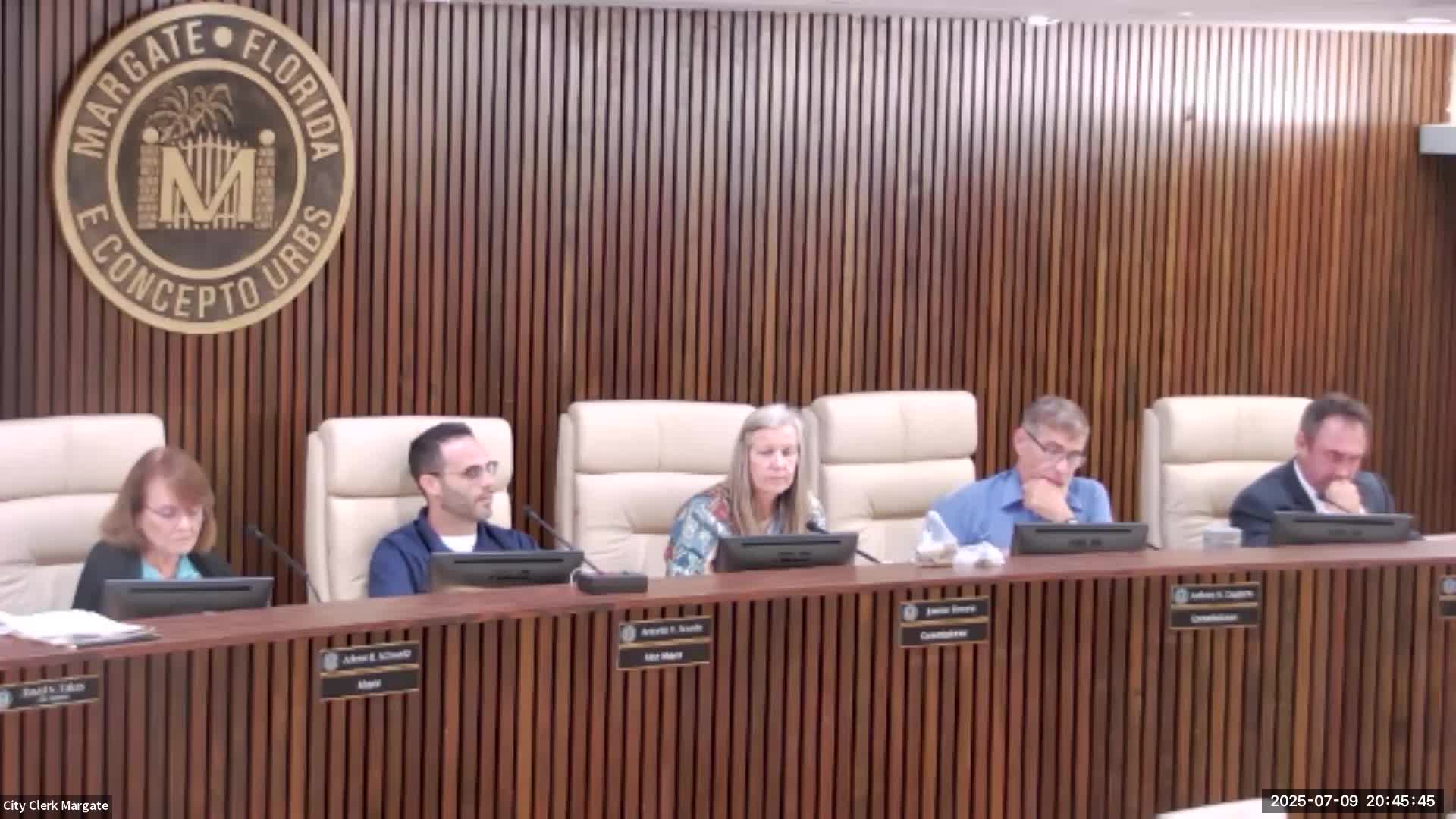
The City Commission of Margate on July 9 tabled consideration of a proposed ordinance that would prohibit parking vehicles in the front yard of residential properties, sending the item to a workshop for further study.
The ordinance would remove an existing exception that currently allows parking on the front lawns of single-family and two-family dwellings and would prohibit parking on grass, landscaped areas and drive aisles except in limited, defined locations. Staff said the revision was drafted to bring Margate closer to the parking rules used in many other Broward County municipalities.
Andrew Penny, the citys senior planner, walked the commission through examples and Google Street View photos showing cars parked on lawns and swales. "Under this proposed ordinance, any vehicle on the grass would not be parked lawfully," Penny said. He said the Planning & Zoning Board recommended approval 2-1 but suggested the commission consider alternative driveway materials for residents unable to pay for full driveway expansions.
Vice Mayor Serio and other commissioners said they supported addressing front-yard parking but asked for a neighborhood-sensitive approach. Serio said many Margate homes are older, have narrow lots or sidewalks that reduce available driveway width, and the city should first pursue targeted enforcement against the worst offenders such as oversized commercial equipment and rental abuses. "I think we should be going after other eyesores first," he said.
Public comment filled more than an hour. Residents described competing priorities: some urged a full ban to preserve neighborhood appearance and property values; others said parking restrictions would disproportionately harm lower-income residents, multigenerational households and renters who lack space to expand driveways. Several speakers proposed intermediate steps: allow alternate permeable surfacing (pavers or gravel), permit limited swale parking in certain streets without curbs, create community parking or permit programs for recreational vehicles, or pursue stricter enforcement of existing rules on commercial vehicles and unregistered cars.
Rich Zucchini, a resident active in neighborhood discussions, urged limiting swale parking because those areas belong to the city and are damaged by vehicle traffic. "Parking on the swale should not be allowed, period," Zucchini said. Another commenter, Natalia Escobar, urged compassion for households sharing space for economic reasons and warned against enforcement that would further strain low-income families.
After extended discussion the commission voted unanimously to table the item and direct staff to schedule a workshop (commission members discussed an October timeframe) to consider neighborhood-specific rules, alternative paving options, a permit program and enforcement priorities. The motion to table passed on a roll call vote in which every commissioner voted "yes."