Get Full Government Meeting Transcripts, Videos, & Alerts Forever!
Get email alerts on the Land Use topic
No spam. Unsubscribe anytime.
Planning Commission recommends revoking planned-development overlay for 1144 Chorro project
Summary
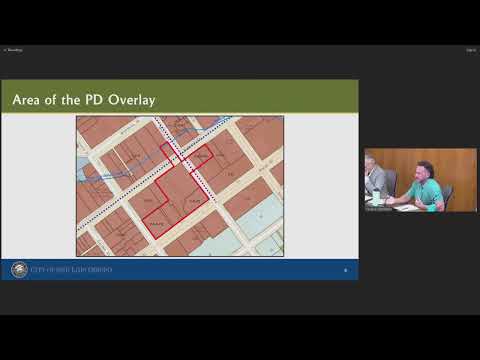
The San Luis Obispo Planning Commission voted unanimously to recommend the City Council adopt an ordinance revoking a planned-development (PD) overlay tied to the 1144 Chorro project, restoring underlying CD/CDH zoning for seven downtown properties.
The San Luis Obispo Planning Commission voted unanimously to recommend the City Council adopt an ordinance revoking the planned-development (PD) overlay associated with the 1144 Chorro project, a six-story mixed-use proposal first approved in 2020.
Associate planner Hannah Hahn told commissioners the overlay affects seven properties in downtown San Luis Obispo on Chorro, Higuera and Marsh streets and was created in 2020 to allow transfer of unused residential density to the 1144 Chorro site. "Revoking the PD overlay would rezone these properties back to CD and CDH as appropriate," Hahn said, and she described the staff recommendation as a cleanup step to remove references on the zoning map to an expired project.
The project approval for the 1144 Chorro development expired in August 2024 (a typo in the staff report listed 2025), Hahn said. Since the 2020 approvals, Jamestown sold the property to NKT in 2023, and NKT is not pursuing the original six-story project; instead the new owner has obtained permits to accommodate Cal Poly uses within the existing building. "The approval of the development project expired in August of last year," Hahn said, and current property owners agreed not to reinitiate the expired project.
Commissioners pressed staff and the project representative on what revocation would mean for future development. Hahn said the PD overlay had been specific to enabling density transfers among contiguous properties and that revoking it would return each lot to standard zoning development standards and density calculations. "So the standard density for the CD zone is 30–36 units per net acre," Hahn said. She added that revocation would prevent the overlay from encumbering future, unrelated development proposals that might want to use density credits.
Applicant Mark Rawson, representing the property owner, told commissioners the flexible-density ordinance the city later adopted made the PD overlay less necessary. "The density transfer is not required," Rawson said, adding that some adjacent properties now under separate ownership would have been subject to obligations—such as historic-preservation conditions and dedication of open space—if the PD overlay remained tied to the expired project. He said Cal Poly's planned use at the corner of Chorro and Marsh is a tenant fit-out of an existing two-story building of about 25,000 square feet, not new construction.
Commissioners also discussed a nearby site at 973 Higuera, which Rawson said had a potential development proposal in the works; staff said revoking the overlay would streamline planning for that and similar projects by removing overlay-related encumbrances.
After discussion, a commissioner moved and the commission seconded the motion to recommend revocation. The city clerk called a roll; Commissioners Munoz Morris, Tully (vice chair), Flores, Cooley, Khan, Jorgensen and Chair Dave Houghton all voted "yes." The motion passed unanimously.
The commission's action is a recommendation to City Council; the ordinance to revoke the overlay must be introduced and adopted by the council before the zoning map is changed. Deputy community development staff noted the revocation request was an applicant-initiated cleanup and that processing was covered by the applicant's fees.
The commission received one written correspondence on the item and no public speakers. With the action concluded, the commission moved on to calendar updates and adjourned.