Get Full Government Meeting Transcripts, Videos, & Alerts Forever!
Get email alerts on the Streetscape Notice Access topic
No spam. Unsubscribe anytime.
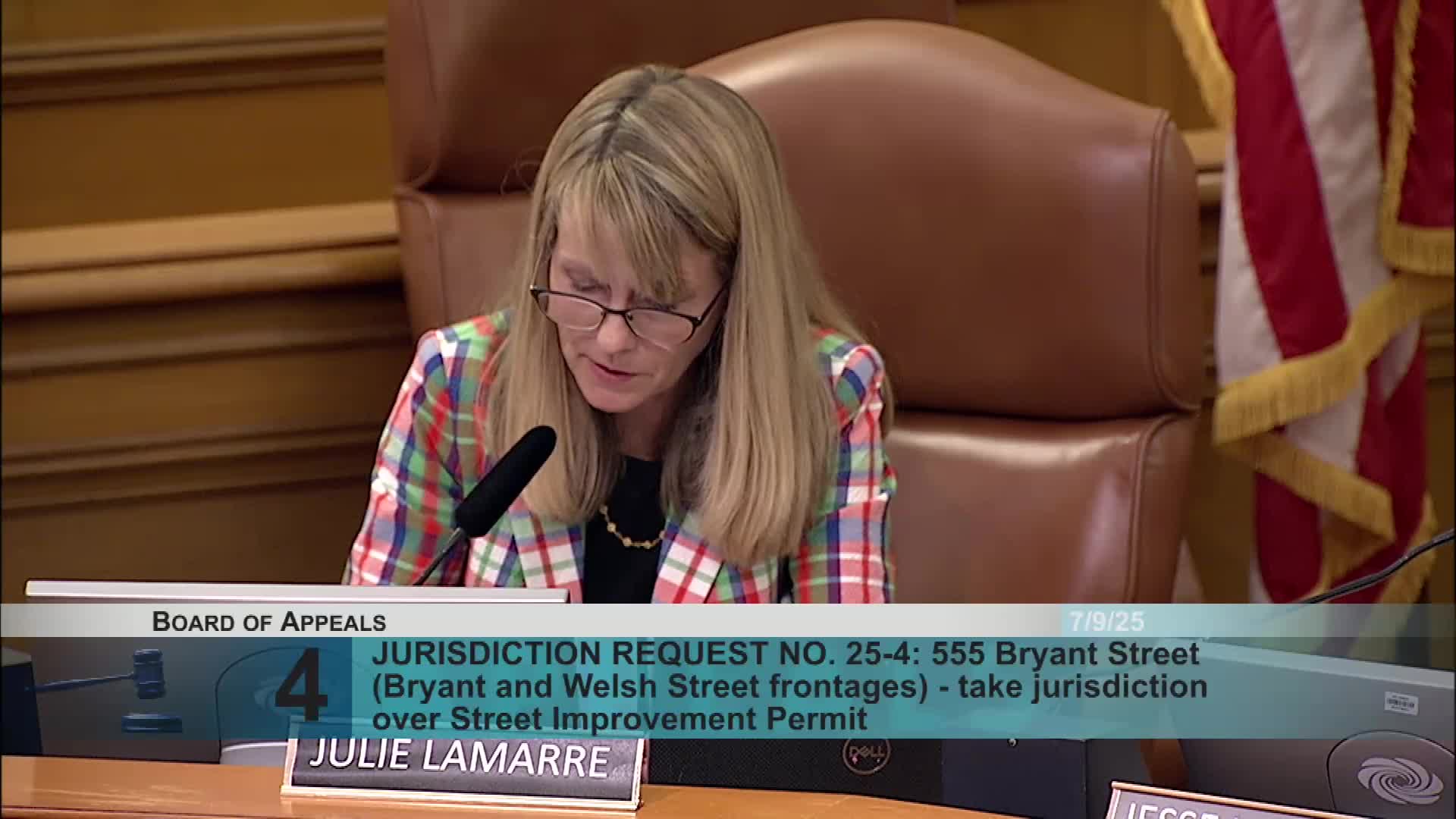
Board of Appeals denies Palms HOA jurisdiction request over 555 Bryant sidewalk widening
Summary
The San Francisco Board of Appeals declined a Palms HOA request to take jurisdiction over a sidewalk/street-improvement permit for 555 Bryant Street, ruling city notice procedures satisfied; the board asked SFMTA and Public Works to follow up with the HOA.
The San Francisco Board of Appeals on July 9 denied a jurisdiction request from the Palms Homeowners Association seeking review of street and sidewalk work at 555 Bryant Street, saying city procedures were followed but urging SFMTA and Public Works to follow up with the HOA.
The Palms HOA told the board that the developer and the city did not give residents proper notice before widening the sidewalk on Wells Street, and that the work encroached on existing driveway access. "City law requires public notification for street changes so any impacted property owner can be heard," the Palms HOA representative said, arguing the sidewalk change was buried in a sidewalk improvement permit rather than taking the usual SFMTA legislative path.
The issue matters to neighbors because the Palms said the widened sidewalk removed a parking lane that had previously allowed large vehicles and maintenance equipment to enter and exit the building garage. The HOA said construction was completed before they had an opportunity to appeal; the jurisdiction request alleges the city's permit process deprived residents of due process.
Developer and permit-holder representatives said the streetscape work was required by the city's Streetscape Design Advisory Team and the Better Streets policies and was incorporated into planning approvals. "The first SDAT letter requested the sidewalk widening along the project's Wells Street frontage," attorney John Kevlin said, describing the requirement as a condition of entitlement. He told the board the project sponsor proceeded "at risk" to complete streetscape work so tenants could occupy the building. Kevlin also said planning and building records and prior public notices showed the streetscape design was part of the entitlement.
City staff described their roles and the interagency process. Norman Wong of the San Francisco Municipal Transportation Agency said the contractor had occupied the parking strip on Welsh for construction staging "for at least a few years" and that the fenced area coincided with the new curb line. Public Works staff told the board the particular street-improvement permit (SIP) at issue does not itself require mailed public notice, and that sidewalk legislation to establish a new curb line will later go through SFMTA and the Board of Supervisors.
After hearing testimony, President John Trezvino said the jurisdiction question under Board of Appeals Rule 10(a) asks whether "the city intentionally or inadvertently caused the requester to be late in filing the appeal." The board majority concluded the city's notice process, taken as a whole, met legal requirements and denied the jurisdiction request 3–1. The board's action did not approve or disapprove the street changes themselves; instead the board declined to take the appeal and left the next formal steps with SFMTA and the Board of Supervisors.
The board added a nonbinding recommendation that SFMTA and Public Works reach out to the Palms HOA and attempt to address access and maintenance concerns. SFMTA had paused scheduling of its public hearing on parking/curb-line legislation while this appeal was pending; the agency said it will resume its process and that the public hearing is the forum where parking removals and other restrictions are formally considered.
What happens next: SFMTA will hold a public hearing on parking changes associated with the new curb line and make a recommendation to its board; if approved there, the matter goes to the Board of Supervisors for sidewalk legislation. Public Works said it will include constructed street-improvement documentation in the legislative package. The board’s denial leaves those agency processes as the available route for neighbors to press for modifications or accommodations such as driveway or maintenance access changes.
Board action: The motion to deny the jurisdiction request carried 3–1. Commissioners Saroyan, Epler and Swig voted to deny; President Trezvino voted no. Commissioner Jose Lopez was absent.
Why it matters: The case highlights tensions between expedited housing approvals and neighborhood notice and access. Developers and city staff said the permit path allowed a large housing project to proceed and be occupied; neighbors said the process left them without a timely forum to contest a change that affects daily access and building maintenance.
— End —