Get Full Government Meeting Transcripts, Videos, & Alerts Forever!
Get email alerts on the Finance Debt topic
No spam. Unsubscribe anytime.
Committee asks administration to study sale of county receivables; report to include operational and workforce impacts
Summary
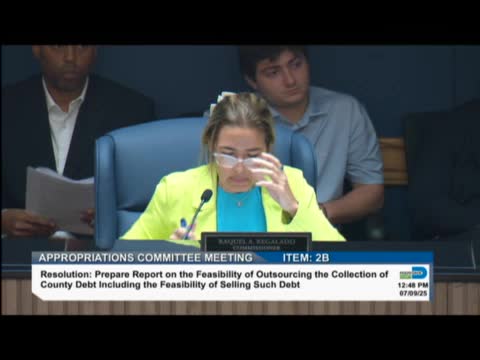
The Appropriations Committee approved a motion directing staff to evaluate selling a portion of Miami-Dade County's outstanding receivables (excluding Jackson Health System accounts) and to return a report within 30 days that analyzes fiscal yield, vendor interest and the operational and workforce impacts of any sale.
The Appropriations Committee approved a request for a staff report on the feasibility of selling a portion of Miami-Dade County's outstanding receivables (explicitly excluding Jackson Health System accounts). The committee asked the administration to evaluate market interest, expected proceeds and implications for the county's in-house collections function.
Commissioners and staff discussed the numbers: county staff said the aggregate receivables owed to the county total roughly $4.1 billion, of which Jackson's portion is about $3.6 billion and the county's non-Jackson portion is approximately $510 million. County collection staff told the committee they collect about $17 million annually and have a roughly 61% success rate on referred accounts; the in-house unit has about 30 collectors. Committee members asked that the report explain whether selling receivables would materially affect the division's operations, including whether staff would be reassigned, eliminated, or redeployed, and whether the sale would reduce long-term collections revenue when compared with continuing in-house collections.
Sponsor comments framed the request as a business decision: selling a portfolio of aged receivables could generate an immediate cash infusion for the county and help close projected budget gaps; staff acknowledged the trade-offs and said the division historically performs well and that Jackson favors the county's collection approach because the county can use bundled debts to facilitate repayment plans.
The committee approved the report directive and asked for a comprehensive analysis that includes projected proceeds, vendor market interest, and workforce and service impacts.