Get Full Government Meeting Transcripts, Videos, & Alerts Forever!
Get email alerts on the Animal Control Feeding Ban topic
No spam. Unsubscribe anytime.
Hawaii County committee advances amended ban on feeding feral animals on county land after hours of public comment
Summary
After more than three hours of testimony, the County Council policy committee amended and voted to recommend Bill 51 — which would prohibit feeding feral or stray animals on county-owned property — to the full council. Opponents urged expanded trap-neuter-return (TNR) support; proponents cited toxoplasmosis and threats to native species.
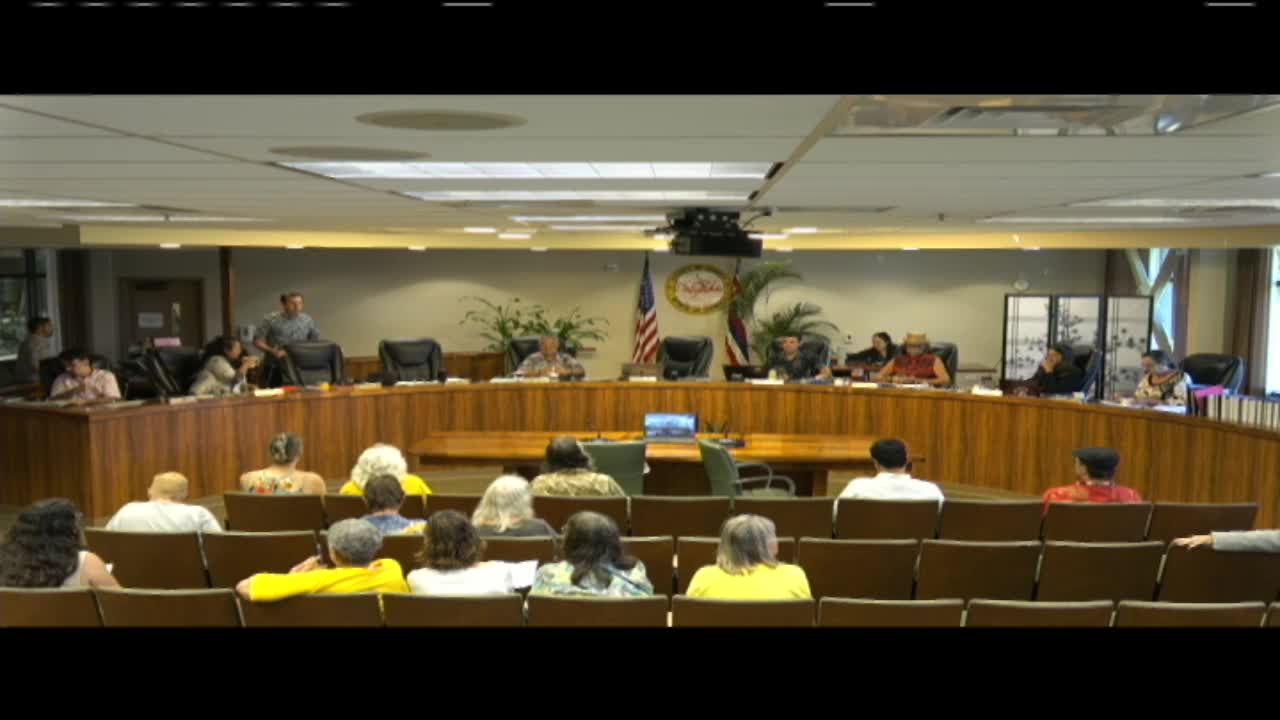
HILO — The Hawaii County Council policy committee on health, safety and well-being voted to forward an amended Bill 51 to the full council after nearly three hours of public testimony on July 8.
The proposal, introduced by Councilmember Connelly Kleinfelder, would amend Chapter 4, Article 3 of the Hawaii County Code to prohibit “feeding” of stray or feral animals on county-owned property except where the county authorizes an animal-management program. The committee adopted a Parks & Recreation–sponsored amendment that carves out county‑authorized programs and left other penalties and prohibitions intact. The committee voted 7–1 to recommend the amended bill to the full council.
Supporters of the bill said feeding stations on public lands attract and sustain populations of nonnative species and increase disease risk to people and protected wildlife. “Feral cats are widespread in Hawaii due to feeding and support provided by well-meaning humans,” said Brett Mossman, Forest Bird Recovery Coordinator at the State Department of Land and Natural Resources. Andrea public commenters and state and federal officials told the committee that toxoplasmosis — a parasite that can be spread by cat feces — has been linked to deaths of endangered species and poses human health risks to pregnant people, keiki and immunocompromised residents.
Opponents — a long line of local volunteers, nonprofit leaders and residents — argued the ordinance would criminalize compassionate caretakers and undermine community-led TNR programs that many said are the most effective long-term approach to reducing free-roaming cat populations. “Trap, neuter, return works,” said Kristen Greenland, president of Jungle Cat Ladies Sanctuary in Volcano. “If TNR had been started and supported by the county decades ago, we wouldn't be in this situation.”
Several testifiers described direct rescue work and placed numbers on sterilization efforts. Barbara Seguinaro of Action for Animals Hawaii said her nonprofit fostered hundreds of animals in 2024 and that “40% of the cats were from animal control.” Lucretia Wooster, who identified herself as working with Action for Animals, told the committee that feeding often leads to rescue, sterilization, vaccination and eventual adoption.
Some speakers urged a middle path. Corey Harden recommended exceptions: “For this bill, perhaps the best approach is to support it but provide exceptions for trap neuter release programs that are approved by the county.” Councilmember Kleinfelder said the measure was not intended as “a starvation bill” and noted Parks and Recreation offered an amendment to allow county‑authorized programs to continue.
Staff testimony and departmental representatives told the committee that parks crews and maintenance staff contend daily with animal waste, food left in parks, and wildlife attracted to feeding stations. Clayton Honma, director of Parks and Recreation, said some park areas have become “big litter boxes” that require sand replacement and costly cleanup at beach volleyball pits and other facilities.
Animal-control staff said enforcement capacity is limited. Matt Reynolds, Administrator for Animal Control, said the department’s small officer corps constrains proactive enforcement and that shelters currently lack space to accept all healthy surrendered animals. Committee members discussed the need for funding and contracts to support certified management programs if the county allows any continued feeding under county authorization.
The committee adopted a Parks & Recreation–draft amendment that explicitly preserves authority for the county or a county‑contracted person or organization to trap, remove, impound or otherwise act under county code and state law. After the amendments, the committee voted 7–1 to advance the measure to full council.
Votes at committee: On a motion to amend, the committee voted in favor; on the final disposition to forward Bill 51 with a favorable recommendation, the roll call recorded seven ayes and one no (Miss Kagiwara). The committee chair said the item will go next to the full council for final action.
The county will now weigh enforcement logistics, possible contracting or grant funding for certified management programs, and the pilot TNR models proposed by local nonprofits before the full council takes up the measure.