Get Full Government Meeting Transcripts, Videos, & Alerts Forever!
Get email alerts on the Zoning Text Amendment Planned Development topic
No spam. Unsubscribe anytime.
York County planning commission adopts text amendments tightening recreation and cluster-subdivision standards
Summary
The York County Planning Commission approved a zoning text amendment, PC 2520, that raises required recreational area in planned developments, loosens mandatory-amenity requirements into active/passive categories, and allows cluster subdivisions on smaller parcels with added buffering and connectivity rules.
The York County Planning Commission on July 9 adopted a zoning text amendment (PC 2520) that raises minimum recreational area in planned residential developments, clarifies what counts as open space, and adjusts design standards for cluster (open-space) subdivisions.
Staff said the revision increases required recreational area in Planned Development Residential (PDR) projects from 10% to 15% of the land area while leaving the open-space requirement at 25%. The staff presentation noted that environmentally sensitive areas such as wetlands, steep slopes or utility easements may be counted as open space but cannot be counted toward required recreational area because they are not usable for recreation. "25% of the land area in a PDR needs to be reserved as open space," staff said during the presentation.
The amendment also replaces a rigid list of mandatory recreational facilities — historically an Olympic-size pool, a tennis court and a play field — with broader required categories of active and passive recreation. Staff told commissioners these changes are intended to allow amenities to be scaled and tailored to the size and type of each development, while maintaining requirements for walkways, trail linkages and safe pedestrian and bicycle access. The proposal sets a minimum surface for multi-use trails (stone-dust, with asphalt preferred) and requires sidewalks on both sides of private streets when private streets are used.
A substantial change in the cluster-subdivision rules reduces the minimum gross acreage threshold that can trigger cluster development from 10 acres to allow lots in the 5-to-9-acre range to be considered. Staff said the county analyzed vacant and occupied parcels and found a meaningful number of parcels between 5 and 9 acres that could be suitable for cluster development, although many parcels are narrow or lack public utilities. To address visual buffering concerns, the commission approved lowering the perimeter buffer requirement from 45 feet to a 35-foot transitional buffer planted with evergreen trees, which staff said provides more reliable screening than existing narrow stands of trees.
Other ordinance adjustments in PC 2520 include: - Clarifying that stormwater ponds and other encumbered open-space areas may be part of open space but should not be counted as required recreational area unless they contain distinct recreational amenities; - Requiring that apartment buildings within Planned Development Mixed Use (PDMU) projects also meet multifamily performance standards (landscaping, yard requirements, etc.); - Restricting a density (recreation) credit so it can be used only for developments larger than 10 acres; and - Removing a seldom-used public-facility credit (land donated for a facility such as a library or school).
At the public hearing, resident Anne Gregorian of 117 Baldrick in Yorktown said she opposed reducing the cluster minimum from 10 acres to 5 acres, citing concerns about school capacity and the comprehensive plan. "We seem to keep modifying [the comprehensive plan] in deference to developers," Gregorian told the commission.
Commission discussion noted that PDR and PDMU projects require a special-use permit and Board of Supervisors approval, while cluster subdivisions remain an allowed-by-right option under the subdivision and zoning regulations. One commissioner said smaller cluster projects (fewer than about 10 acres and only a handful of lots) often cannot support private-street maintenance costs and therefore the draft clarifies that smaller subdivisions must provide a public street accepted by the Virginia Department of Transportation.
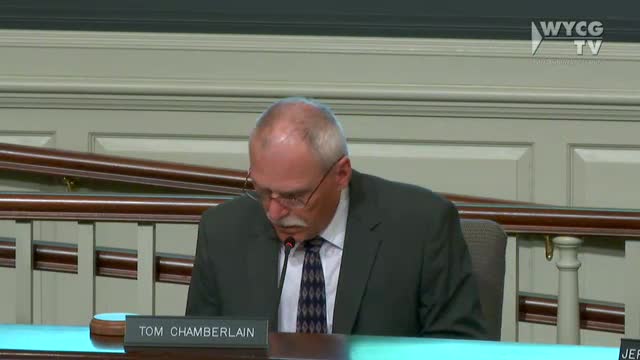
The commission voted to adopt PC 2520. The motion to adopt was made by Mr. Wossmer; Mr. Kriner recorded an abstention. The roll call recorded Mr. Burke — yes; Mr. King — yes; Mr. Wossmer — yes; Mr. Chamberlain — yes. The motion passed.
The amendments follow a February staff work session and are intended by staff to modernize formatting and clarify ambiguous provisions while responding to public and HOA feedback about amenity maintenance and feasibility for smaller developments.
The revised ordinance language and the staff maps showing potentially eligible parcels in lower and upper portions of the county are available in the commission packet and will be forwarded to the Board of Supervisors as the Planning Commission's recommendation.