EFF Austin urges Technology Commission to oppose automated license-plate readers, citing privacy and contract concerns
Loading...
Summary
Kevin Welch, board president of EFF Austin, told the Technology Commission on July 9 that automated license-plate readers (ALPRs) are mass-surveillance tools, described risks identified in the city pilot audit and urged the commission to advise city council against renewal or future adoption.
Kevin Welch, board president of EFF Austin, told the Austin Technology Commission on July 9 that automated license-plate readers, or ALPRs, are “a mass surveillance technology because they canvas an entire area indiscriminately by gathering information about where people were at certain times without a warrant, probable cause, or evidence of criminal wrongdoing.”
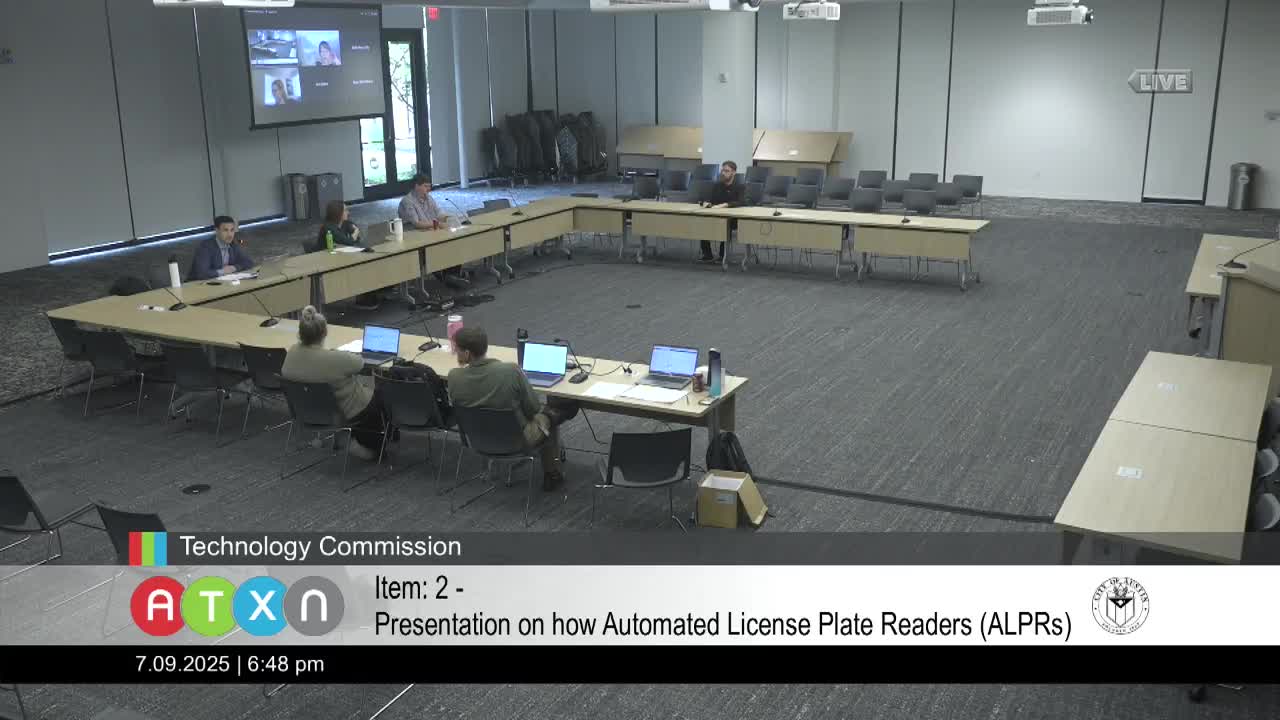
Welch gave a 90-minute presentation and Q&A on the city’s yearlong ALPR pilot and the role of private vendors, including Flock, in operating the system used by Austin Police Department (APD). He said the pilot logged about 75 million plate reads in a year and that only “0.02 percent” of those reads returned matches to the vendor hot lists. He told commissioners that the pilot’s audit and contract language raised “stunning” legal and privacy concerns, notably a contract clause that he said gave the vendor “a nonexclusive, perpetual, irrevocable, worldwide, royalty free, fully paid license to use, reproduce, modify, and distribute the agency data.” Welch said the contract language meant, in practice, Austin did not legally limit the vendor’s use of the data.
Why it matters: Welch framed ALPRs as a policy decision that weighs a small operational benefit against broad privacy and civil‑liberties costs. He described risks including inaccurate reads that have led to wrongful stops, third‑party access or resale of location data, politicized placement of cameras near clinics or places of worship, and real‑world harms such as bounty‑hunter use and a reported fatality linked to ALPR data elsewhere in Texas.
Details from the presentation and discussion: - Technology and vendors: Welch summarized differences between fixed pole ALPRs (Flock) and mobile ALPRs in squad cars (Axon) and said both scan plates indiscriminately and record location and time data. - Efficacy: Welch presented the pilot statistics—about 75 million scans with a hot‑list match rate he described as less than 0.02 percent—and argued that low yield does not justify the privacy risks and recurring vendor licensing costs. - Contract and audit issues: Welch said the city resolution that set limits on data sharing contrasted with the signed contract’s broader vendor license language. He and members of the public and council discovered that the pilot’s web form allowed optional entry for the reason for a search and that about 25 percent of searches lacked a documented purpose, which he called a process failure with significant consequences. - Threats and documented incidents: Welch cited national reporting that law‑enforcement searches across 83,000 ALPR cameras were used to locate a person who had an abortion, a Dallas case in which bounty hunters used ALPR data and a fatal shootout ensued, and reporting that Flock data had been used in immigration enforcement in other states despite local prohibitions.
Commissioner questions focused on vendor practices, data ownership and retention, comparable municipal practices and the pilot’s cost and metrics. Welch said he did not have the exact pilot contract value at hand but estimated “over $1 million, under $10 million.” He said New Hampshire law limits ALPR retention to three minutes and described that as a model for stricter retention limits. Welch urged the commission to continue outreach to council and to the commission’s public‑surveillance working group.
What the commission said: Chair Steven Apodaca thanked Welch and invited follow‑up; several commissioners asked technical and policy questions and expressed interest in continued engagement, including inviting Welch to the commission’s public‑surveillance work group and coordinating with the council liaison.
Ending: Welch said his coalition’s position is “no ALPRs for Austin — not now, not ever,” and he asked the Technology Commission to use its advisory role to educate city council about the risks and to pursue alternatives. Commissioners agreed to continue the conversation and to consider next steps with staff and council liaisons.