Get Full Government Meeting Transcripts, Videos, & Alerts Forever!
Get email alerts on the Micro Mobility topic
No spam. Unsubscribe anytime.
Overland Park begins review of e‑bikes, scooters and other small vehicles; officials flag safety and clarity issues
Summary
Police and staff briefed the Public Safety Committee on the range of personal mobility devices—electric bicycles, scooters, motorized wheelchairs, ATVs and golf carts—and said local ordinances have not kept pace with new vehicle types; staff will review code and propose updates focused on safety, education and clarity.
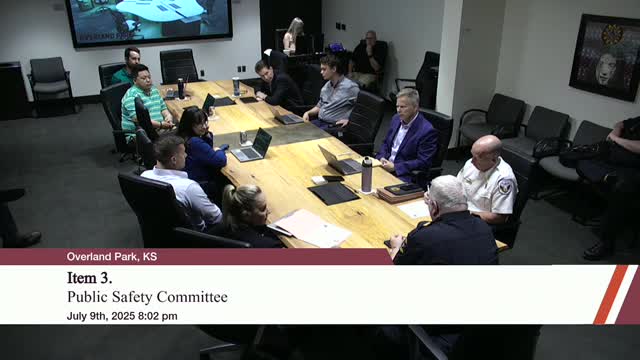
City police and public‑works staff told the Public Safety Committee on July 7 that the rapid rise of e‑bikes, electric scooters and other small motorized devices has created enforcement confusion and safety concerns, and they recommended a full review of municipal code definitions and related traffic rules.
Deputy Chief Harper and Captain Steve Edwards presented a typology of devices in current use—electric‑assist bicycles (classes 1–3), electric scooters, motorized bicycles/mopeds, motor‑driven cycles, electric personal‑assistant mobility devices, motorized wheelchairs, golf carts, ATVs and micro‑utility vehicles. Presenters said state statute and city ordinance sometimes differ, and city code does not clearly cover certain fast electric scooters (examples given included models that can reach 40–60 mph).
Captain Edwards said the municipal code currently allows some devices on sidewalks and bike/hike trails while prohibiting others; that patchwork can confuse residents and officers. For example, the city’s ordinance allows certain bicycles and scooters on sidewalks with the obligation to yield to pedestrians, but other device classes are not defined consistently. Officers told the committee that the ambiguity led to a recent contact in which neither the rider nor officers were certain what the applicable rule was.
Staff outlined next steps: Police and legal will review the city code and consider adopting the State’s Standard Traffic Ordinance language where appropriate to reduce conflicts between municipal and state rules. The review will prioritize safety for vulnerable road users and attempt to identify where different devices should be allowed—on sidewalks, trails, neighborhood streets or arterial roads—and how to educate users and parents.
Committee members discussed the tradeoffs between mobility access and safety. Several members urged focusing on speed differentials and roadway geometry—identifying streets and routes that are appropriate for slower devices and protecting both riders and motorists. Members also suggested using School Resource Officers and community outreach, including bike rodeos and trail wayfinding, to build awareness and encourage helmet use.
Staff said the initial deliverable will be a set of recommended ordinance updates and an educational plan; enforcement guidance for patrol officers could be deployed earlier using mapping and mobile data terminals so officers have clear, on‑duty references while rules are refined.
The committee asked staff to coordinate the ordinance review with planned updates to the Greenway Linkages and Safe Streets planning efforts and to seek input from disability advocates and local multimodal groups.