Get Full Government Meeting Transcripts, Videos, & Alerts Forever!
Upland staff present comprehensive water, recycled-water and wastewater master plans; near-term pipe backlog and fire-flow gaps flagged
Summary
City staff and Brown and Caldwell presented coordinated water, recycled water and wastewater master plans showing an aging-pipe backlog, fire-flow deficiencies and preliminary capital needs; staff will return with formal sewer system management plan adoption July 28 and master-plan reports Aug. 11 to feed a forthcoming rate study.
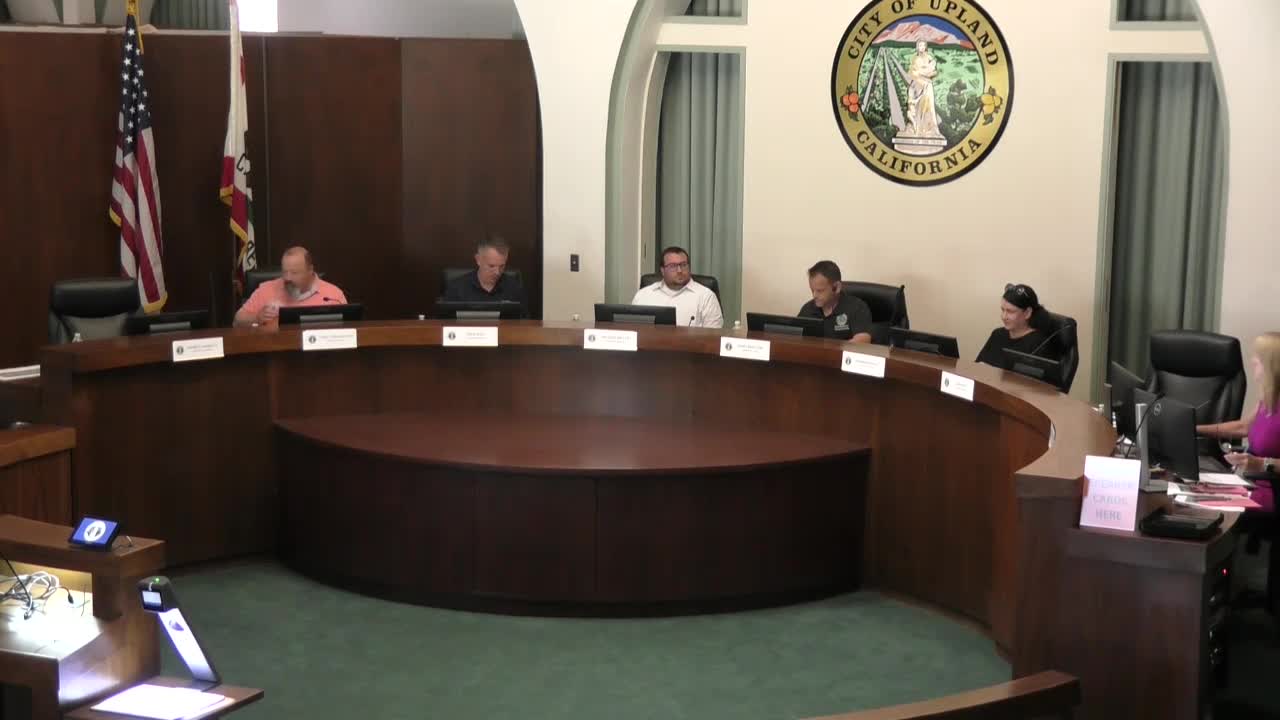
Damien Arul, assistant city manager and public works director, told the Public Works Committee on July 8 that an integrated set of master plans for the city's water, recycled-water and wastewater systems represents “the most comprehensive utilities master planning effort the City has ever undertaken.”
The plans, prepared with consultant Brown and Caldwell, update networks last reviewed between 2006 and 2010 and combine capacity, condition and reliability analyses into a prioritized capital improvement program (CIP). The study found a significant near-term replacement need on the water system, multiple fire-flow deficiencies caused largely by old, undersized pipes, and a multi-decade investment requirement that staff say will feed the city’s ongoing rate study.
Why it matters: The master plans quantify aging infrastructure across systems, identify geographic shortfalls in fire-flow and service capacity, and produce a project list staff say is needed to avoid future emergency repairs and to maintain regulatory compliance. Those project costs will be a central input to a rate proposal the city expects in the fall.
Key findings and next steps
Brown and Caldwell’s team told the committee the city’s supply portfolio is diverse — roughly 64% groundwater, 19% surface water and about 17% imported water — and the overall water balance can meet projected demand under typical scenarios. The consultants also reported no immediate pumping- or storage-capacity failures at wells or pump stations but said they identified many fire-flow shortfalls and a large volume of water pipeline that has reached or passed its useful life.
Ian Jaffe, a Brown and Caldwell project engineer, said: “We didn't find any storage efficiencies or pumping deficiencies at any of the wells or the pump stations. However, we did find a number of fire-flow deficiencies,” and attributed many of those to older 2- to 3-inch mains and to changes in land use that raised fire-flow requirements.
Amy Martin, the Brown and Caldwell project lead, described the modeling approach: updated hydraulic models for water and wastewater, field calibration including hydrant flow tests, and a condition assessment that incorporated a tank study (Harper & Associates) and a pump/well evaluation (Southern California Edison).
The consultants…
Already have an account? Log in
Subscribe to keep reading
Unlock the rest of this article — and every article on Citizen Portal.
- Unlimited articles
- AI-powered breakdowns of topics, speakers, decisions, and budgets
- Instant alerts when your location has a new meeting
- Follow topics and more locations
- 1,000 AI Insights / month, plus AI Chat