
Upland staff present comprehensive water, recycled-water and wastewater master plans; near-term pipe backlog and fire-flow gaps flagged
Get AI-powered insights, summaries, and transcripts
Subscribe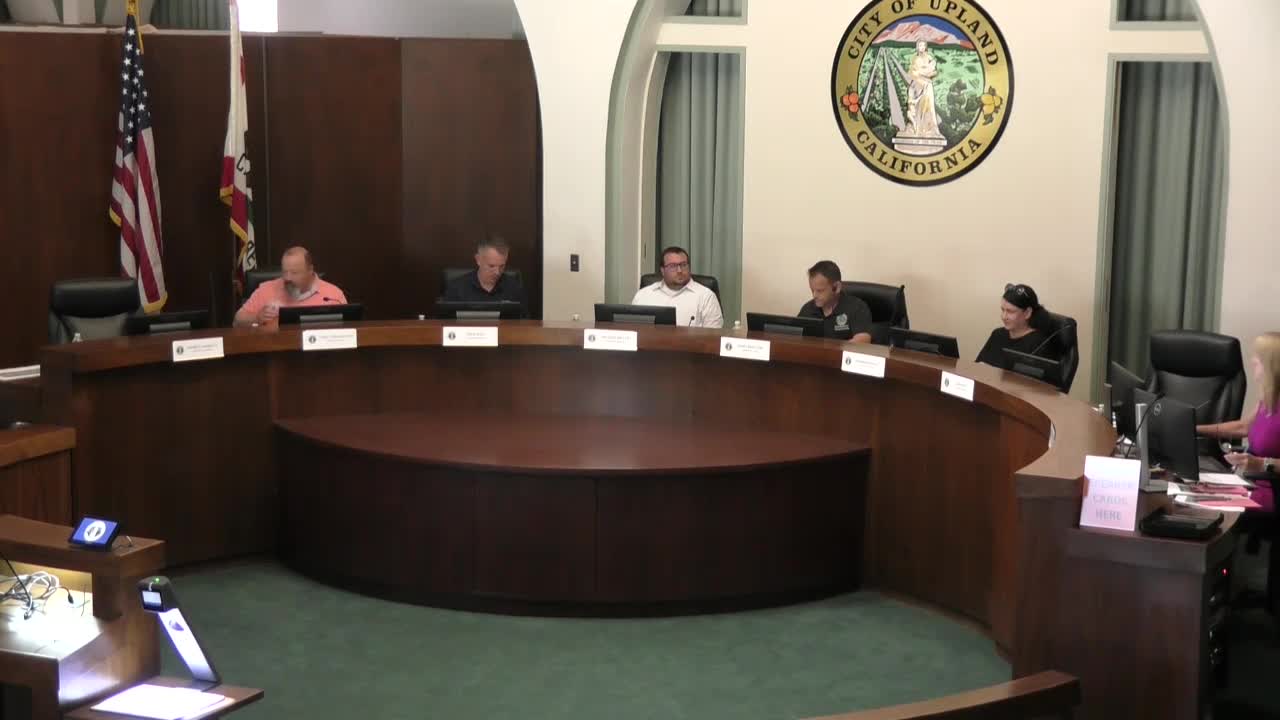
Summary
City staff and Brown and Caldwell presented coordinated water, recycled water and wastewater master plans showing an aging-pipe backlog, fire-flow deficiencies and preliminary capital needs; staff will return with formal sewer system management plan adoption July 28 and master-plan reports Aug. 11 to feed a forthcoming rate study.
Damien Arul, assistant city manager and public works director, told the Public Works Committee on July 8 that an integrated set of master plans for the city's water, recycled-water and wastewater systems represents “the most comprehensive utilities master planning effort the City has ever undertaken.”
The plans, prepared with consultant Brown and Caldwell, update networks last reviewed between 2006 and 2010 and combine capacity, condition and reliability analyses into a prioritized capital improvement program (CIP). The study found a significant near-term replacement need on the water system, multiple fire-flow deficiencies caused largely by old, undersized pipes, and a multi-decade investment requirement that staff say will feed the city’s ongoing rate study.
Why it matters: The master plans quantify aging infrastructure across systems, identify geographic shortfalls in fire-flow and service capacity, and produce a project list staff say is needed to avoid future emergency repairs and to maintain regulatory compliance. Those project costs will be a central input to a rate proposal the city expects in the fall.
Key findings and next steps
Brown and Caldwell’s team told the committee the city’s supply portfolio is diverse — roughly 64% groundwater, 19% surface water and about 17% imported water — and the overall water balance can meet projected demand under typical scenarios. The consultants also reported no immediate pumping- or storage-capacity failures at wells or pump stations but said they identified many fire-flow shortfalls and a large volume of water pipeline that has reached or passed its useful life.
Ian Jaffe, a Brown and Caldwell project engineer, said: “We didn't find any storage efficiencies or pumping deficiencies at any of the wells or the pump stations. However, we did find a number of fire-flow deficiencies,” and attributed many of those to older 2- to 3-inch mains and to changes in land use that raised fire-flow requirements.
Amy Martin, the Brown and Caldwell project lead, described the modeling approach: updated hydraulic models for water and wastewater, field calibration including hydrant flow tests, and a condition assessment that incorporated a tank study (Harper & Associates) and a pump/well evaluation (Southern California Edison).
The consultants presented several quantitative findings the committee discussed: a city water-supply portfolio near 25,000 acre-feet per year in average conditions, a draft estimate of more than 100 miles of water pipe approaching replacement within the next decade, and an initial near-term water CIP estimate the team described as “over $100,000,000” (a figure the presenters called draft and subject to refinement). Ian Jaffe summarized the pipeline replacement rate implied by the plan as roughly 20,000 feet per year in the near term to address the existing backlog, easing to 5,000–6,000 feet per year once the backlog is reduced.
Several committee members pressed for detail on the cost implications. Arul said the master-plan outputs will “directly support the City's comprehensive rate study” and that the study and master plans are being run in parallel so the city can present a rate recommendation informed by the updated CIP. He warned the council that past skipped rate adjustments contributed to the current backlog.
Regulatory items, SSMP and schedule
As part of the wastewater work, the consultants updated a Sewer System Management Plan (SSMP) — a required document tied to state oversight by the State Water Resources Control Board. Arul told the committee staff will bring the SSMP to City Council on July 28 for formal adoption; the city must submit the SSMP to the state by Aug. 2. The master-plan reports themselves will be finalized and presented to council on Aug. 11, the staff said.
Operational and prioritization decisions
Presenters and staff emphasized coordination opportunities: aligning pipeline replacements with planned paving projects to reduce overall cost, prioritizing projects based on deficiency magnitude (for example where required fire flows exceed available flows by large margins) and targeting early work to areas with repeated leaks or elevated risk. Staff also said they are expanding the CIP to include facility security, and plan further site-level facility assessments for wells and treatment sites.
Committee discussion highlighted several technical details: pipe average useful-life assumptions (~60 years for water mains; ~100 years for sewer mains), recent water-quality monitoring that flagged nitrate and tetrachloroethylene at a small number of wells (wells 3 and 8 were discussed), and continued recycling/reuse of treated wastewater through the Inland Empire Utilities Agency partnership.
What was directed
- Staff will return to City Council July 28 with the SSMP for adoption (required for state submission by Aug. 2). - Staff and consultants will finalize master plan reports for an Aug. 11 Council presentation and will incorporate the CIP into the ongoing rate study.
Quotes
“This represents the most comprehensive utilities master planning effort the City has ever undertaken,” Damien Arul said during his introduction of the consultant team.
“We didn't find any storage efficiencies or pumping deficiencies at any of the wells or the pump stations. However, we did find a number of fire-flow deficiencies,” Ian Jaffe said, describing model results.
Context and outlook
Presenters repeatedly described the project list as draft and subject to refinements and additional site-level assessments. Arul and the consultants said the exercise is intended to move the utility away from “run to failure” reactive repairs toward predictable, funded capital replacement that can be smoothed over time in coordination with paving and development projects. The committee asked staff to provide a publicly accessible CIP tracking tool and to pursue coordination with development impact-fee updates so new development pays an appropriate share of system expansion.
Speakers
Damien Arul, assistant city manager and public works director; Amy Martin, Brown and Caldwell (consultant); Ian Jaffe, Brown and Caldwell (consultant); Nicole DeMouette (city staff); Norberto Ferrera (city staff); Hector Gonzalez, senior engineer (city); Mark Warner, utilities supervisor (city); Chair Breitling and committee members present during Q&A.
Clarifying details (as presented)
- Water supply portfolio: ~25,000 acre-feet per year average; ~23,000 AFY expected in dry-year scenarios. - Supply mix cited in presentation: 64% groundwater, 19% surface, ~17% imported. - Master-plan dates: last wastewater master plan 2006; recycled water 2008; water 2010. - Pipe useful-life assumptions: water mains ~60 years; sewer mains ~100 years. - Draft near-term water CIP presented as “over $100,000,000” (consultants called the list draft and still being adjusted); consultants estimated near-term pipeline replacement need at roughly 20,000 feet/year to address backlog. - Historic typical water CIP spending: ~ $12,000,000/year (staff noted one recent year at $22,000,000 due to a large reservoir project). - Wastewater near-term projected annual spend presented near the city’s current $3.5M annual program; long-term sewer replacement needs rise substantially 30–40 years out.
Proper names referenced
Upland; Brown and Caldwell; Inland Empire Utilities Agency; Harper & Associates; Southern California Edison; State Water Resources Control Board; Upland Municipal Code Title 13.
Authorities
- statute: SB 606 / AB 1668 mentioned as statewide mandates informing demand projections (referenced by consultants during demand discussion) - regulation: Sewer System Management Plan (SSMP) requirement administered by the State Water Resources Control Board (referenced by staff and consultant)
Discussion_decision
Discussion points: model results, fire-flow deficiency mapping, pipe-age replacement schedule, coordination with paving, potential development-impact fee adjustments, and facility security/condition assessments.
Directions: staff to bring SSMP to Council July 28 (state submission timeline Aug. 2) and master-plan reports to Council Aug. 11; staff to fold CIP into the rate study and to pursue a publicly accessible CIP tracking tool.
Searchable_tags:["water","wastewater","CIP","infrastructure","master plan","Upland","Brown and Caldwell","rate study","SSMP"]
provenance:{"transcript_segments":[{"block_id":"transcript-72.15","local_start":0,"local_end":556,"evidence_excerpt":"Alright. There he goes. Good evening, Council members and members of the committee. Damien Arul, Assistant City Manager and Public Works Director. I'm joined here tonight by Nicole DeMouette, as well as Norberto Ferrera from our team, and then we will be introducing our consultant momentarily.","reason_code":"topicintro"},{"block_id":"transcript-3022.5598","local_start":0,"local_end":140,"evidence_excerpt":"So, in terms of next steps, we're looking to finalize the sewer system management plan for presentation accounts. That'll come July 28 to the council. That is necessary to submit to the state by August 2. It says a statute requirement that we have for that utility. And then finalize the master plan reports.","reason_code":"topicfinish"}]}