Get Full Government Meeting Transcripts, Videos, & Alerts Forever!
Get email alerts on the Civic Legislation Hearing topic
No spam. Unsubscribe anytime.
Senate Public Safety committee advances wide-ranging bills on price gouging, prison reforms, gun orders and firefighter pay
Summary
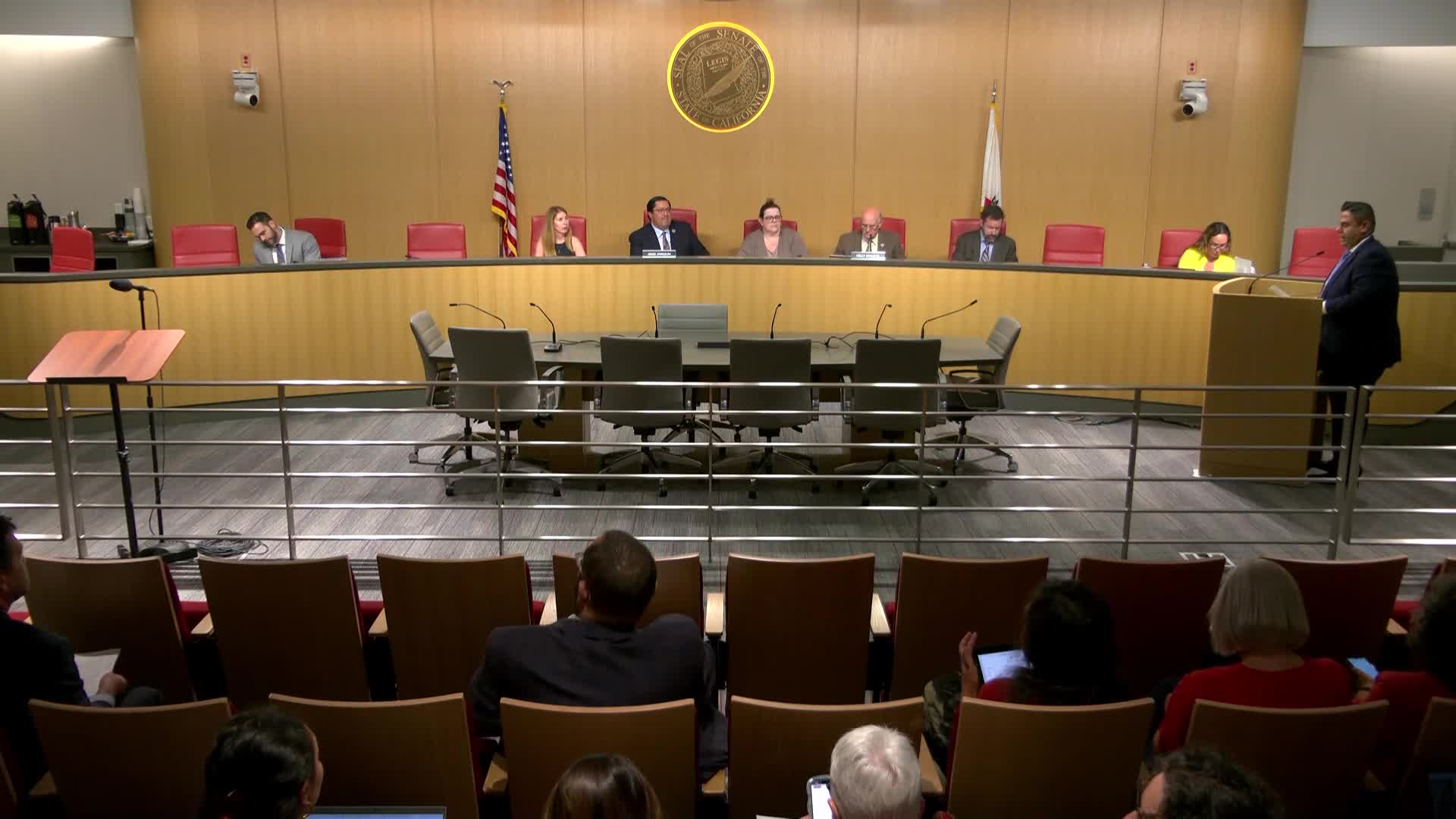
The Senate Public Safety Committee on July 8, 2025, heard testimony and advanced a package of bills addressing disaster price‑gouging protections, burglary tools that use electronic key‑programming devices, prison reforms for women, wildfire survivor protections, gun‑violence restraining orders and pay and reentry pathways for incarcerated firefighters.
The Senate Standing Committee on Public Safety met July 8, 2025, and heard extended testimony on bills addressing disaster price‑gouging, burglary tools that use key‑programming devices, reforms for incarcerated women, protections for wildfire‑impacted homeowners, mental‑health diversion, vacatur for survivors, and wages and resentencing pathways for incarcerated firefighters.
The committee heard authors, law‑enforcement representatives, advocates and survivors for sustained presentations and debate. Several measures received committee votes to move to the Appropriations Committee; others remain under negotiation with stakeholders. Major themes were (1) consumer and small‑business protections after disasters; (2) whether modern electronic key‑programming devices should be treated as burglary tools under Penal Code section 466; (3) expanding rehabilitative programming and oversight for women in state prisons; (4) expanding access and use of gun‑violence restraining orders; and (5) compensation and reentry opportunities for incarcerated firefighters.
“The small business clients we serve do not have the means to pay for attorneys,” attorney Jasmine Poyawan testified during debate on AB 380, which the author described as a response to the Los Angeles wildfires and aimed at strengthening price‑gouging protections for goods, services and certain real property during declared emergencies. The author and supporters said the bill would set time‑limited caps on certain price increases and expand protections for small businesses; several industry groups signaled they were negotiating amendments on the commercial‑property language.
On AB 486, which would amend Penal Code section 466 to add “key programming” and key‑duplication devices to the statutory list of burglary tools, chief law‑enforcement witnesses told the committee that modern electronic devices have been used to steal vehicles by mimicking vehicle keys and that law enforcement lacks explicit statutory authority to act. Opponents, including civil‑liberties groups, warned the expansion could criminalize lawful possession by mechanics and hobbyists and invite biased stops if officers treat possession alone as suspicious.
AB 788, described by its author as a women’s caucus priority, would require the California Department of Corrections and Rehabilitation (CDCR) to restore and strengthen the Female Offender Master Plan and to reestablish accountability structures and a gender‑responsive approach to rehabilitative services. Wendy Still, the original architect of the female offender master plan, told the committee the program’s progress had eroded and urged statutory restoration and oversight.
AB 851 would codify an executive order extending protections for homeowners in ZIP codes affected by the Eaton and Palisades wildfires, and would allow a limited rescission window to undo sales made under emergency pressure. Sponsor testimony described repeated outreach from survivors who reported predatory solicitations in the fires’ aftermath.
AB 46 (mental‑health diversion) drew sharply divided testimony. Prosecutors and law‑enforcement witnesses sought clearer judicial discretion in diversion decisions and cited public‑safety concerns in a small number of high‑profile cases. Public defenders and diversion practitioners urged preserving access to diversion as a public‑safety measure, citing data on lower recidivism among people who receive court‑supervised treatment. Several organizations participated in negotiation over language and burden of proof amendments.
Survivors’ advocates and defenders mounted sustained support for AB 938, a bill to expand vacatur and an affirmative defense for survivors of trafficking and intimate‑partner violence who were criminalized for conduct tied to their victimization; the author accepted committee amendments narrowing vacatur access for murder convictions and preserving judicial review.
Two related bills focused on incarcerated firefighters. AB 247 would raise pay for incarcerated hand‑crew firefighters to federal minimum wage while working fires; supporters called it a dignity and reentry measure, while sheriff and county groups raised concerns about who would bear the added wage cost and whether counties would reduce camp deployments. AB 812 would create a process for CDCR to recommend crew members for resentencing consideration; sponsors said it would be a judge‑controlled pathway, not an automatic release.
The committee also debated AB 1269 (notification to families when a person dies in county or municipal custody), AB 704 (sealing and destruction of certain low‑level convictions committed before age 26), AB 572 (requirements for law‑enforcement interactions with families of people killed or seriously injured by officers), and AB 847 (clarifying civilian oversight commissions’ access to records and their ability to meet in closed session). Many of those measures drew testimony from impacted families, advocacy groups and law enforcement; sponsors said the bills sought narrowly tailored reforms to protect victims, families and public safety.
At the close of the hearing, the committee took motions and roll calls. Multiple measures were ordered to the Appropriations Committee; several votes remained subject to final attendance and further negotiation. Committee members repeatedly urged continued in‑room negotiations between authors and opposition groups on technical language and implementation to reduce unintended consequences.
Ending: The committee recessed to continue negotiations; authors and stakeholders committed to ongoing talks. Several measures advanced with committee approval to Appropriations; others remained under active discussion.
Votes at a glance (committee action to Appropriations or floor, July 8, 2025): - AB 46 (clarify judicial discretion in mental‑health diversion): passed out of committee as amended (moved to Appropriations). - AB 247 (incarcerated firefighter pay to federal minimum wage): passed out of committee (moved to Appropriations). - AB 1269 (custody‑death family notification): passed out of committee. - AB 704 (sealing/destruction for certain convictions before age 26): passed out of committee. - AB 812 (resentencing pathway for incarcerated firefighters, pilot/DA recommendations): passed as amended to Appropriations. - AB 788 (female offender master plan / CDCR reforms): passed out of committee. - AB 812 and AB 247 were both advanced; AB 812 contains standards to preserve judicial discretion on resentencing petitions. - AB 380 (price‑gouging protections): advanced out of committee with members retaining some concerns about commercial property language; negotiations continue. - AB 486 (add key‑programming devices to burglary tools under Penal Code section 466): advanced for further consideration; opponents requested narrow technical exemptions for mechanics/legitimate owners. - AB 851 (rescission window for wildfire ZIP codes): advanced. - AB 938 (vacatur and affirmative defense for survivors): advanced as amended; the committee narrowed vacatur eligibility for murder convictions but kept judicial review. - AB 572 (admonitions and family protections in officer interviews with grieving family members): advanced; authors and law enforcement agreed to continue working on language to avoid interfering with urgent investigations. - AB 847 (civilian oversight access to personnel records, closed sessions): advanced; negotiations on confidentiality safeguards and ongoing litigation were noted. - AB 1078 (updates to CCW/firearms law to reflect recent caselaw): advanced to Appropriations.
Committee action notes: Most measures were advanced to the Appropriations Committee for fiscal review or moved toward floor consideration; for bills with active opposition, authors accepted further work with stakeholders.
Quotes (selection): - “If you're a commercial property owner and you're not price‑gouging, you have nothing to be worried about,” Assemblymember Mark Gonzales said while presenting AB 380, urging protections for small businesses after disasters. - “Existing law outlines rudimentary tools — picks, slim jims — when it describes burglary tools,” Jonathan Feldman of the California Police Chiefs Association said in support of AB 486, adding that courts have not explicitly covered modern programming devices. - “This bill will restore and strengthen CDCR's commitment to providing safe, appropriate, and effective services that are both gender responsive and trauma informed,” Wendy Still said in support of AB 788.
What to expect next: Several measures will be refined in follow‑up negotiations with interested parties and technical amendments preparing bills for Appropriations. Authors and opposing groups signaled a willingness to continue talks to narrow definitions, carve out narrow exemptions and protect due process while seeking the bills’ stated objectives.