Get Full Government Meeting Transcripts, Videos, & Alerts Forever!
Get email alerts on the End Of Life topic
No spam. Unsubscribe anytime.
Assembly committee moves to preserve California’s End of Life Option Act permanently with SB 403
Summary
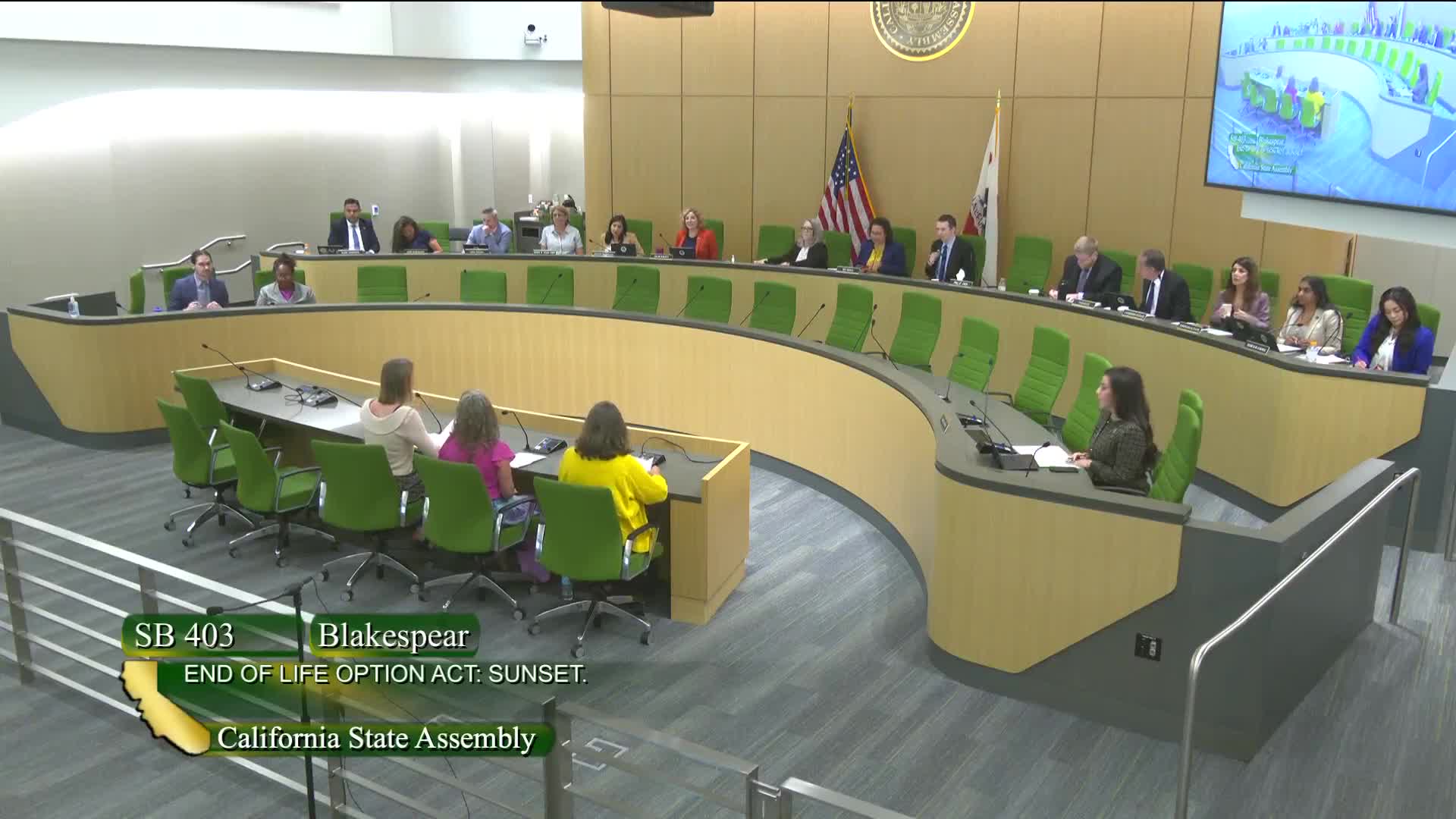
SB 403 would remove the 01/01/2031 sunset from California's End of Life Option Act, making the medical aid-in-dying law permanent. Supporters — including physicians, hospice social workers and family members — described the law as functioning safely and compassionately over nine years; the committee passed SB 403 to the Judiciary Committee.
SB 403, which would remove the sunset provision from California’s End of Life Option Act, won committee approval on July 8 and will proceed to the Judiciary Committee. The bill’s author, Senator Blake Spear, and multiple witnesses described the law as working safely since it took effect in 2016 and urged the committee to make it permanent.
Senator Blake Spear told the committee the End of Life Option Act gives mentally capable, terminally ill adults with a prognosis of six months or less another option and reviewed the law’s multiple safeguards including two oral requests, a written request with witnesses, and evaluations by two doctors. "Nine years of data show the law is working exactly as intended," Spear said, noting that state data shows thousands of Californians have used the option and that a large majority were enrolled in hospice or palliative care at the time.
Family members and clinicians offered first-person accounts. Bonnie McKegan described her mother’s 2018 death under the law after years of metastatic cancer and said removing the sunset would ensure future patients the same option. Physician Catherine Forrest, who has prescribed aid-in-dying medication, recounted the case of her late partner and said the law provided agency and relief in a terminal diagnosis.
Opposition witnesses included representatives of faith-based groups and Catholic health associations who urged the committee to oppose permanence.
Committee action and next steps
The committee passed SB 403 to the Judiciary Committee. The motion was moved and seconded in committee; supporters said the bill preserves — rather than expands — the existing law and retains all statutory safeguards.
Why this matters
Removing the sunset would eliminate uncertainty for patients, clinicians and families who rely on the law’s option. Supporters argued the data from the California Department of Public Health and clinical experience show the law operates with safeguards; opponents raised ethical and moral objections and urged continued review.
Votes at a glance
Action: Motion to pass SB 403 to Judiciary — Passed (committee roll call recorded)