Get Full Government Meeting Transcripts, Videos, & Alerts Forever!
Get email alerts on the Care Court topic
No spam. Unsubscribe anytime.
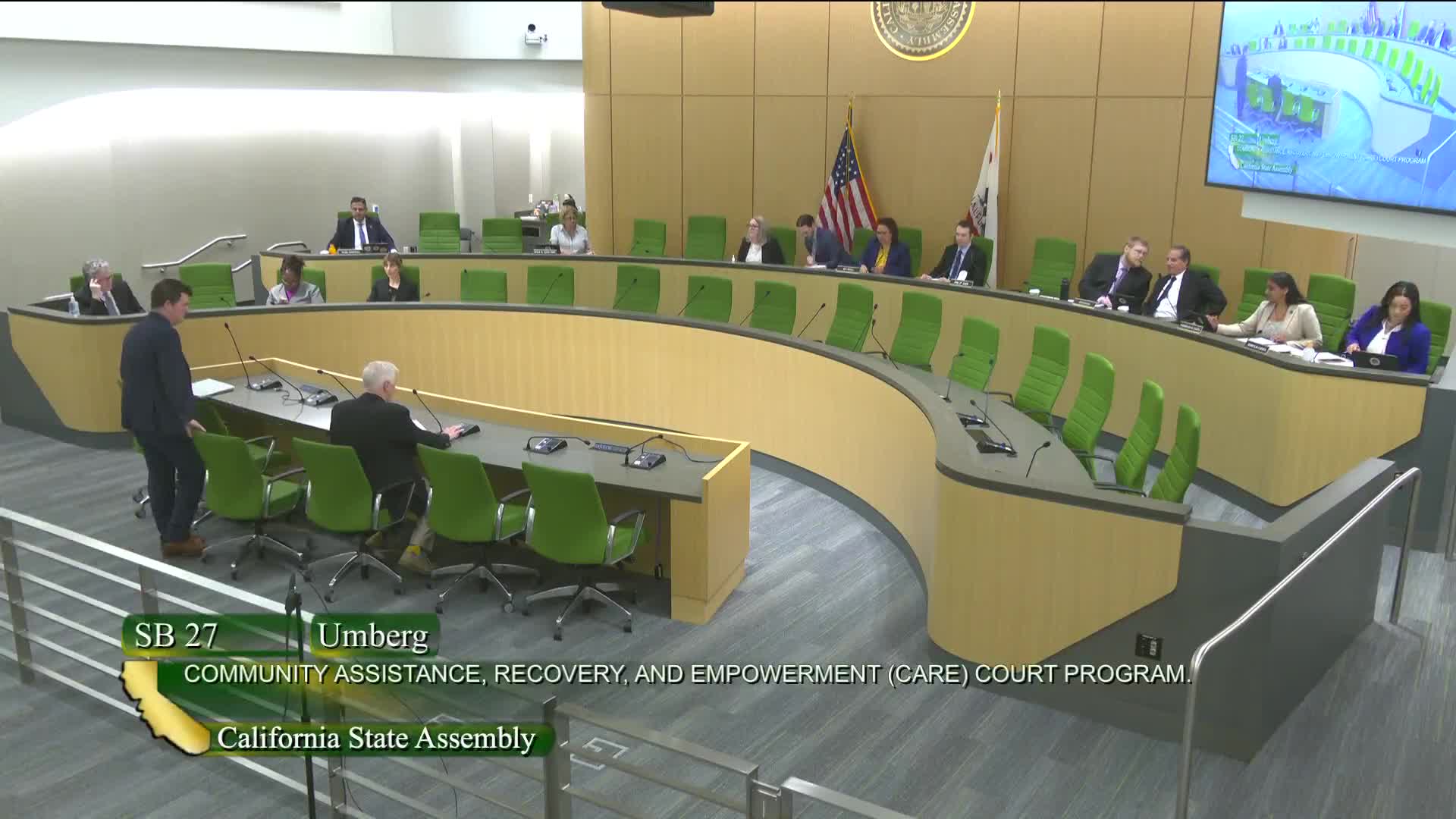
Assembly Health Committee approves SB 27 to refine Care Court eligibility and clarify clinical stabilization
Summary
Senators and witnesses told the Assembly Health Committee on July 8 that SB 27 would tighten definitions and preserve safeguards in California’s Care Court process while narrowly extending eligibility to people with bipolar I disorder accompanied by psychosis.
Senators and witnesses told the Assembly Health Committee on July 8 that SB 27 would tighten definitions and preserve safeguards in California’s Care Court process while narrowly extending eligibility to people with bipolar I disorder accompanied by psychosis.
Supporters said the bill addresses a high dismissal rate for family petitions and clarifies that mere enrollment in treatment does not automatically mean a person is "clinically stabilized." "For respondents who were already enrolled in treatment prior to petition filing, why would people take the time and effort to complete these petitions when everything is fine?" said Aaron Meyer, behavioral health officer for the city of San Diego and a practicing psychiatrist. Meyer cited a state report that he summarized as showing a high percentage of family petitions were dismissed and said SB 27 would reduce dismissals by clarifying that stabilization requires more than enrollment alone.
The bill’s author, Senator Tom Umberg, told the committee Care Court was intended to create accountability across counties, providers and individuals and that the amendments remove a prior, broader expansion of mood-disorder eligibility to instead limit the expansion to bipolar I disorder with psychotic features.
Family members who supported SB 27 described using Care Court as a last option after other treatment levels failed. "My daughter tried every other level of care available, and none of them have been enough," said Elizabeth Keanu Hopper, a family member who testified in support. She described Care Court as "the next least restrictive option" for her daughter.
County behavioral health officials and peer-run organization representatives opposed or urged caution. Michelle Cabrera of the County Behavioral Health Directors of California said counties were concerned that the bill’s urgency clause would cause a sudden increase in petitions "without more staff, resources, and perhaps more importantly, the housing to satisfy the courts." Cabrera said counties had already spent down an initial allocation of behavioral health bridge housing and warned that court timelines could strain staffing and engagement efforts. The California Association of Mental Health Peer-Run Organizations’ executive director Lynn May Rivas, speaking from lived experience with bipolar I with psychosis, warned against coercive processes and advocated for peer-run community services.
Agency witnesses described upcoming funding and policy changes they said would help. Stephanie Welch, deputy secretary at the California Health and Human Services Agency, said beginning July 1, 2026, counties would be able to use Behavioral Health Services Act dollars for housing supports and that many people who petitioned while unhoused later obtained housing; she characterized the expected increase in eligible people under the bill as a small fraction once all Care Court criteria are applied.
Committee action and next steps
The committee took and accepted amendments that: limit the expansion to bipolar I disorder with psychotic features; strike certain paragraphs from the clinically stabilized definition so that enrollment alone is not sufficient; and narrow the role of nurse practitioners and physician assistants to allow them to provide affidavits rather than be treated as full licensed behavioral health professionals in the statute. The committee voted to pass SB 27 to the Committee on Public Safety. The motion was raised by Assemblymember Aghaier Curry and seconded by Assemblymember Patel; the roll call reflected the committee's recorded yes votes and the measure moved forward.
Why this matters
Care Court remains a contested, resource-dependent civil process that links courts, counties, and behavioral health providers. Supporters say clearer definitions will reduce petition dismissals and get help to people who repeatedly decompensate; counties say capacity limits and housing availability must be resolved before expansions take effect. SB 27’s urgency clause and its timing relative to county capacity were central concerns raised during debate.
Votes at a glance
Action: Motion to pass SB 27 to the Committee on Public Safety — Passed (committee roll call recorded)