Get Full Government Meeting Transcripts, Videos, & Alerts Forever!
Get email alerts on the Arpa Funds topic
No spam. Unsubscribe anytime.
Skagit County details roughly $25 million in ARPA spending on public health, homelessness, behavioral health and broadband
Summary
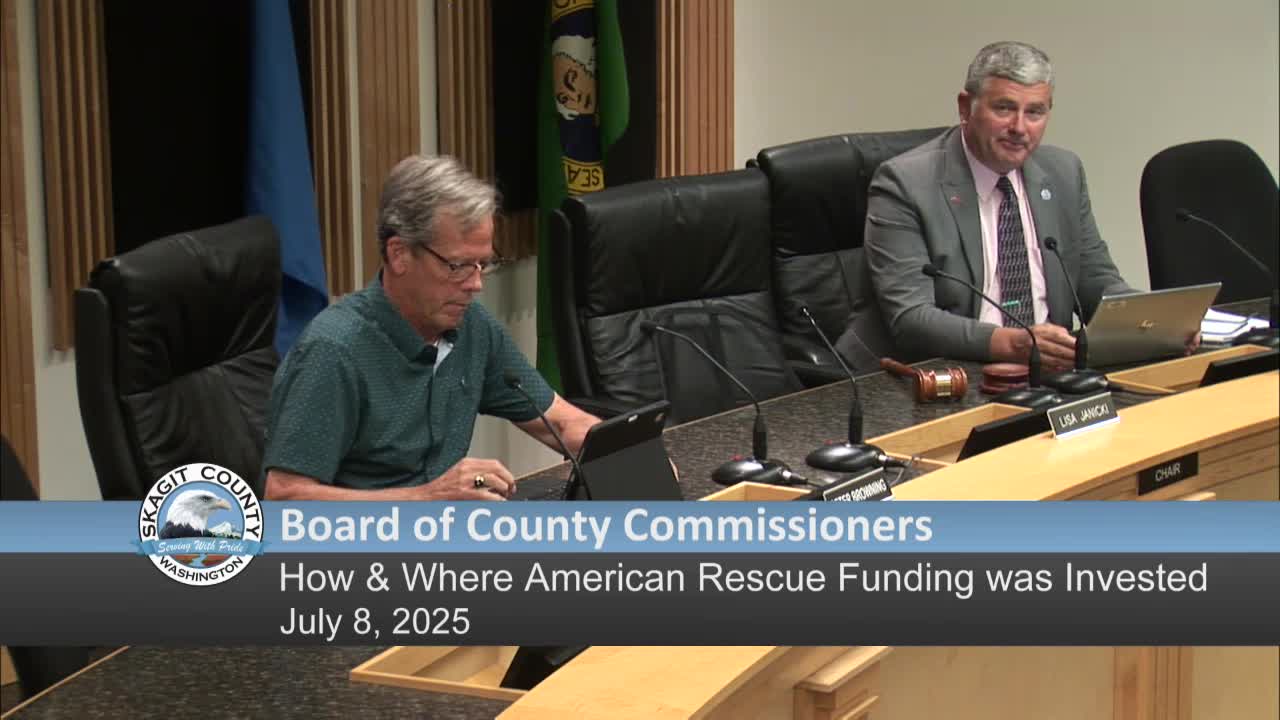
Deputy Administrator Jennifer Johnson told the Skagit County Board of Commissioners on July 8 that the county allocated about $25 million in American Rescue Plan Act funds to expand public‑health capacity, emergency management, behavioral health, shelters, childcare and broadband, with some funds still unspent and earmarked for future priorities.
Deputy Administrator Jennifer Johnson told the Skagit County Board of Commissioners on July 8 that the county allocated about $25 million in American Rescue Plan Act (ARPA) State and Local Fiscal Recovery Funds to address pandemic-related needs including public health capacity, emergency management, behavioral health, homelessness and broadband expansion.
The sums and projects Johnson described aim to convert one‑time federal aid into longer‑term services and infrastructure: investments included expanded public‑health staffing and clinics, more emergency‑management equipment and an incident‑command van, several homelessness shelter and motel‑voucher programs, grants and start‑up funding for childcare, behavioral‑health staffing and programs for children, and broadband mapping and fiber build matching funds.
Johnson said the Treasury program delivered the county “approximately $25,000,000” in two payments and that the final Treasury rule for State and Local Fiscal Recovery Funds allowed local governments broad flexibility to spend on pandemic response and on certain services affected by the pandemic. She told commissioners the county used about $10 million as the permitted revenue‑replacement option and that about $4.3 million of ARPA funds remained unspent at the end of 2024 and were earmarked for future commissioner priorities.
The largest single categories Johnson highlighted were social‑safety‑net and behavioral‑health investments. She said commissioners invested more than $5.7 million in programs addressing social determinants of health, including child‑care retention and expansion, perinatal behavioral‑health support, a county food‑security plan and a Latinx mental‑health navigator program. On behavioral health, she said the county invested another “over $5,700,000” for services ranging from promotor(a) outreach and syringe‑exchange staffing to crisis‑response teams and a planned voluntary treatment facility called the Star Center.
Johnson described several homelessness and shelter investments: startup costs for the First Step Shelter in Burlington, a 45‑unit pallet shelter that she said serves roughly 700 people annually; a motel‑voucher program run by Friendship House that housed 44 households with an average stay of about 60 (Johnson did not specify the unit, which the transcript presents as “60”); four winter shelters operated by community providers; a bridge motel program for high‑need individuals transitioning into Martha’s Place (a 70‑unit permanent supportive housing project); and a $600,000 ARPA backfill to cover a shortfall in document‑recording fees that fund nine local homeless‑service providers.
Public‑health spending funded testing and vaccination sites, expansion of the public‑health workforce (including temporary hires that became permanent), a new clinic space with improved access and AV for training, and the re‑establishment of a local Medical Reserve Corps (MRC) with a paid coordinator. Johnson said the county’s low‑barrier testing site and later drive‑through vaccination operations drew residents from neighboring counties during the pandemic.
Emergency‑management investments totaled about $1.1 million, Johnson said. She said that covered improvements to the county Emergency Operations Center, mobile radio and vehicle communications, training and planning support, an incident‑command van, and two Zodiac boats equipped for flood response and search‑and‑rescue support for areas such as La Conner. The county also funded a consultant feasibility study for a proposed “safety campus” to co‑locate training and possibly portions of emergency‑management and public‑safety functions.
Johnson said the county directed more than $2.8 million to learning and behavioral‑health services for school‑age children, including four social workers who conducted more than 5,800 sessions countywide and a school‑based clinical model contracted through the Northwest Educational Service District. She said crisis‑response services were expanded so licensed social workers and mental‑health professionals could pair with deputies to de‑escalate crises and provide follow‑up case management instead of relying solely on law enforcement.
On economic and workforce recovery, Johnson listed programs run through the county’s economic development arm (EDASC) including a small‑business mental‑health pilot (Novati), the Northwest Innovation Resource Center, a RAIN accelerator role that served 320 entrepreneurs through 153 workshops, and technical assistance for agricultural producers to reconnect with wholesale markets. Broadband actions included about $1 million of county investment: $100,000 for broadband mapping and planning to support a BEAD application and a 10% match for a grant to build about 36 miles of fiber to serve the Bow community.
Johnson and the commissioners framed many expenditures as one‑time investments intended to avoid long‑term staffing commitments. She noted the county used allowed “revenue replacement” ($10 million of the allocation) and that commissioners nonetheless directed roughly $5 million of that revenue‑replacement toward the pandemic priorities described.
Commissioner Janicki, who joined the meeting online, and Commissioner Browning both thanked Johnson and staff for the presentation and for setting priorities early in the pandemic. Browning said the presentation was “a really, really accurate and really good depiction” of the county’s response.
The presentation ended with Johnson asking whether commissioners had questions; the board scheduled a 3 p.m. legislative update later the same day and then adjourned.
Sources: July 8, 2025 Skagit County Board of Commissioners meeting transcript (presentation by Deputy Administrator Jennifer Johnson).