Get Full Government Meeting Transcripts, Videos, & Alerts Forever!
Get email alerts on the Proposition 36 topic
No spam. Unsubscribe anytime.
San Diego County DA: Proposition 36 implementation has driven treatment uptake and new arrests; counties warn funding shortfall
Summary
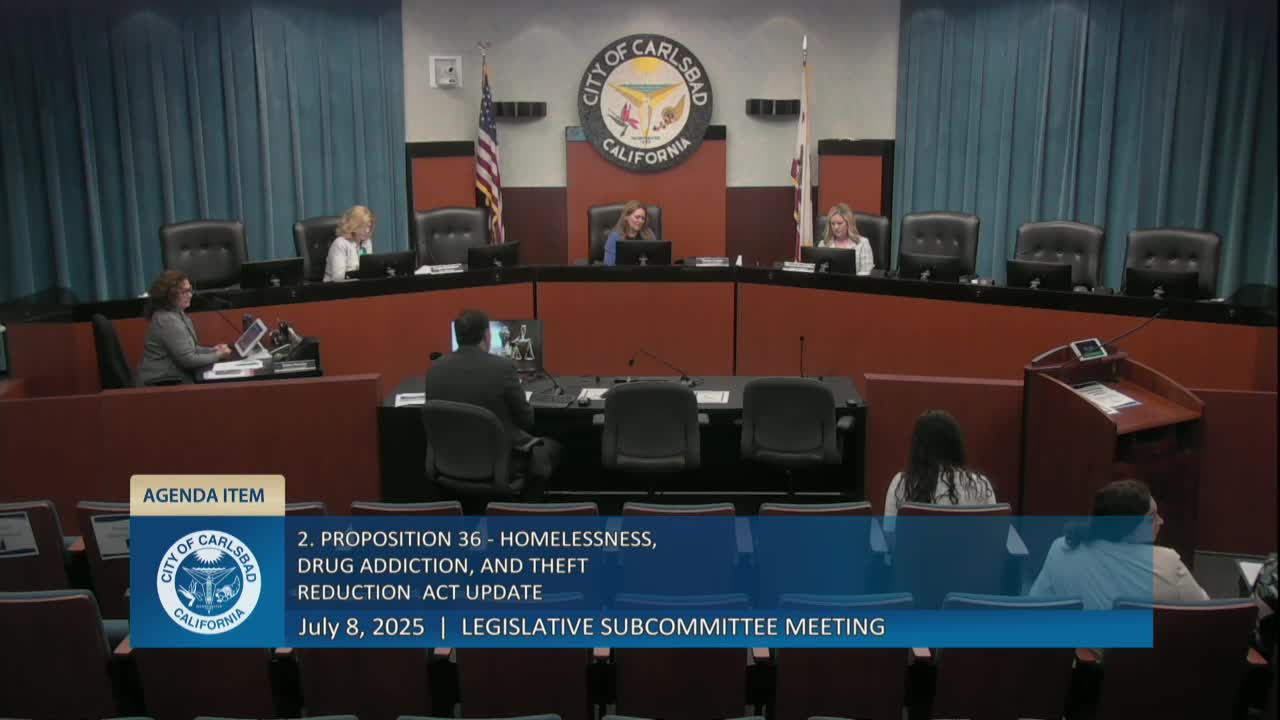
San Diego County District Attorney Summer Stephan told the Carlsbad City Council legislative subcommittee that countywide implementation of Proposition 36 has increased treatment referrals and arrests for repeat theft and drug offenses, but officials say long‑term funding remains uncertain.
San Diego County District Attorney Summer Stephan told the Carlsbad City Council legislative subcommittee that countywide implementation of Proposition 36 has produced high rates of treatment acceptance and has changed how officers and prosecutors handle repeat drug and theft offenders.
Stephan spoke at length about components of Proposition 36, formally referred to in the meeting as the Homelessness, Drug Addiction and Theft Reduction Act, describing new prosecutorial enhancements for dealers of fentanyl and methamphetamine, a countywide behavioral health assessment process implemented April 7, and a treatment‑mandated felony pathway for qualifying habitual drug users.
The measure, approved by voters in November and effective December, includes changes that allow prosecutors to seek heavier penalties when drug sales result in severe injury or death, and it brings fentanyl within weight‑enhancement frameworks previously applied to other drugs. "This section also brought my state prosecutors in line with federal prosecutors," Stephan said. She added that many of the new provisions were written by county prosecutors and went into effect immediately.
Stephan said the county began a standardized assessment program on April 7 that determines whether a person should receive six to 18 months of residential or outpatient treatment. "We're one of the first counties to do that," she said, and reported that more than 80% of people offered the treatment pathway accepted it; she said only one person chose jail instead of treatment. She said about 175 cases had entered the treatment‑mandated track and that it was too early to report long‑term outcomes such as conviction dismissals tied to successful completion of treatment.
On theft, Stephan said prosecutors had handled roughly 1,400 countywide qualifying cases since implementation, with North County accounting for about 32% of those. She told the committee that roughly 450 of the countywide caseload were theft‑related, and that many individuals charged under the law have long prior histories. "Not everybody, not the first time person who steals something that is food or a necessity, will still be eligible for probation, for treatment, for diversion. It is about the habitual offenders," she said.
Stephan credited law enforcement for quickly implementing the changes: she said all 5,000 county officers received training on the new sections so arrests and filings could be handled correctly from day one. She also described operational tools and programs linked to implementation: Shelter Ready, an app launched countywide on June 9 that helps officers and social workers locate available shelter beds rapidly, and local pilot participation by Carlsbad Police and North County providers.
Committee members asked detailed questions about funding and sustainability. "How long they can sustain it? I don't think any of us know but we know we can't sustain it in the way we want to unless additional funding comes," Stephan said, noting the county had set up programming with behavioral health and health and human services but that treatment capacity and long‑term funding remain concerns. Council members and the DA discussed the state budget appropriation for implementation; at least one speaker referenced a $100 million allocation in the state budget packet presented earlier in the meeting, but Stephan emphasized that ongoing funding beyond one‑time allocations will be necessary to maintain capacity.
Carlsbad officials and staff discussed local coordination with county partners. Council members praised the Carlsbad Police Department and Chief Christy Calderwood for early operational work and pilot testing of technology tools; Mandy Mills, Carlsbad's director of housing and homeless services, joined later in the meeting to describe local homelessness and shelter capacity concerns and to ask for clarity about funding responsibilities for interim shelter and case management should the state add requirements.
Stephan and council members also discussed recent and pending state legislation that could affect Proposition 36 implementation, including AB 1231 (mentioned during the meeting as a potential bill that would broaden felony diversion) and SB 16, as well as SB 43 and the Care Act in the context of behavioral health responses. Stephan flagged AB 1231 for the committee as a proposal she believed could undercut parts of Proposition 36 and said she had sent a letter opposing it.
The presentation concluded with Stephan offering staff contacts from her office for follow‑up and with the committee signaling support for continued coordination on treatment access and shelter readiness.