Get Full Government Meeting Transcripts, Videos, & Alerts Forever!
Get email alerts on the Public Engagement topic
No spam. Unsubscribe anytime.
Board sets community engagement process for ARPA/general‑fund reserves, agrees to up to $15,000 per district and delays final allocation to October
Summary
Supervisors agreed to fund local community engagement for allocation of formerly reserved COVID‑era funds, approving up to $15,000 per supervisorial district for town halls and outreach. The board pushed the final decision on allocations to an October board meeting to allow more time for community input and federal budget clarity.
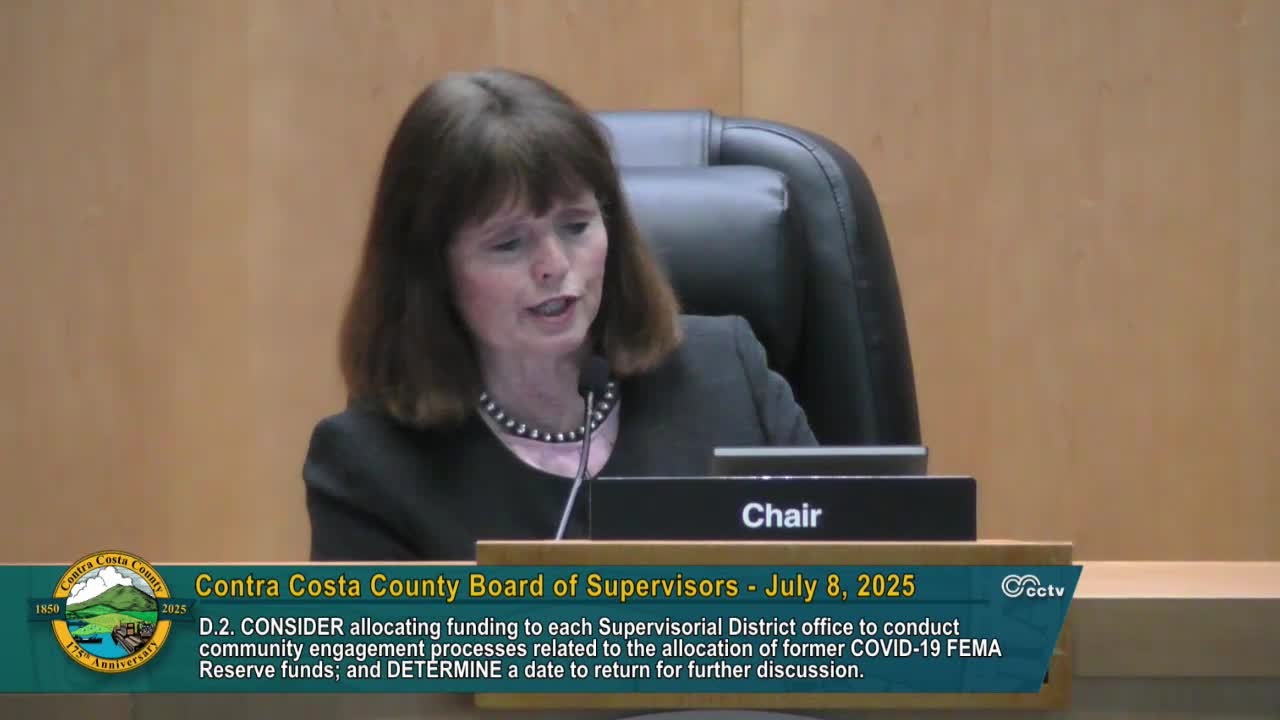
The Contra Costa County Board of Supervisors on July 8 approved a plan to fund district‑level community engagement as it considers how to allocate COVID‑era reserve funds now held in the general fund, resolving to provide up to $15,000 per supervisorial district for town halls and outreach and moving the final allocation decision to an October board meeting.
The board had previously indicated support for $1,000,000 per district to support community processes. At the July 8 meeting staff presented cost estimates for in‑person meetings, including interpretation and facility rental, and noted those estimates can vary widely by district depending on the number of town halls each supervisor chooses to host.
Nut graf: Supervisors approved a motion to allocate up to $15,000 per district for community engagement, with a request that chiefs of staff work with county administrators to develop a common input form and return with implementation details. Supervisors also postponed the board's final allocation decisions to an October 21 meeting to allow more time for outreach and to await greater clarity on the federal budget and related needs.
What the board decided and why
Chief Assistant County Administrator Tim McDonald advised supervisors that simultaneous interpretation, full‑day interpretation, and facility rentals are major cost drivers and estimated $2,500–$5,000 per town hall depending on translation needs and duration. The board discussed options ranging from single large town halls to multiple smaller meetings in districts where geography or language diversity make wide outreach necessary.
Supervisor Diane Burgis proposed and the board approved a motion to allow each district discretion to spend up to $15,000; supervisors said they expected to spend less in some districts and more in others depending on local needs. The funds will be used for outreach and engagement to inform how to allocate remaining ARPA/general‑fund reserve dollars that the board intends to dedicate to community needs.
The board also asked staff to develop a standardized intake/feedback form that supervisors' offices can use at town halls and online so responses can be aggregated and compared across districts. Chiefs of staff will meet with county staff to design the form and return with a plan ahead of the fall outreach.
Timing and next steps
Supervisors set a target return date of Oct. 21, 2025, for final decisions on allocations after the fall engagement process. The earlier plan to return on Aug. 5 was delayed after supervisors urged more time for summer schedules and broader participation. Several supervisors said they preferred waiting to see the federal 2026 budget and other developments to better understand county funding gaps.
Community and staff considerations
Supervisors emphasized the need for translation, food, and accessible venues to encourage broad attendance. Several supervisors and public commenters urged partnering with community‑based organizations to reach residents who are not typically engaged through county channels. Staff noted the county has an existing “Empowering Enrollment” program to help residents access public assistance and will be launching an RFP to partner with nonprofits for outreach and enrollment work.
Ending note
The board's decision creates a modest—but flexible—local engagement budget while delaying final funding decisions until fall so supervisors can present aggregated public input when considering how to allocate remaining ARPA/general fund reserves.