Get Full Government Meeting Transcripts, Videos, & Alerts Forever!
Get email alerts on the Guaranteed Income topic
No spam. Unsubscribe anytime.
Board approves ‘Contra Costa Thrives’ guaranteed-income pilot after debate over eligibility and evaluation
Summary
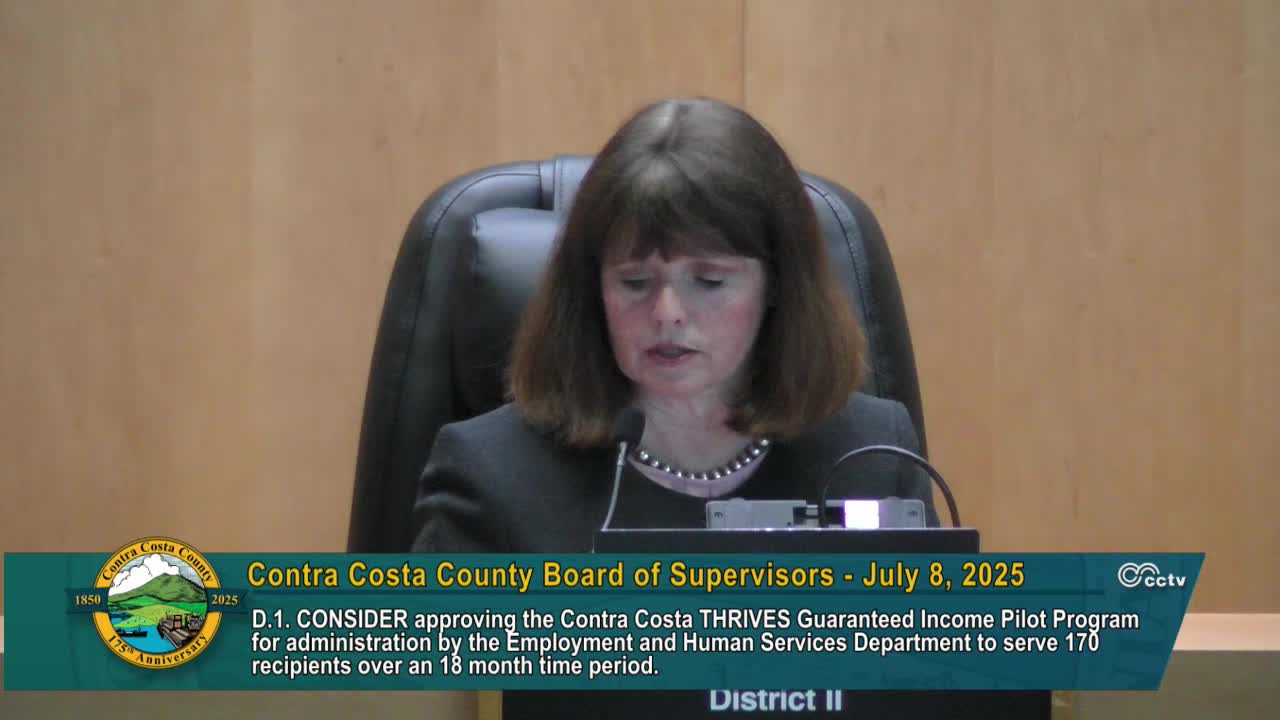
The Contra Costa County Board of Supervisors on July 8 approved a pilot guaranteed‑income program, Contra Costa Thrives, that will deliver monthly cash payments to about 170 people drawn from county program caseloads over an 18‑month period, funded with Measure X and AB 109 money.
The Contra Costa County Board of Supervisors on July 8 approved a pilot guaranteed‑income program, Contra Costa Thrives, that will deliver monthly cash payments to about 170 people drawn from county program caseloads over an 18‑month period, funded with Measure X and AB 109 money.
County Director of Employment and Human Services Marla Stewart presented the plan and said the pilot will use $3,250,000 in Measure X funds plus $1,000,000 in AB 109 funding to test outcomes for four target populations and to fund an evaluation. “We are recommending a long‑term evaluation to you because that's one thing that's missing in this field,” Stewart said during the presentation.
The proposal directs EHSD to enroll recipients from four county programs—independent living services for former foster youth, CalWORKs welfare‑to‑work families, probation clients returning from incarceration, and Adult Protective Services clients age 60+ at risk of homelessness—and to use existing case managers to provide voluntary supportive services. Selected participants will receive a total of $18,000 each distributed over either 12 or 18 months, with three payment‑option schedules available and a tapering in the last six months to reduce the risk of an abrupt “cliff” when payments end.
Stewart told supervisors the plan is designed so most funds go to direct payments: “With our plan, we can dedicate 75% of the budget to direct payments,” and she said the county team proposed contracting UC Davis to manage a literature review and evaluation. The presentation identified a proposed $615,111 allocation for a five‑year longitudinal evaluation (roughly 14% of the pilot budget), roughly $160,000 of which would be participant incentives.
Nut graf: The board approved the pilot after hour‑long discussion in which supervisors and community members voiced competing priorities—some urged broader eligibility that would include people not currently enrolled in county programs, while county staff and other supervisors argued that using existing casework relationships reduces administrative costs and allows a greater share of scarce funds to go directly to payments. The vote authorizes EHSD to implement the pilot as presented and to begin payments in mid‑January 2026, with a long‑term evaluation to follow.
Details of the pilot and debate
EHSD project manager Ayesha Teal and Stewart said the county expects roughly 1,400 referrals from caseworkers across the four program areas, with UC Davis to conduct random assignment for the first three populations (probation, CalWORKs parents, and foster youth), and a different screening process for older adults served by Adult Protective Services. Stewart said the county will hold mandatory orientation sessions for candidates to explain benefits‑counseling (how GI affects eligibility for other programs) and financial counseling before candidates consent and are randomized to the recipient or control groups.
Probation Chief Eamon Krause and other department leads participated in the planning team in chambers, Stewart said. She described the plan as built from several sources: the Measure X Community Advisory Board allocation direction, the Contra Costa GI Collaborative's proposal, a UC Davis literature review, and feedback from community meetings.
Several supervisors said they favored funding direct payments while cutting evaluation costs; others argued for keeping a longer‑range evaluation to produce evidence that could inform state or federal policy. "We will do whatever you want," Stewart told the board when supervisors asked whether the evaluation could be shortened. Supervisor John Gioia pushed for a larger share to go to recipients; Supervisor Chanel Scales‑Preston said evaluation funds could be reduced so more people can be served, and asked that community partners be involved in any evaluation design.
Public comment and community demands
Dozens of community members and community‑based organizations urged the board to broaden eligibility beyond county clients, saying many people in need are not connected to county programs and that contracting community organizations would improve outreach and trust. Joanna (representing the Contra Costa Guaranteed Income Coalition) told the board, “This plan is not guaranteed income. This is now a process that's been sequestered by the county,” and urged removing eligibility barriers that require county program enrollment.
Speakers from RISE, Monument Impact and other community groups urged removing public‑benefits requirements and involving trusted community organizations in outreach and administration. Several said the proposed randomized controlled trial and a five‑year longitudinal evaluation were costly and urged lower‑cost evaluation approaches that center participant priorities. RISE staff said their own direct cash transfer pilot served close to 100 young people from 175 referrals and offered alternative models for outreach and evaluation.
Board action and next steps
A motion to approve the EHSD recommendation passed (voice vote; recorded as unanimous in the meeting transcript). Supervisors asked staff to form a work group with community partners to refine evaluation design and consider whether to include a portion of recipients who are not current county clients; the motion recorded that EHSD should return with contracts, implementation timelines and a final assessment roll. Stewart said payments would start Jan. 15, 2026, if implementation proceeds on schedule.
What the pilot will and will not do
- The pilot will enroll only people who are engaged in one of four county programs at the time of selection; household members may benefit but selection is tied to program caseloads. - The pilot will not enroll undocumented‑status households as a separate category; county staff said citizenship evidence is not required for several of the county programs used for recruitment, and minors in CalWORKs households are served regardless of parents' documentation status. - The control group will receive incentives to participate in evaluation activities but will not receive monthly GI payments.
Ending note
Supporters say the pilot will provide immediate financial reprieve and generate local evidence; critics say the county should not restrict eligibility to county clients and should partner more deeply with community‑based organizations for outreach and administration. EHSD told the board it can modify the evaluation design and the program parameters if the board directs it to do so; supervisors asked staff to return with refined evaluation options and to continue community engagement as implementation proceeds.