
Colleyville CCCPD adopts FY2026 budget, applies $50,000 to entry-level officer pay
Get AI-powered insights, summaries, and transcripts
Sign Up Free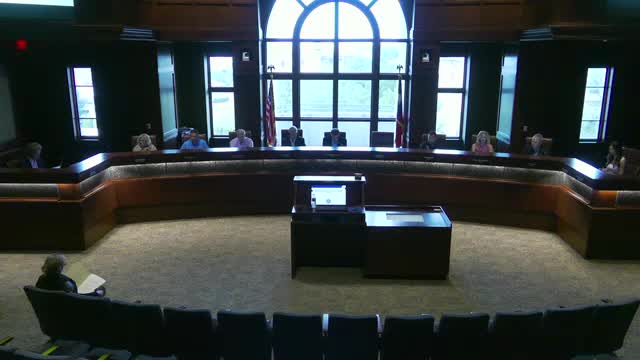
Summary
The Colleyville Crime Control and Prevention District Board adopted a FY2026 budget July 8 and amended it to allocate $50,000 to raise entry-level police pay and address pay compression. The board voted 7-0 to approve the budget and related amendments.
The Colleyville Crime Control and Prevention District Board of Directors on July 8 adopted its fiscal year 2026 budget and approved an amendment to apply $50,000 to entry-level police pay to address pay compression, voting 7-0.
Chief Frey, presenting the budget, said the district’s revenue is specifically dedicated to law enforcement and “is an important component of our ability to maintain our status as one of the safest cities in Texas.” The board voted to increase the budgeted revenues from $3,740,000 to $3,790,000 and to increase expenditures from $4,112,684 to $4,162,684 so the $50,000 allocation would be reflected in both revenue and expense lines without changing the projected ending fund balance of $3,267,321.
The nut graph: The half-cent sales-and-use tax that funds the Crime Control and Prevention District (CCCPD) supports police operations and equipment in Colleyville. This year’s budget vote included a policy choice about whether to use a modest surplus and projected revenues to boost front-line pay amid concerns about recruitment and retention; the board approved using the funds to raise entry-level pay and address compression rather than a one-time bonus.
Most important facts: The adopted budget lists projected revenues and opening cash as follows: projected revenue received in FY2025, $3,755,000; projected cash on hand as of Oct. 1, 2025, $3,640,000. The board approved a sales-and-use tax rate of 0.5 (a half-cent local option tax). At the July 8 meeting the board approved the amendment to raise the revenue and expenditure lines by $50,000 and to apply that $50,000 to entry-level officer pay (the board characterized this as “option 1” from staff budget options). After the amendment the board recorded an operating surplus of $27,316 for FY2026.
Programs and purchases described in the presentation that are funded or maintained by the CCCPD include expanded modules in PowerDMS (policy management, testing and field training), the PowerEngage community feedback module (reported average response rate 52.77% and average positive satisfaction 92.93%), a one-time purchase of 50 Motorola Apex NEXT all-band P25 smart radios (one-time cost $336,465), contributions to a six-city trunked radio system upgrade (total $967,309; Colleyville’s estimated share $161,218, later noted to be about $24,000 less), and the city’s share of a regional SWAT armored vehicle (Bearcat) costing $386,866 split among five cities (Colleyville share $77,373; order placed October 2024).
The FY2026 budget also includes departmental maintenance agreements (CentralSquare CAD and RMS noted as the largest ongoing maintenance item) and a proposed full-time network and cybersecurity administrator position. Staff said they propose funding half that new position from the CCCPD and half from the utility fund to support citywide cybersecurity and network modernization required for federal and industry standards.
Board discussion focused on three concrete options for how to use roughly $50,000 identified during the budget-work process: 1) raise entry-level officer pay and address pay compression (the option the board adopted), 2) a one-time, evenly distributed bonus for officers, or 3) a one-time, performance-based bonus. Board members debated retention effects, the fiscal “roll-up” of permanent pay increases versus one-time bonuses, and fairness across other city departments. Several directors said they preferred addressing base pay and compression to help recruitment and retention; others favored a one-time bonus to avoid compounding costs in future years.
The board and staff also discussed School Resource Officer (SRO) funding: the presentation said SRO costs are currently offset by Tax Increment Financing (TIF) revenue through 2030 (the presentation said 2030/2031 as the end of the TIF term) and that the district and city will need plans for SRO funding after the TIF expires. Staff flagged that if the TIF is not available in 2031, those costs would need to be covered by other revenue.
Votes at a glance: Resolution R-25-10102 (consent items including minutes) — motion by Director Brandy Elder, second by Director Ben Graves; passed 7-0. Resolution R-25-10103 (adopt FY2026 budget, as amended to increase revenues to $3,790,000, expenditures to $4,162,684, and to apply $50,000 to entry-level officer pay to address compression) — motion by President Linda Moots, second by Director Ben Graves; passed 7-0. Resolution R-25-10104 (elect board president and vice president for one-year terms; elected Director Bobby Lindemuth as president and Director Brandy Elder as vice president) — motion by President Linda Moots, second by Director Mark Alfonso; passed 7-0.
What’s next: The board adopted the budget as amended; staff said the capital item for justice center servers (identified as a $400,000 capital line) will appear in the city CIP presentation next week. Staff also reiterated the long-term funding issue for SROs once the TIF expires and said they will continue work with regional partners and federal representatives on potential grant funding for radio-system upgrades.
Sources: presentation and budget figures presented at the July 8, 2025 Colleyville Crime Control and Prevention District Board meeting; on-the-record motions and votes taken during that meeting.